Medically Reviewed by Prof. Dr. Akram
Chief Medical Content Strategist | Senior Neurologist | 30+ Years Clinical Experience
“In my three decades of clinical practice, I have seen that blood pressure is not just a number on a screen; it is a whisper from the body that its internal harmony is disrupted. This guide bridges the gap between the ancient wisdom of Ayurveda and the precision of modern cardiology.”
Patient Guide & Clinical Index
The Global Crisis of the Silent Killer

Ayurvedic Medicine for Hypertension (1)
Hypertension, or high blood pressure, is often called the “Silent Killer” because it can damage your cardiovascular system for years without showing a single symptom. Imagine your body is like a high-rise building. The blood vessels are the plumbing pipes, and the heart is the central water pump. If the pressure in those pipes is too high for too long, the pipes eventually leak or burst, and the pump wears out prematurely. In medical terms, this leads to strokes, heart attacks, and kidney failure.
In the modern world, especially within the Indian demographic, stress, sedentary habits, and processed foods have turned this condition into an epidemic. Conventional medicine focuses on managing the numbers using synthetic drugs. While these are life-saving, they often act as a “band-aid” rather than addressing why the pressure rose in the first place. This is where Ayurveda steps in—not as a replacement, but as a profound system to restore the body’s innate balance.
Prof. Dr. Akram’s Clinical Insights: “In my clinic, I often see patients who are on three different BP medications yet still feel ‘off.’ They have brain fog, fatigue, and anxiety. This is because we are treating the symptom, not the person. Ayurveda looks at the soil, not just the plant.”
Asaan Alfaz mein Summary (हिंदी सारांश) – Click to Expand
- High BP एक “खामोश कातिल” है जो बिना बताए अंगों को नुकसान पहुँचाता है।
- आयुर्वेद इसे वात, पित्त और कफ के असंतुलन के रूप में देखता है।
- सर्पगंधा (Sarpagandha) एक बहुत ताकतवर जड़ी-बूटी है जो BP कम करती है।
- जटामांसी और ब्राह्मी तनाव को कम करके दिल को सुकून देती हैं।
- पुनर्नवा शरीर से फालतू पानी और नमक निकालती है।
- सुबह की 30 मिनट की सैर BP के लिए सबसे अच्छी दवा है।
- नमक का कम इस्तेमाल और ताज़ा फल (जैसे अनार) बहुत ज़रूरी हैं।
- योग और प्राणायाम (भ्रामरी) नसों को तुरंत शांत करते हैं।
- अपनी मर्जी से एलोपैथी दवा बंद न करें, डॉक्टर की सलाह लें।
- शुद्ध जड़ी-बूटियों का ही चुनाव करें, भारी धातुओं (Metals) से बचें।
- रात को 10 बजे तक सो जाना दिल की मरम्मत के लिए ज़रूरी है।
- लहसुन खून की नलियों को लचीला बनाता है।
- तनाव कम करने के लिए ध्यान (Meditation) का सहारा लें।
- घर पर BP नापने की मशीन रखें और रिकॉर्ड बनाएँ।
- आयुर्वेद और एलोपैथी को मिलाकर बेहतर नतीजे मिल सकते हैं।
Quick Insights in Hinglish (Roman Hindi) – Click to Expand
- Hypertension ek “Silent Killer” hai jo organs ko dheere dheere damage karta hai.
- Ayurveda ke mutabiq ye Vata, Pitta aur Kapha ke imbalance se hota hai.
- Sarpagandha blood pressure ko natural tarike se control karti hai.
- Jatamansi aur Brahmi dimaag ko shant rakhti hain aur stress kam karti hain.
- Punarnava natural diuretic hai jo excess sodium nikalne mein madad karti hai.
- Daily 30 mins ki brisk walk heart muscles ko strong banati hai.
- Processed foods aur extra namak (salt) se parhez karein.
- Yoga mein Shavasana aur Bhramari Pranayama BP ke liye best hain.
- Apni BP medications ko bina doctor se puche band na karein.
- Quality herbs use karein jinmein heavy metals na hon.
- Raat ko jaldi sona (10 PM) recovery ke liye mandatory hai.
- Garlic (Lehsun) arteries ki stiffness ko kam karta hai.
- Pomegranate (Anaar) blood vessels ko relax karne mein help karta hai.
- Stress management ke liye meditation ko routine ka hissa banayein.
- Ayurveda root cause par kaam karta hai, sirf symptoms par nahi.
The Science of Doshas: Why Your Pressure Rises
Ayurvedic Medicine for Hypertension (2)
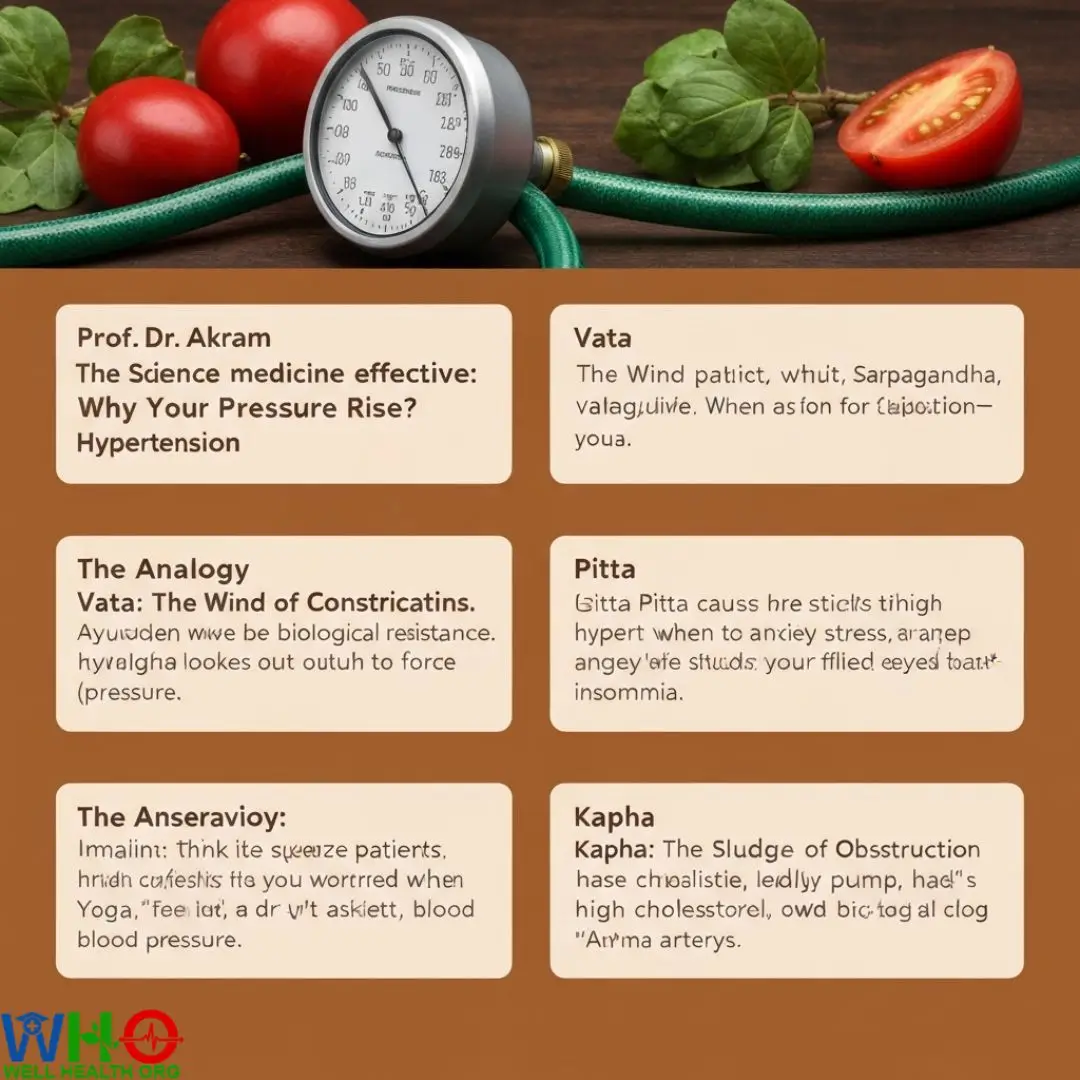
In modern medicine, we look at cardiac output and peripheral resistance. Ayurveda looks at the Doshas—the biological energies that govern your life. When these are out of sync, hypertension occurs.
Vata: The Wind of Constriction
The Analogy: Think of a garden hose. If you squeeze the hose, the water comes out with more force (pressure). Vata is like the wind; when it is too high, it “squeezes” or constricts your blood vessels through stress and anxiety.
Clinical Observation: Vata-type patients often have “labile” hypertension—their BP spikes when they are worried or haven’t slept, but might be normal when they are relaxed. They often feel cold, have dry skin, and suffer from insomnia.
Pitta: The Fire of Inflammation
The Analogy: Imagine the blood is like soup on a stove. If the fire is too high, the soup boils over. Pitta is heat. Excess Pitta causes inflammation in the lining of the arteries, making them angry and reactive.
Clinical Observation: These patients are often perfectionists, easily angered, and love spicy food. Their hypertension is “hot”—they may have red eyes, feel overheated, and have a constant high baseline of pressure.
Kapha: The Sludge of Obstruction
The Analogy: Imagine the same garden hose, but now it’s filled with thick mud or grease. The pump has to push much harder to get the water through. Kapha imbalance leads to high cholesterol and “Ama” (toxins), which clog the arteries.
The Herbal Pharmacy: Nature’s Cardiovascular Support

Ayurvedic herbs are not just supplements; they are complex chemical messengers. Let’s look at the “Powerhouse” herbs used in managing hypertension.
Sarpagandha (The Natural Beta-Blocker)
Sarpagandha (Rauvolfia serpentina) contains Reserpine. In the 1950s, Western medicine used this as a primary BP drug. It works by quieting the nervous system’s “fight or flight” response. It’s like turning down the volume on a loud radio so the heart can finally rest.
How to Use: Usually taken in tablet form (Ghan Vati).
Dosage: 125mg to 250mg, but strictly under a doctor’s eye.
Reaction Treatment: If it causes extreme lethargy or a stuffy nose, the dose is too high. Stop immediately and consult your physician.
Punarnava (The Natural Diuretic)
The Analogy: If your car is too heavy, it’s hard to drive. Punarnava helps the body “offload” excess weight by flushing out extra water and salt through the kidneys.
How it works: It reduces the total volume of blood. Less volume = Less pressure on the vessel walls.
Dr. Akram’s Practical Advice: “Never take herbal diuretics like Punarnava if you are already on pharmaceutical diuretics (like Lasix) without supervision. You risk dehydrating your kidneys and causing an electrolyte imbalance.”
| Herb Name | Mechanism (How it works) | Impact (Result) |
|---|---|---|
| Arjuna | Strengthens the heart muscle (Myocardium) | Better pumping efficiency; lower heart rate. |
| Brahmi | Increases Nitric Oxide production | Relaxes blood vessels (Vasodilation). |
| Jatamansi | Calms the central nervous system | Reduces stress-induced BP spikes. |
Dinacharya: The Daily Protocol for a Healthy Heart
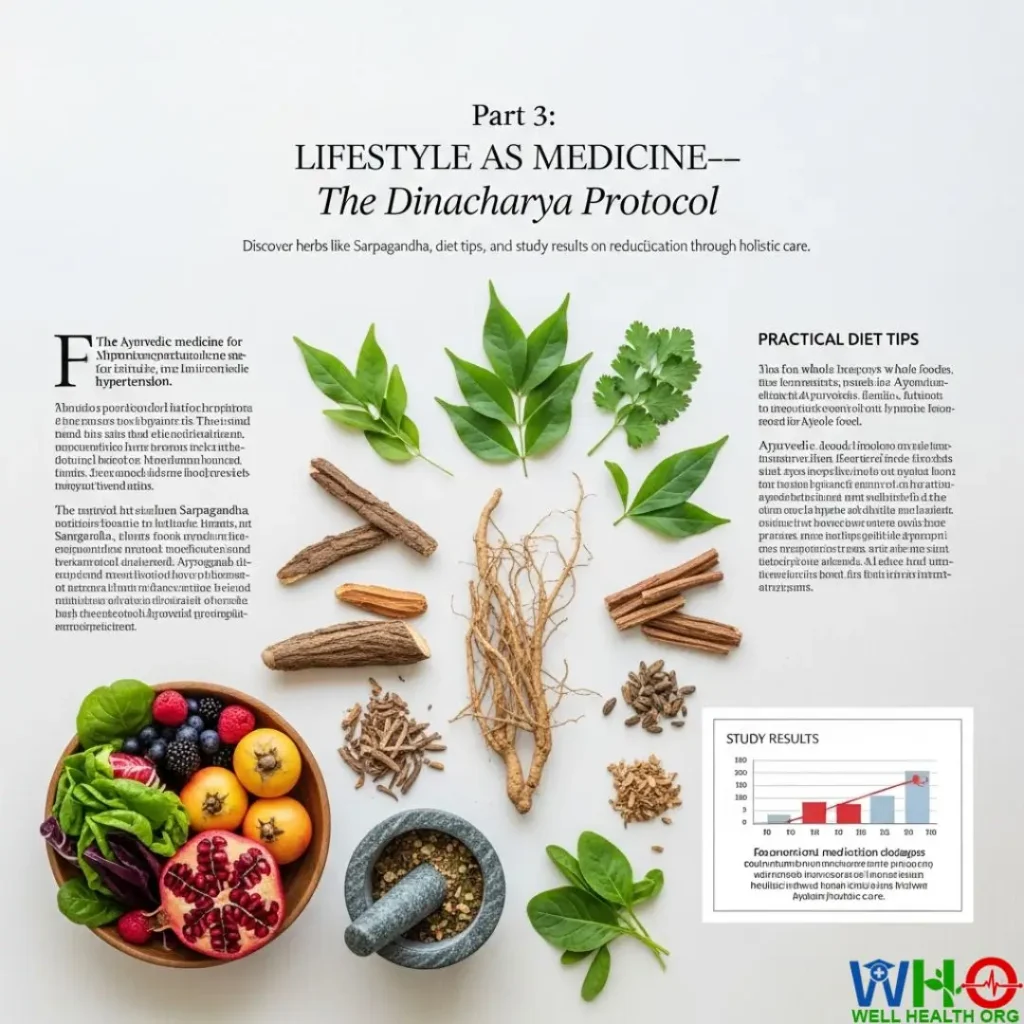
In Ayurveda, when you do something is as important as what you do. Your heart thrives on rhythm.
The 24-Hour Heart Cycle
Your blood pressure is not a static number. It follows a circadian rhythm. It dips at night and peaks in the morning. If you stay up late scrolling on your phone, you prevent the “nocturnal dip,” which is a major risk factor for heart attacks.
Implementation:
* The 10 PM Rule: Be in bed by 10 PM. This is ‘Kapha time’—the time for repair and stability.
* The Morning Sunlight: Get 10 minutes of sun. This sets your internal clock and regulates cortisol.
Exercise: The Goldilocks Rule
Don’t overdo it. High-intensity interval training (HIIT) can sometimes spike pressure in hypertensive patients.
The Best Medicine: A 30-minute brisk walk.
Why? It acts like a “vent” for a pressure cooker, releasing the built-up tension in the nervous system without overstraining the heart muscle.
Yoga & The Vagus Nerve: The Science of the Breath

Yoga is the technology of the nervous system. The most important part of Yoga for hypertension is Pranayama (Breathing exercises).
Bhramari (Humming Bee Breath)
How to do it: Close your ears with your thumbs, place your fingers on your eyes, and take a deep breath. As you exhale, make a steady “hmmm” sound like a bee.
The Science: This vibration stimulates the production of Nitric Oxide in the sinuses. Nitric Oxide is a gas that tells your blood vessels to open up wide. It’s like a natural “nitroglycerin” tablet without the side effects.
Shavasana (The Ultimate Reset)
Lying perfectly still for 10 minutes after exercise allows the Parasympathetic Nervous System to take over. This is the “Rest and Digest” mode. It lowers the heart rate and allows the kidneys to filter blood more effectively.
The Ayurvedic Kitchen: Eating Your Way to Lower BP

In the Indian context, our diet is often our greatest enemy and our greatest friend. To heal the heart, we must change the “fuel” we put in the tank.
The Salt Trap (Lavana Rasa)
Salt attracts water. If you eat too much salt, your blood holds onto more water, increasing the pressure in your pipes.
Pro-Tip: Replace table salt with Saindhava Lavana (Himalayan Pink Salt) in small quantities, as it is less aggravating to the Pitta dosha.
Heart-Healing Superfoods
- Garlic (Lashuna): Take one crushed clove with warm water in the morning. It acts as a natural blood thinner.
- Pomegranate (Anaar): Acts as a natural ACE inhibitor. Drink 100ml of fresh juice daily.
- Moringa (Sahjan): Extremely high in potassium, which balances the negative effects of sodium.
Prof. Dr. Akram’s Clinical Insights: “I’ve had patients reduce their systolic BP by 10 points just by cutting out pickles and papads—the hidden salt bombs of the Indian diet. Never underestimate the power of the plate.”
Safety & Integration: How to Combine Ayurveda with Modern Care

This is the most critical section. Ayurveda and Allopathy are not enemies. They are two tools in the same toolbox.
The “Step-Down” Strategy
If you start Ayurvedic herbs, do not stop your BP tablets. Instead, monitor your BP daily. As the herbs and lifestyle take effect, your BP might start dropping too low. This is when you go to your Cardiologist and say, “Doctor, my numbers are consistently 110/70 now. Can we reduce my dosage?” This is the safe, scientific way to heal.
The Danger of Heavy Metals
Some cheap Ayurvedic medicines contain lead or mercury (Bhasmas) that aren’t purified correctly. These can damage the kidneys—the very organ that regulates BP.
Action: Only buy from reputable, GMP-certified, and lab-tested brands.
Frequently Asked Questions (Clinical FAQ)
Can Ayurveda cure hypertension permanently?
Hypertension is a lifestyle-driven condition. Ayurveda can “reverse” it to the point where you don’t need meds, but if you go back to old habits (salt, stress), the BP will return. It’s a management system, not a one-time ‘fix’.
Is Sarpagandha safe for everyone?
No. People with a history of depression or stomach ulcers should avoid Sarpagandha as it can worsen these conditions. Always consult a practitioner.
How long does it take to see results?
Lifestyle changes show results in 2-4 weeks. Herbal effects usually take 4-8 weeks to stabilize in the system.
Can I take Garlic and blood thinners together?
Garlic has natural anti-platelet properties. If you are on Aspirin or Warfarin, consult your doctor as it may increase bleeding risk.
Is Himalayan salt safe for high BP?
It is “better” than table salt because of minerals, but it is still Sodium Chloride. You must still limit your total intake to less than 5g per day.
Does drinking water from a copper vessel help?
Copper water (Tamra Jal) helps balance Kapha and can aid in weight loss, which indirectly helps BP. However, it is not a direct treatment for hypertension.
Can stress alone cause permanent high BP?
Chronic stress keeps the body in a state of ‘Vata aggravation,’ leading to permanent changes in the artery walls. Stress management is 50% of the cure.
Is Amla juice good for BP?
Yes. Amla is rich in Vitamin C which improves nitric oxide bioavailability and strengthens the arterial walls.
What is the best time to exercise for BP patients?
Early morning (Sattvic hours) is best. It aligns with the body’s natural cortisol rise and helps regulate the day’s pressure.
Does Ayurveda help with ‘White Coat’ hypertension?
Yes. Herbs like Shankhpushpi and Jatamansi calm the nervous system, making you less reactive to clinical environments.
Can I take Arjuna with my heart medication?
Arjuna is generally safe and synergistic, but it can increase the effect of some heart meds. Get your doctor’s approval first.
Is coffee bad for hypertension?
Caffeine is Vata-aggravating and spikes BP temporarily. If you have high BP, limit coffee to one cup or switch to herbal teas like Hibiscus.
What is ‘Ama’ and how does it affect BP?
‘Ama’ is metabolic sludge caused by poor digestion. It’s like ‘plaque’ in your arteries. Ayurveda uses detox (Panchakarma) to clear it.
Can I use Ashwagandha for BP?
Ashwagandha is an adaptogen. It helps with stress-related BP but can occasionally increase Pitta in some people. Use with guidance.
Why do my feet swell with high BP?
This is often a sign of Kapha/Pitta imbalance where the heart or kidneys are struggling to manage fluid. Punarnava is very helpful here.
Is alcohol allowed in the Ayurvedic BP diet?
Alcohol is highly Pitta-aggravating and causes immediate inflammation of the vascular system. It is best avoided.
Can Nadi Shodhana be done anytime?
It is best done on an empty stomach, either in the morning or evening. It balances the ‘Ida’ and ‘Pingala’ nadis (energetic channels).
Are there any side effects of long-term Ayurvedic use?
If the herbs are balanced (formula vs. single herb), side effects are rare. However, overusing diuretics or cooling herbs can cause Vata imbalances.
Can teenagers have hypertension?
Yes, due to diet and academic stress. Ayurveda focuses on ‘Brahmi’ and lifestyle for younger patients rather than heavy herbs.
How should I monitor my BP at home?
Check at the same time every day. Sit quietly for 5 minutes before checking. Do not talk or cross your legs. Keep a log for your doctor.
Your Roadmap to Heart Health
To summarize, managing hypertension requires a multi-pronged approach:
- Analyze: Determine if your BP is driven by Stress (Vata), Anger/Heat (Pitta), or Weight/Congestion (Kapha).
- Nourish: Switch to a low-salt, plant-rich diet. Add Garlic and Pomegranate.
- Breathe: Practice 10 minutes of Bhramari and Nadi Shodhana daily.
- Supplement: Use a combination of Sarpagandha, Arjuna, and Punarnava under expert guidance.
- Connect: Ensure your modern doctor and Ayurvedic practitioner are aligned.
MEDICAL DISCLAIMER:
This information is for educational purposes only and does not constitute medical advice. Hypertension is a serious condition. Never stop or change your pharmaceutical medications without the direct supervision of a qualified medical doctor. Ayurvedic herbs can interact with Western drugs. Always consult your cardiologist before starting any new herbal regimen.