🩺 Dr. Akram’s Private Clinical Notes
“It was the peak of July, and the hospital ward in Punjab was sweltering despite the air conditioning. They brought in a 34-year-old man, a robust construction supervisor who split his year working between Dubai and the intense humid heat of rural India. His family thought it was just severe exhaustion from working under the direct afternoon sun. He complained of agonizing pain in his thighs—so severe he couldn’t stand—and a profound, heavy weakness.
But what immediately caught my clinical attention was the catheter bag. The urine wasn’t just yellow or concentrated; it was the dark, opaque color of black tea or cola. His family thought he just needed a glass of water, but I knew his body was quietly destroying itself from the inside out. His muscle fibers, literally melting from extreme heat and physical exertion (exertional rhabdomyolysis), were dumping toxic myoglobin into his bloodstream, suffocating his kidneys. Within an hour, his blood potassium levels spiked dangerously close to causing a cardiac arrest. This wasn’t simple dehydration. This was Heat-Induced Rhabdomyolysis, and a delay of even a few more hours would have meant permanent, irreversible acute kidney injury or death.”
Table of Contents
- 👉 What is Heat-Induced Rhabdomyolysis? (The Silent Muscle Killer)
- 👉 The Root Causes: Why Summer Heat Destroys Muscle Tissue
- 👉 Advanced Medical Treatments for Rhabdomyolysis
- 👉 Proven Home Remedies for Heat Recovery (Post-Discharge)
- 👉 Doctor’s Final Verdict & The Bottom Line
- 👉 Global Community Insights (Localization)
- 👉 Frequently Asked Questions (FAQs)
What is Heat-Induced Rhabdomyolysis? (The Silent Muscle Killer)
Heat-induced rhabdomyolysis is a catastrophic medical emergency that occurs when severe dehydration, extreme ambient temperatures, and physical exertion cause rapid, widespread death of muscle tissue (muscle necrosis). When we look at this from a neurological and physiological standpoint, the human body is an incredibly balanced machine. But under the intense strain of hyperthermia, that balance shatters.
As skeletal muscle fibers disintegrate, their intracellular contents spill massively into the circulatory system. The most dangerous of these spilled contents is a protein called myoglobin. Myoglobin is essential inside the muscle for oxygen storage, but once it escapes into the bloodstream, it acts as a literal poison to the renal system.
The Myoglobin Crisis: Why the Kidneys Fail
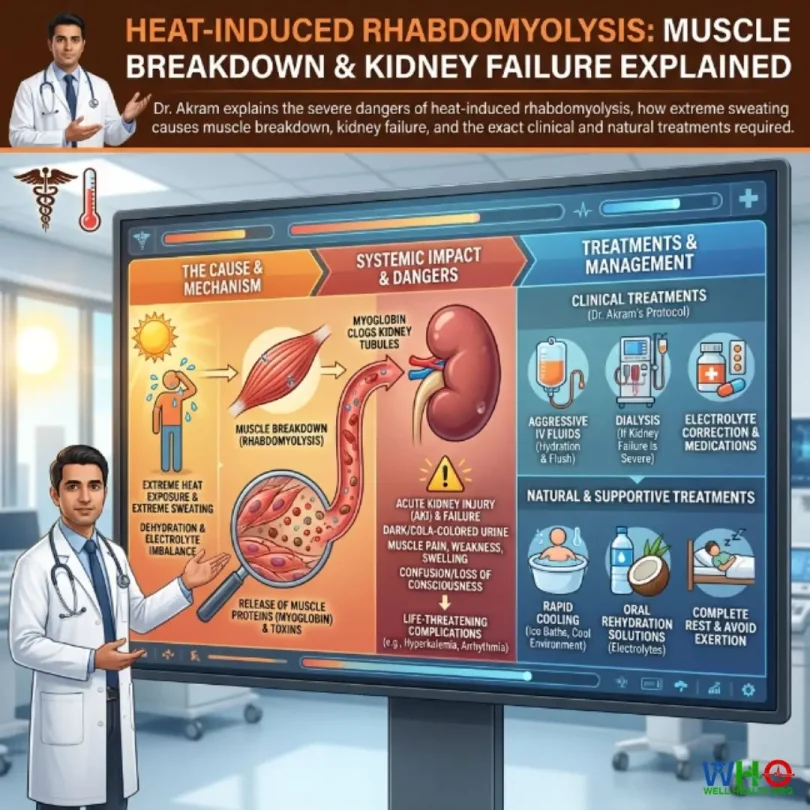
When millions of muscle cells suddenly explode, they release their internal contents directly into the systemic circulation. This debris field includes immense amounts of potassium, creatine kinase (CK), uric acid, and most dangerously, a dark red protein called myoglobin.
Myoglobin is excellent at storing oxygen inside the muscle, but it is highly toxic when roaming freely in the blood. As your kidneys attempt to filter this toxic sludge, the heavy myoglobin molecules become trapped inside the delicate renal tubules. Because severe sweating has already caused hypovolemia (low blood volume), the fluid flowing through the kidneys is sluggish and highly acidic. In this acidic environment, myoglobin proteins clump together to form solid casts, physically plugging the kidney’s drainage system. This mechanical obstruction, combined with direct oxidative damage from the myoglobin, triggers Acute Kidney Injury (AKI), which can rapidly progress to total renal failure if aggressive intravenous intervention is not initiated.
The Triad of Warning Signs
Before permanent acute kidney injury sets in, the body will present a classic triad of symptoms. Recognizing these can be the difference between a few days of hospital recovery and a lifetime of dialysis:
- Severe Muscle Pain (Myalgia): This is not your standard post-workout soreness. Patients describe an agonizing, deep, throbbing pain, usually in large muscle groups like the thighs, lower back, or shoulders. The muscles may feel severely swollen and tender to the touch.
- Tea-Colored Urine: As myoglobin is filtered by the kidneys, its deep red-brown pigment turns the urine dark. It can look like black tea, cola, or dark rust.
- Profound Muscular Weakness: The structural integrity of the muscle is compromised. Patients often report being physically unable to move their legs or lift their arms, completely drained of basic motor function.
The Root Causes: Why Summer Heat Destroys Muscle Tissue
To understand why this happens, we must look at the vicious cycle of massive fluid loss and cellular hypoxia. In extreme summer heat and humidity, your body’s primary cooling mechanism is profuse sweating. However, sweating has a devastating cost if fluids are not perfectly replaced.
Western Factors: The Exertion Paradox and Pharmaceuticals
In regions such as the United States, the UK, and Europe, cases of heat-induced rhabdo frequently emerge during summer months among recreational athletes, military recruits, and outdoor festival attendees.
- Unacclimatized High-Intensity Training: A sedentary individual deciding to undertake a high-intensity interval training (HIIT) session, marathon, or intense hiking trail in 95°F weather is a prime candidate. The muscles are unprepared for the extreme metabolic demand, leading to rapid cellular exhaustion.
- Medication Interactions: A significant but rarely discussed factor involves everyday pharmaceuticals. Statin drugs (used to lower cholesterol) carry a baseline risk of muscle irritation. When combined with intense heat and dehydration, the risk of statin-induced muscle breakdown multiplies exponentially. Furthermore, antihistamines and anticholinergic drugs block the neurotransmitters responsible for stimulating sweat glands, paralyzing the body’s primary cooling mechanism.
- Stimulant Consumption: High doses of caffeine, pre-workout supplements, or amphetamine-based medications accelerate the heart rate and core temperature while simultaneously acting as diuretics, hastening critical dehydration.
Eastern Factors: Wet-Bulb Extremes and Occupational Hazards
In Asian, Middle Eastern, and equatorial regions, the pathology often stems from prolonged, inescapable environmental exposure coupled with lethal humidity levels.
- The Wet-Bulb Temperature Crisis: In Southeast Asia and the Indian subcontinent during monsoon seasons, temperatures may read 92°F, but the humidity sits at 90%. Sweating relies on evaporation to pull heat away from the body. In near-total humidity, sweat drips off the skin without evaporating. The body’s cooling mechanism is entirely nullified, causing the core temperature to spiral upwards unimpeded.
- Agricultural and Construction Labor: Occupational heat exposure is a massive driver of rhabdomyolysis in developing nations. Workers engaged in heavy manual labor in agricultural fields or construction sites under direct sun exposure for 10-12 hours a day suffer from chronic, cumulative dehydration. Over consecutive days, their baseline electrolyte reservoirs are depleted, setting the stage for sudden, massive muscle necrosis.
- Restricted Fluid Access: In rural or highly demanding occupational settings, laborers may lack access to cool, electrolyte-fortified water, relying instead on insufficient amounts of plain water, which fails to replace the massive sodium and potassium losses excreted through sweat.
The Biological Mechanism of Injury
- Volume Depletion: Extreme sweating severely reduces blood volume. To protect the brain and heart, the body constricts blood vessels leading to the muscles and kidneys (ischemia).
- ATP Depletion: Deprived of oxygen and blood, muscle cells run out of ATP (adenosine triphosphate), the energy currency that keeps cellular walls intact.
- Cell Membrane Rupture: Without ATP, calcium floods into the muscle cells, activating enzymes that literally eat the cell from the inside out. The cell bursts, releasing myoglobin, potassium, and creatine kinase (CK) into the blood.
- Kidney Blockage (Nephrotoxicity): The kidneys try to filter this toxic sludge. The myoglobin proteins clump together inside the tiny kidney tubules (nephrons), creating a physical blockage. Urine production stops, and acute renal failure begins.
Advanced Medical Treatments for Rhabdomyolysis
When a patient arrives at the emergency room with suspected heat-induced rhabdomyolysis, time is the ultimate enemy. The medical protocol focuses immediately on preserving kidney function and preventing a fatal heart arrhythmia caused by soaring potassium levels (hyperkalemia).
⚡ Clinical Application: Aggressive Intravenous (IV) Fluid Resuscitation
⚖️ Dosage (US/Metric): Medical teams will typically administer Normal Saline (0.9% NaCl) or Lactated Ringer’s solution at an aggressive rate of 1 to 2 Liters per hour initially, targeting a urine output of 200 to 300 mL per hour.
🔬 Mechanism of Action: This high-volume fluid physically forces the kidneys to stay open. By drastically increasing the liquid volume in the blood, it dilutes the concentration of myoglobin. This prevents the proteins from clumping, crystallizing, and creating a mechanical blockade inside the renal tubules. It flushes the toxic debris directly into the bladder.
⚠️ Medical Warning: Must be closely monitored by a physician. Over-hydration in patients with pre-existing heart failure can lead to dangerous fluid buildup in the lungs (pulmonary edema).
⚡ Clinical Application: Urinary Alkalinization (Sodium Bicarbonate)
⚖️ Dosage (US/Metric): Administration of IV Sodium Bicarbonate, carefully titrated by a nephrologist to maintain a urine pH above 6.5.
🔬 Mechanism of Action: Myoglobin is highly toxic in an acidic environment (which the body naturally becomes during severe dehydration). By adding bicarbonate to the IV fluids, the blood and urine become more alkaline. In an alkaline environment, myoglobin is much less likely to break down into its toxic byproducts, protecting the delicate internal lining of the kidneys from chemical burns.
⚠️ Medical Warning: Only administered in an ICU or ER setting under strict blood gas monitoring. Improper dosing can cause severe alkalosis or drastically lower blood calcium levels.
⚡ Clinical Application: Renal Replacement Therapy (Dialysis)
⚖️ Dosage (US/Metric): Continuous or intermittent hemodialysis applied immediately if the patient stops producing urine (anuria) or if blood potassium exceeds 6.5 mEq/L.
🔬 Mechanism of Action: If the kidneys have already shut down, they can no longer filter toxins. Dialysis involves connecting the patient to a machine that acts as an artificial kidney. Blood is pumped out, run through a highly specialized filter to remove myoglobin, excess potassium, and waste, and then returned cleanly to the body. This buys the natural kidneys weeks or months to heal.
⚠️ Medical Warning: This is a life-saving measure for acute renal failure. Risks include infection at the catheter site and rapid drops in blood pressure during treatment.
Proven Home Remedies for Heat Recovery (Post-Discharge & Prevention)
Once the acute medical crisis has been managed by doctors and you are discharged, your body enters a vulnerable state of prolonged healing. Furthermore, these remedies are essential for prevention for those working or exercising in severe heat. As a doctor, I emphasize extreme detail (har cheez detail mein) so you know exactly how to prepare, use, and manage these natural solutions.
⚡ Preparation & Use: Clinically Formulated Home ORS (Oral Rehydration Solution / Shikanji Base)
⚖️ Quantity (US/Metric): Take 1 Liter of clean, boiled (then cooled) drinking water. Add precisely 6 level teaspoons (approx. 25-30g) of standard white sugar and exactly 0.5 level teaspoon (approx. 2.5g) of standard table salt (sodium chloride). Squeeze half a fresh lemon for potassium and flavor. Drink 1 cup (250ml) every 2 hours during heat exposure.
🔬 Natural Healing Process: Water alone cannot rehydrate severely depleted muscle cells. The human intestine has specific ‘co-transporters’ that only absorb sodium effectively when glucose (sugar) is present. This precise ratio of salt to sugar forces the intestinal walls to rapidly absorb water and pump it straight back into your bloodstream and muscle fibers, restoring cellular pressure and preventing muscle death.
⚠️ Safe Usage Note: If a reaction occurs (like bloating or mild nausea), slow down consumption—sip over 30 minutes instead of gulping. Diabetics must consult a doctor before using sugar-based ORS. Do not guess the measurements; too much salt pulls water out of the brain, causing severe complications.
⚡ Preparation & Use: Raw Coconut Water & Himalayan Pink Salt
⚖️ Quantity (US/Metric): Drink 1 fresh, raw green coconut (approximately 300ml to 400ml of liquid) mixed with a tiny pinch (1/8th of a teaspoon) of Himalayan pink salt. Consume twice a day during the intense heat of summer, or daily for two weeks post-hospitalization.
🔬 Natural Healing Process: Coconut water is nature’s most potent source of natural potassium and magnesium, which are strictly required to stop muscle spasms and stabilize muscle cell walls. However, coconut water is naturally low in sodium, which is why adding the pinch of pink salt is clinically necessary to create a perfectly balanced isotonic fluid that mimics human blood plasma. It flushes the remaining trace toxins from the recovering kidneys gently.
⚠️ Safe Usage Note: If you experience an upset stomach (mild diarrhea), it means your body is receiving too much magnesium too fast. The remedy (ilaj) for this reaction is to reduce consumption to half a coconut per day and consume it with a complex carbohydrate meal. Patients with end-stage renal disease must avoid high-potassium coconut water entirely.
⚡ Preparation & Use: Cold Watermelon & Cucumber Cellular Hydration Matrix
⚖️ Quantity (US/Metric): Consume 2 large cups (approx. 300g) of freshly chopped, chilled watermelon mixed with 1 cup of sliced cucumber. Eat this raw, without adding heavy spices or sugar, once daily during the hottest part of the afternoon (typically 2:00 PM to 4:00 PM).
🔬 Natural Healing Process: Watermelon is over 90% water, but more importantly, it is rich in the amino acid L-citrulline. L-citrulline converts to L-arginine in the body, which creates nitric oxide. Nitric oxide dilates (opens up) the blood vessels. This vasodilation improves blood flow directly to the damaged kidneys and exhausted muscles, helping them clear out microscopic cellular debris and speeding up the healing of muscle necrosis.
⚠️ Safe Usage Note: Overeating large amounts of watermelon too quickly can cause a sudden spike in blood sugar or mild digestive discomfort. Ensure you chew thoroughly and eat it slowly. If stomach discomfort occurs, pair the fruit with a small amount of protein, like a handful of soaked almonds, to slow digestion.
Acclimatization: The Ultimate Biological Shield
Your body has incredible adaptive capabilities, but it requires time. Heat acclimatization is the process of gradually exposing yourself to heat stress over 10 to 14 days. During this period, physiological miracles happen: your body increases total blood volume, your sweat glands become highly efficient (sweating sooner and in larger volumes), and your sweat actually becomes less salty, conserving vital sodium. Throwing an unacclimatized body into extreme heat for intense work or exercise bypasses these defenses, significantly raising the risk of muscle lysis.
Doctor’s Final Verdict & The Bottom Line
As a senior medical strategist who has monitored countless cases across diverse climates, my final clinical verdict is absolute: Heat-induced rhabdomyolysis is not merely heat exhaustion; it is the physical breakdown of your body’s structural foundation. Your kidneys are the ultimate victims of your muscles’ distress.
The bottom line is vigilance. Do not rely on thirst as an indicator of hydration. By the time your brain signals severe thirst, your cells are already operating at a dangerous deficit. Monitor your urine closely—it must remain pale yellow or clear. If it shifts toward amber, rust, or tea, and is accompanied by deep muscle pain, you must abandon all physical activity, escape the heat immediately, and seek emergency medical evaluation. Acclimatize to heat gradually over two weeks, respect your physical boundaries, and prioritize electrolyte-balanced fluids over plain water during strenuous activities.
Global Community Insights
🌍 For US, UK, & European Audiences
In Western countries, the primary triggers often involve intense physical fitness regimes (like ultramarathons, outdoor military-style boot camps, or heavy landscaping work) during unprecedented summer heatwaves. Certain prescription medications common in the West—such as statins (cholesterol-lowering drugs), SSRIs (antidepressants), and powerful antihistamines—can drastically reduce the body’s ability to sweat and cool itself, or they can directly increase the risk of muscle breakdown. If you are on a high-dose statin, your threshold for exertional rhabdomyolysis is much lower. Always check with your pharmacist regarding your summer medication profile.
🌏 For Asian & Indian Subcontinent Audiences
In the Indian subcontinent, the intense heat (Garmi ki shiddat) combined with high monsoon humidity creates a lethal environment where sweat simply drips off the body without evaporating, meaning zero cooling effect takes place. The cultural habit of drinking massive amounts of plain water without replenishing salts leads to severe hyponatremia (low blood sodium), which accelerates muscle damage. Laborers and farmers must prioritize drinks like Nimbu Pani (lemon water with a pinch of salt) or standardized ORS instead of just plain water. Furthermore, the reliance on unverified herbal tonics during a heat stroke can delay critical IV hydration in a hospital, turning a treatable condition into permanent kidney failure.
Frequently Asked Questions (FAQs)
How do I tell the difference between normal muscle soreness and rhabdomyolysis?
Normal post-workout soreness (DOMS) usually peaks 24-48 hours after exercise, feels like a dull ache, and improves with light stretching. Rhabdomyolysis pain is acute, deeply agonizing, accompanied by profound weakness (inability to move the limb), noticeable swelling, and almost always presents with dark, tea-colored urine.
Can a healthy young person get acute kidney injury from the heat?
Absolutely. Heat-induced rhabdomyolysis does not discriminate by age. In fact, healthy young adults (athletes, military recruits, construction workers) are often at higher risk because their cardiovascular systems are strong enough to let them push past normal exhaustion limits, ignoring the warning signs until massive muscle necrosis has already occurred.
How long does it take for kidneys to recover from myoglobin toxicity?
If IV fluid resuscitation is started rapidly in the ER, renal function can begin normalizing within a few days. However, if acute kidney injury is severe and requires dialysis, full recovery of the renal tubules can take anywhere from a few weeks to 6 months. In tragic cases where treatment was severely delayed, the kidney damage may be permanent.
Should I take pain killers like Ibuprofen for the muscle pain?
No. Never take NSAIDs (like Ibuprofen, Naproxen, or Diclofenac) if you suspect heat-induced rhabdomyolysis. NSAIDs constrict the blood vessels leading to the kidneys, vastly reducing blood flow. If your kidneys are already choking on myoglobin, reducing their blood flow with painkillers is a rapid recipe for total kidney failure. Only use physician-prescribed pain management.
Medically Reviewed by Prof. Dr. Akram
Orthopedic Surgeon | Professor | Senior Medical Specialist
Prof. Dr. Akram is a distinguished surgeon with over 15 years of clinical expertise. Having served as a lead Emergency Specialist at Complex International Government Hospital, he currently leads a specialized team of 13 medical professionals at his private hospital. As a Professor at top medical universities, he ensures that every article on WellHealthOrg.com meets rigorous clinical standards.
Medical Disclaimer:
The information provided is for educational purposes only and is not a substitute for professional medical advice, diagnosis, or treatment. Always consult your physician for any medical concerns.
Our content is rigorously fact-checked by our 13-member Editorial Team under the clinical supervision of Prof. Dr. Akram.