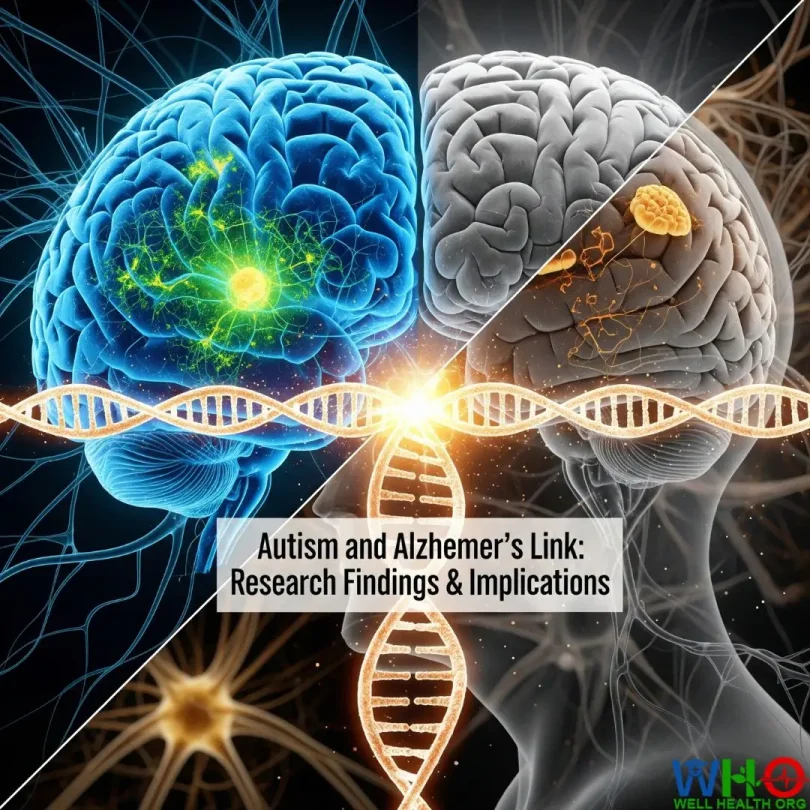
Understanding the link between autism and Alzheimer’s disease
Introduction
For decades, autism spectrum disorder (ASD) and Alzheimer’s disease seemed to occupy opposite ends of the neurological spectrum. Autism is most often diagnosed in early childhood, while Alzheimer’s typically develops later in life, affecting adults over the age of 65. At first glance, these conditions appear to have little in common. Yet recent research suggests that they may be more closely connected than previously believed.
- Understanding the link between autism and Alzheimer’s disease
- Introduction
- Autism Spectrum Disorder: A Lifelong Journey
- Common Features of Autism Include:
- Alzheimer’s Disease: A Progressive Decline
- Hallmarks of Alzheimer’s Disease:
- Early Symptoms Include:
- Genetic and Neurological Overlap Between Autism and Alzheimer’s
- Shared Genetic Factors
- Overlapping Neurological Pathways
- Elevated Alzheimer’s Risk in Autistic Adults
- Key Observations:
- Diagnostic Challenges
- Challenges Include:
- Best Practices for Diagnosis:
- Supporting Autistic Adults with Alzheimer’s
- Environmental Modifications
- Communication Adaptations
- Ongoing Research and Future Directions
- Current Research Focus
- Promising Innovations
- Future Priorities
- Building Awareness and Support Networks
- Steps Forward:
- Conclusion: Hope Through Understanding
- Frequently Asked Questions (FAQs)
- 1. Are autistic adults more likely to develop Alzheimer’s disease?
- 2. What genetic factors do autism and Alzheimer’s share?
- 3. How does Alzheimer’s present differently in autistic people?
- 4. Can autism cause Alzheimer’s disease?
- 5. What are early warning signs of Alzheimer’s in autistic adults?
- 6. How can caregivers support autistic adults with dementia?
- 7. Are there treatments that help both autism and Alzheimer’s?
- 8. What role does inflammation play in both conditions?
- 9. Can lifestyle changes reduce risk for autistic adults?
- 10. What is the future of research in this area?
Autism affects approximately 1 in 36 children in the United States, while Alzheimer’s disease impacts over 6 million Americans, most of them seniors. Understanding the potential overlap between these two conditions is not just a scientific curiosity — it has profound implications for healthcare, caregiving, and public health policy.
Emerging studies indicate that autism and Alzheimer’s disease may share genetic vulnerabilities, neurological pathways, and biological processes. This raises critical questions: Could autistic individuals face a higher risk of Alzheimer’s as they age? Could Alzheimer’s research help improve autism care — and vice versa? And how can families, caregivers, and medical professionals prepare for these challenges?
This article explores the connection between autism and Alzheimer’s disease, highlighting key research findings, diagnostic complexities, and support strategies while offering practical guidance for families and caregivers.
Autism Spectrum Disorder: A Lifelong Journey
Autism spectrum disorder is a neurodevelopmental condition, meaning it affects brain development from an early age. The word “spectrum” reflects the diversity of symptoms and abilities among autistic individuals. Some may require lifelong support with daily tasks, while others live independently but still navigate challenges in communication, social interaction, or sensory processing.
Common Features of Autism Include:
- Social communication differences – Difficulty interpreting tone, body language, or facial expressions.
- Repetitive behaviors or restricted interests – Repeating actions, phrases, or developing intense focus on specific topics.
- Sensory sensitivities – Heightened or reduced responses to sound, light, texture, or touch.
- Preference for structure and routine – Predictability often reduces stress and provides comfort.
Importantly, autism is not an illness to be “cured.” It is a difference in neurological wiring. Many autistic individuals and advocates highlight strengths such as heightened focus, creativity, and unique problem-solving approaches.
Over the past 30 years, autism diagnoses have increased significantly. This rise is largely attributed to greater awareness, better diagnostic tools, and expanded diagnostic criteria, rather than a true epidemic. As a result, a growing number of autistic individuals are now reaching adulthood and older age — an area where research is still limited but increasingly necessary.
Alzheimer’s Disease: A Progressive Decline
In contrast, Alzheimer’s disease is a progressive neurodegenerative condition — meaning it worsens over time as brain cells deteriorate and die. It is the most common cause of dementia, accounting for 60–80% of all dementia cases worldwide.
Hallmarks of Alzheimer’s Disease:
- Beta-amyloid plaques – Abnormal protein clusters between nerve cells.
- Tau tangles – Twisted protein fibers inside neurons, disrupting communication.
- Brain cell death and shrinkage – Leading to memory loss and cognitive decline.
- Inflammation in the brain – Exacerbating damage and accelerating progression.
Early Symptoms Include:
- Short-term memory loss (forgetting recent events or conversations).
- Difficulty with language, problem-solving, or planning.
- Confusion about time, place, or familiar faces.
As Alzheimer’s progresses, individuals may lose the ability to communicate, recognize loved ones, or perform daily activities. Ultimately, it becomes a life-limiting condition requiring full-time care.
Genetic and Neurological Overlap Between Autism and Alzheimer’s
The discovery that autism and Alzheimer’s may share genetic and neurological mechanisms has surprised scientists and clinicians alike.
Shared Genetic Factors
- APOE4 gene – Known as the strongest genetic risk factor for Alzheimer’s, APOE4 has also been found in higher frequency among middle-aged autistic adults. This variant is linked to hippocampal shrinkage, affecting memory and learning.
- Synaptic function genes – Variants that regulate neuron communication appear in both autism and Alzheimer’s.
- Genes influencing brain inflammation – Dysregulated immune responses are increasingly recognized as a shared factor.
- Neurotransmitter regulation – Both conditions involve disruptions in serotonin, dopamine, and glutamate systems, which influence mood, memory, and learning.
Overlapping Neurological Pathways
Both autism and Alzheimer’s involve abnormalities in how the brain processes and communicates information. Researchers have observed:
- Protein mismanagement – Improper folding and accumulation of proteins in neurons.
- Mitochondrial dysfunction – Reduced cellular energy, impacting brain performance.
- Chronic inflammation – Ongoing immune responses that may damage neurons.
- Disrupted neural connectivity – Affecting how different brain regions “talk” to one another.
Dr. Anya Sharma of the Institute for Cognitive Health summarizes: “The convergence of autism and Alzheimer’s at the molecular level opens new opportunities for cross-condition therapies and early detection.”
Elevated Alzheimer’s Risk in Autistic Adults
While research is still evolving, studies suggest that autistic adults may face a higher risk of developing Alzheimer’s disease as they age.
A 2022 study in Lancet Neurology reported that autistic adults — especially those with intellectual disabilities — were diagnosed with Alzheimer’s at younger ages and showed faster cognitive decline than neurotypical peers.
Key Observations:
- Earlier onset – Symptoms may begin in middle age rather than late 60s or 70s.
- Rapid progression – Once cognitive decline begins, it may advance more quickly.
- Unique symptom presentation – Alzheimer’s may manifest differently in autistic individuals, complicating diagnosis.
Dr. Ben Carter of City University explains: “Our longitudinal studies emphasize the importance of early cognitive screening for autistic adults, as subtle changes can easily be overlooked.”
Diagnostic Challenges
Diagnosing Alzheimer’s in autistic individuals is uniquely complex. Many standard tests for memory or communication may not be accurate for people with baseline differences.
Challenges Include:
- Communication differences – Standard verbal assessments may not capture decline.
- Behavioral overlap – Repetitive behaviors or sensory sensitivities may mask early dementia signs.
- Baseline variations – Autistic individuals may already process information differently, making change harder to detect.
Best Practices for Diagnosis:
- Compare current abilities to the individual’s own baseline, not neurotypical standards.
- Use adapted cognitive tests designed for autistic individuals.
- Involve family and caregivers who can recognize subtle changes.
- Rule out other medical or psychiatric conditions that may mimic dementia.
Supporting Autistic Adults with Alzheimer’s
When Alzheimer’s symptoms develop in autistic adults, support strategies must be tailored to address both conditions simultaneously.
Environmental Modifications
- Maintain familiar routines to reduce stress.
- Limit sensory overload (dim lighting, quiet environments).
- Use visual cues and structured reminders for daily tasks.
- Ensure caregiver consistency to build trust.
Communication Adaptations
- Use simple, clear, and direct language.
- Provide extra processing time.
- Support with visual aids or written instructions.
- Respect preferred communication methods (speech, devices, sign language).
Dr. David Lee of the Center for Neurodevelopmental Disorders emphasizes: “Care must be individualized — autism and Alzheimer’s intersect differently in every person. Flexibility and empathy are key.”
Ongoing Research and Future Directions
The scientific community is increasingly prioritizing research into the autism-Alzheimer’s connection.
Current Research Focus
- Identifying biomarkers for early detection.
- Developing autism-adapted dementia assessments.
- Testing neuroprotective therapies that may benefit both groups.
- Studying environmental influences such as diet, stress, and toxins.
Promising Innovations
- Personalized medicine tailored to genetic profiles.
- Anti-inflammatory treatments targeting shared pathways.
- Cognitive training programs adapted for autistic individuals.
- Technology-assisted care (apps, wearables, AI monitoring).
Future Priorities
- Large-scale longitudinal studies tracking autistic individuals over decades.
- Development of autism-specific dementia diagnostic tools.
- Exploration of protective factors that may delay decline.
- Understanding how autism-related strengths (such as strong memory in some individuals) may influence aging.
Building Awareness and Support Networks
For families and communities, awareness is critical. Without it, autistic adults with Alzheimer’s may be misdiagnosed, misunderstood, or unsupported.
Steps Forward:
- Healthcare training – Providers must learn to recognize Alzheimer’s in autistic populations.
- Family education – Loved ones should be prepared for unique symptom presentations.
- Community resources – Access to services that address both autism and dementia.
- Policy changes – Expanding funding and support for aging autistic adults.
Conclusion: Hope Through Understanding
The connection between autism and Alzheimer’s disease highlights the complexity of the human brain and the importance of lifespan research. While much remains to be discovered, current evidence suggests that autistic adults may face elevated risks of cognitive decline.
But this knowledge also brings hope. By recognizing shared pathways, we open the door to earlier detection, targeted treatments, and more compassionate care. For families, caregivers, and autistic individuals themselves, awareness is the first step toward empowerment.
The intersection of autism and Alzheimer’s is not just a scientific puzzle — it is a call to action. With continued research, collaboration, and advocacy, we can ensure that every person — autistic or not, young or old — receives the understanding, dignity, and support they deserve.
Frequently Asked Questions (FAQs)
1. Are autistic adults more likely to develop Alzheimer’s disease?
Yes, research suggests autistic adults may face a higher risk, particularly of early-onset Alzheimer’s, though more studies are needed.
2. What genetic factors do autism and Alzheimer’s share?
Both conditions involve genes linked to synaptic function, inflammation, and the APOE4 variant, which is strongly tied to Alzheimer’s risk.
3. How does Alzheimer’s present differently in autistic people?
Symptoms may overlap with autism traits, making changes harder to spot. Memory issues or increased confusion may be mistaken for typical autistic behaviors.
4. Can autism cause Alzheimer’s disease?
No. Autism does not cause Alzheimer’s, but overlapping pathways suggest autistic individuals may be more vulnerable as they age.
5. What are early warning signs of Alzheimer’s in autistic adults?
Look for increased forgetfulness, disorientation, or changes in daily functioning that go beyond the individual’s baseline.
6. How can caregivers support autistic adults with dementia?
By maintaining routine, minimizing sensory stress, adapting communication, and ensuring consistency in caregiving relationships.
7. Are there treatments that help both autism and Alzheimer’s?
Some anti-inflammatory and neuroprotective treatments show promise, but most current therapies remain condition-specific.
8. What role does inflammation play in both conditions?
Chronic brain inflammation is a shared factor that may accelerate decline in Alzheimer’s and contribute to differences in autism.
9. Can lifestyle changes reduce risk for autistic adults?
While no guaranteed prevention exists, healthy diet, regular exercise, social engagement, and stress reduction may help.
10. What is the future of research in this area?
Scientists are focusing on biomarkers, personalized medicine, and autism-adapted dementia tools, with the goal of earlier intervention and better care.
Medically Reviewed by Prof. Dr. Akram
Orthopedic Surgeon | Professor | Senior Medical Specialist
Prof. Dr. Akram is a distinguished surgeon with over 15 years of clinical expertise. Having served as a lead Emergency Specialist at Complex International Government Hospital, he currently leads a specialized team of 13 medical professionals at his private hospital. As a Professor at top medical universities, he ensures that every article on WellHealthOrg.com meets rigorous clinical standards.
Medical Disclaimer:
The information provided is for educational purposes only and is not a substitute for professional medical advice, diagnosis, or treatment. Always consult your physician for any medical concerns.
Our content is rigorously fact-checked by our 13-member Editorial Team under the clinical supervision of Prof. Dr. Akram.