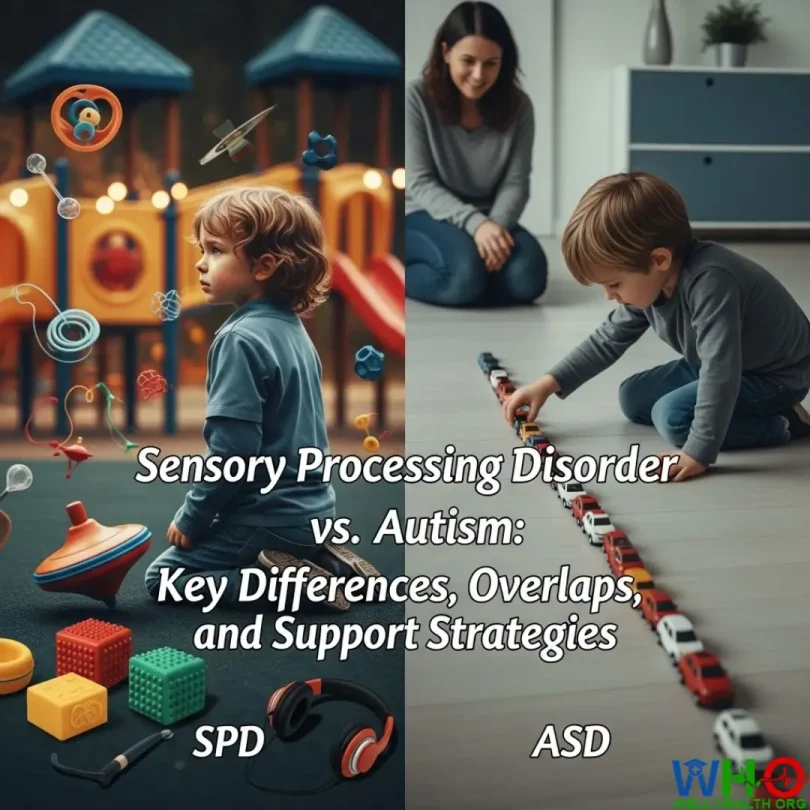
Introduction Sensory Processing Disorder vs Autism
When parents, teachers, or caregivers notice a child struggling with loud noises, bright lights, or changes in routine, two terms often come up in conversation: Sensory Processing Disorder (SPD) and Autism Spectrum Disorder (ASD). At first glance, the behaviors may look very similar—covering ears in a noisy classroom, avoiding certain food textures, or seeking constant movement. Because of this overlap, people often wonder: Are SPD and autism the same thing? Or are they separate conditions?
- Introduction Sensory Processing Disorder vs Autism
- What is Sensory Processing Disorder (SPD)?
- How Experts Define SPD
- Types of Sensory Processing Challenges
- 1. Auditory Processing (Hearing)
- 2. Visual Processing (Seeing)
- 3. Tactile Sensitivities (Touch)
- 4. Olfactory and Gustatory (Smell and Taste)
- 5. Vestibular (Balance and Head Movement)
- 6. Proprioceptive (Body Awareness)
- Core Behavioral Patterns in SPD
- 1. Sensory Over-Responsiveness
- 2. Sensory Under-Responsiveness
- 3. Sensory Seeking
- Prevalence and Diagnostic Status of SPD
- What is Autism Spectrum Disorder (ASD)?
- Why It’s Called a Spectrum
- Core Characteristics of ASD
- 1. Social Communication and Interaction Challenges
- 2. Restricted and Repetitive Behaviors or Interests
- Prevalence of Autism
- Gender Differences
- Global Trends
- Early Screening
- Overlap Between SPD and ASD
- The Neurological Connection
- Everyday Overlap
- Key Differences Between SPD and ASD
- Practical Example
- How SPD is Diagnosed
- The Role of Occupational Therapists
- Assessment Tools and Input
- Challenges in Diagnosis
- How ASD is Diagnosed
- Diagnostic Criteria
- Steps in the Diagnostic Process
- The Importance of Early Intervention
- Treatment and Management of SPD
- 1. Sensory Integration Therapy
- 2. Sensory Diets
- 3. Environmental Modifications
- 4. Family and School Involvement
- Treatment and Management of ASD
- 1. Behavioral and Developmental Interventions
- 2. Educational Supports
- 3. Speech and Language Therapy
- 4. Occupational Therapy
- 5. Medications
- 6. Parent and Family Training
- Building a Supportive Future
- 1. Creating Sensory-Friendly Environments
- 2. Advocating for Recognition of SPD
- 3. Reducing Stigma
- 4. Empowering Families
- 5. Looking Toward Independence
- Conclusion
- FAQs
- 1. Can someone have SPD without having autism?
- 2. Why isn’t SPD officially recognized in the DSM-5-TR?
- 3. How do I know if my child has SPD or autism?
- 4. What therapies are most helpful for SPD?
- 5. Can adults have SPD or autism, too?
- Final Note
The truth is, SPD and autism frequently occur together, but they are not identical. SPD is primarily a challenge with how the brain interprets sensory input, while autism is a broader developmental condition that affects communication, behavior, and social interactions—often accompanied by sensory differences.
Understanding the differences between these two conditions isn’t just a matter of semantics. It directly impacts how professionals diagnose, how families support their children, and which therapies are most effective. When families know what they’re dealing with, they can advocate for the right services, avoid unnecessary frustration, and help individuals thrive in everyday life.
This in-depth guide will walk you through the essentials: what SPD and autism are, how they overlap, how they differ, and what kinds of treatment and support strategies are available. By the end, you’ll have a clearer understanding of both conditions and practical insights for supporting children or adults who experience them.
What is Sensory Processing Disorder (SPD)?
Sensory Processing Disorder is a condition where the brain struggles to properly receive, organize, and respond to sensory information from the environment. For most people, sensory experiences like the hum of a refrigerator or the texture of a sweater fade into the background. But for someone with SPD, those same sensations can feel either overwhelmingly intense or strangely muted.
Imagine walking into a grocery store. For the average person, it’s a mildly busy environment. But for a child with SPD, it might feel like stepping into chaos: the bright fluorescent lights sting their eyes, the hum of freezers is unbearably loud, the smells from the bakery mix with cleaning chemicals to create nausea, and the texture of their clothing tag is scratching their neck until they can’t focus on anything else.
On the other hand, another child with SPD might barely react at all. They may not notice when someone calls their name, may not realize their face is messy after eating, or may walk into furniture without appearing to feel pain.
In essence, SPD is about how the nervous system interprets and reacts to sensory input—and those responses can disrupt everyday routines, learning, and relationships.
How Experts Define SPD
Professionals describe SPD as a difficulty in detecting, modulating, and interpreting sensory stimuli to the point that it interferes with functioning. This means a person with SPD may:
- React much more strongly than expected (over-responsiveness).
- React much less than expected, or not at all (under-responsiveness).
- Seek out intense sensations in ways that may look unusual (sensory-seeking).
Because sensory input shapes how we move, learn, and interact, SPD can ripple into many areas of life—impacting emotional regulation, behavior, and even social participation.
Types of Sensory Processing Challenges
SPD doesn’t look the same for everyone. It can affect one or multiple senses, and each person’s sensory profile is unique. Here are the main sensory domains where SPD shows up:
1. Auditory Processing (Hearing)
Children with auditory sensitivities may cover their ears at ordinary noises, like a vacuum cleaner, classroom chatter, or even the sound of a flushing toilet. Others may not respond when their name is called, leading parents to worry about hearing loss, when in fact the issue lies in how the brain processes sound.
2. Visual Processing (Seeing)
Some children are extremely sensitive to bright lights, moving patterns, or cluttered environments. A busy classroom bulletin board may be visually overwhelming. Others may seem under-responsive, needing bold colors and movement to capture their attention.
3. Tactile Sensitivities (Touch)
This is one of the most noticeable features of SPD. Children may refuse certain clothing (because tags or seams feel unbearable), resist hugs, or avoid messy play like finger painting. Conversely, some may constantly touch objects or people, craving tactile input.
4. Olfactory and Gustatory (Smell and Taste)
Strong smells—like perfume, cleaning supplies, or certain foods—can trigger gagging or even meltdowns. Taste sensitivities can make children extremely picky eaters, limiting their diet to a narrow range of “safe” foods.
5. Vestibular (Balance and Head Movement)
This system helps with balance and coordination. A child with vestibular challenges may appear clumsy, avoid playground equipment, or feel dizzy easily. Others may constantly spin, swing, or rock to seek vestibular stimulation.
6. Proprioceptive (Body Awareness)
This sense tells us where our body is in space. Children with proprioceptive challenges may bump into people, chew on non-food objects, push too hard when playing, or have trouble with handwriting.
These differences can appear in isolation, but often, children show a combination across multiple sensory systems, creating a highly individualized pattern of needs.
Core Behavioral Patterns in SPD
While sensory sensitivities can vary, professionals often describe SPD behaviors as falling into three broad patterns:
1. Sensory Over-Responsiveness
- Children may react with fear, anger, or withdrawal to normal stimuli.
- A common example: a child screams when water splashes on their face or refuses to enter a cafeteria because of noise.
- Over time, these strong reactions can lead to avoidance of everyday activities, increasing social isolation.
2. Sensory Under-Responsiveness
- These children seem “tuned out” or “in their own world.”
- They may not notice pain, fail to respond when called, or appear unmotivated.
- Teachers often mistake under-responsiveness for inattention or laziness, when in fact the brain isn’t registering sensory cues effectively.
3. Sensory Seeking
- Children may crave sensory input in ways that appear unusual or disruptive.
- They may spin, jump, crash into objects, chew on clothing, or constantly touch others.
- While these behaviors can look like hyperactivity, they are actually attempts to regulate the nervous system.
Each pattern comes with challenges, but also insights: understanding whether a child is overwhelmed, under-stimulated, or seeking input helps caregivers provide the right support.
Prevalence and Diagnostic Status of SPD
SPD is not rare. Studies estimate that 5–16% of children in the U.S. show symptoms of significant sensory processing difficulties. The rates are much higher among children with developmental conditions: around 90% of individuals with autism and up to 64% of those with ADHD also have SPD.
Despite its prevalence, SPD faces a major challenge: it is not officially recognized in the DSM-5-TR (the main diagnostic manual for mental health and developmental disorders). This omission creates practical barriers. Without formal recognition, insurance coverage for therapies is inconsistent, and families often struggle to get official accommodations in schools.
Occupational therapists (OTs) are usually the professionals who identify and treat SPD. They use structured observations, caregiver interviews, and specialized assessments to map out a child’s sensory profile. Still, without DSM status, SPD is sometimes dismissed as a “symptom” of another disorder rather than a standalone challenge.
This debate continues in the medical and research community. Advocates argue that SPD deserves recognition as a distinct condition, given its significant impact on learning, mental health, and family life. For now, though, families often navigate a gray area when seeking formal diagnosis and treatment.
What is Autism Spectrum Disorder (ASD)?
Autism Spectrum Disorder, often simply called autism, is a neurodevelopmental condition that affects the way a person communicates, interacts with others, and experiences the world around them. The word “spectrum” is important here—it reflects the wide range of challenges and strengths that autistic individuals may display. Some may have significant support needs in daily life, while others live independently but still face unique social or sensory challenges.
Unlike SPD, autism is officially recognized in the DSM-5-TR as a developmental disorder. This recognition provides clearer diagnostic pathways, access to therapies, and educational supports.
Autism symptoms usually become noticeable in early childhood, often before the age of three. Parents might notice delays in speech, differences in play skills, or unusual behaviors such as repetitive movements or a strong attachment to routines. While autism can be diagnosed later in life, early identification gives children the best chance to receive targeted support.
Why It’s Called a Spectrum
The term “spectrum” acknowledges that no two autistic people are alike. One child might be nonverbal and require full-time care, while another might excel academically but struggle with social communication. These differences don’t mean one person is “more autistic” than another—it means that autism manifests differently across individuals, affecting social interaction, communication, behavior, and sensory processing to varying degrees.
Real-life example:
- Child A may avoid eye contact, flap their hands when excited, and have intense interests in trains.
- Child B may talk at length about astronomy, excel in math, but struggle to make friends because they misinterpret social cues.
Both children are autistic, but their day-to-day experiences look very different.
Core Characteristics of ASD
Clinicians group the symptoms of autism into two broad categories, each with different features. To receive a diagnosis, both must be present.
1. Social Communication and Interaction Challenges
This includes:
- Difficulty with social reciprocity: For example, a child may not instinctively respond to a parent’s smile, or they may struggle to maintain back-and-forth conversations.
- Nonverbal communication difficulties: Many autistic individuals struggle with interpreting gestures, tone of voice, or facial expressions. They may also avoid eye contact, which can sometimes be misinterpreted as disinterest.
- Challenges with relationships: Making and keeping friends can be difficult. Some children prefer solitary play, while others want social connection but may not know how to navigate the unspoken rules of interaction.
2. Restricted and Repetitive Behaviors or Interests
These behaviors help autistic individuals regulate their environment and make sense of the world:
- Repetitive movements like rocking, spinning, or hand-flapping.
- Strong preference for routines: Sudden changes—such as a substitute teacher at school—can feel overwhelming and may lead to distress.
- Highly focused interests: Some children may memorize every detail about dinosaurs, computer coding, or maps, engaging with these topics at an intensity that feels unusual compared to peers.
- Sensory differences: Hypersensitivity or hyposensitivity to sound, light, textures, or smells often appears as part of autism, which creates overlap with SPD.
These traits can range from subtle to very pronounced, depending on the individual. Importantly, many autistic people also have unique strengths: excellent memory, deep focus, or creativity in areas of strong interest.
Prevalence of Autism
Autism is far more common today than many people realize, not necessarily because more people have autism, but because awareness and screening have improved. According to the CDC (2023 update), about 1 in 36 children in the United States is diagnosed with autism by age 8.
Gender Differences
Boys are diagnosed at about four times the rate of girls, though experts believe this may partly reflect underdiagnosis in girls. Girls with autism sometimes “mask” their symptoms, mimicking social behaviors to fit in, which makes their struggles less visible.
Global Trends
The World Health Organization (WHO) estimates that 1 in 100 people worldwide is autistic. Rates vary by country, depending on diagnostic practices, awareness, and cultural factors.
Early Screening
Most professionals now recommend developmental screenings at 18 and 24 months, because early intervention has been shown to significantly improve outcomes. The earlier a child receives therapies, the more support they get in developing communication, social skills, and adaptive behaviors.
Overlap Between SPD and ASD
This is where things get tricky: the symptoms of SPD and autism often overlap, which can make diagnosis confusing for families.
Research shows that about 90% of autistic individuals also display significant sensory processing differences. This is why sensory issues were included in the DSM-5 criteria for autism. For many families, the first red flag is not language or social skills, but sensory behaviors like covering ears, extreme picky eating, or constant spinning.
The Neurological Connection
Brain imaging studies provide clues. Both autistic children and children with SPD show differences in brain connectivity compared to typically developing peers. However, the affected regions differ:
- In autism, changes often appear in areas related to social-emotional processing as well as sensory integration.
- In SPD, abnormalities are found primarily in sensory processing networks, without the same degree of social communication differences.
For example, a landmark 2014 study found that while both groups showed disrupted sensory pathways, only autistic children showed significant differences in brain regions tied to social cognition. This suggests that while SPD and autism share surface-level behaviors, their neurological roots are not identical.
Everyday Overlap
- A child with autism may cover their ears during a fire drill because the sound is overwhelming (sensory).
- A child with SPD may do the same thing—but unlike the autistic child, they don’t also show persistent social communication difficulties.
This distinction is subtle but critical for accurate diagnosis and support.
Key Differences Between SPD and ASD
The biggest difference lies in the scope of challenges:
- SPD is primarily about sensory regulation.
- Autism is a broader developmental condition that includes social communication differences, restricted behaviors, and sensory challenges.
Here’s a closer comparison:
| Feature | Sensory Processing Disorder (SPD) | Autism Spectrum Disorder (ASD) |
|---|---|---|
| Primary Challenge | Difficulty processing and responding to sensory input. | Persistent differences in social communication and restricted, repetitive behaviors, often with sensory issues. |
| Social Communication | Social issues are usually secondary to sensory overload or avoidance. | Core deficit: challenges in understanding, using, and responding to social communication. |
| Repetitive Behaviors | May show sensory-seeking behaviors (e.g., spinning, touching). | Broader set of repetitive behaviors, routines, and intense special interests. |
| Diagnostic Status | Not officially recognized in DSM-5-TR. Diagnosed mainly by occupational therapists. | Official DSM-5-TR diagnosis with clear criteria and recognition in healthcare and education. |
| Overlap with Other Conditions | Common in autism, ADHD, anxiety. | May include sensory processing issues but extends far beyond them. |
Practical Example
- SPD child: Covers ears during music class but engages with peers normally once the noise is gone.
- Autistic child: Covers ears during music class, avoids eye contact, struggles to join group activities, and insists on following the same schedule every day.
Both show sensory sensitivity, but autism includes social and behavioral patterns that SPD alone does not.
How SPD is Diagnosed
Diagnosing Sensory Processing Disorder is not as straightforward as diagnosing autism because SPD does not have official recognition in the DSM-5-TR. This lack of formal classification creates challenges for families who are seeking validation and support. Still, occupational therapists (OTs) have developed structured ways to assess sensory difficulties.
The Role of Occupational Therapists
Occupational therapists are usually the professionals who identify SPD. During an evaluation, they observe how a child responds to different sensory experiences. For example, an OT may introduce tactile activities like finger painting, monitor how a child reacts to sudden noises, or watch for balance issues during movement exercises.
Assessment Tools and Input
- Standardized Tests: Tools like the Sensory Processing Measure (SPM) or Sensory Profile questionnaires provide structured data on how a child responds to sensory input across environments like home and school.
- Caregiver Reports: Parents’ observations are critical. A caregiver might describe how a child refuses to wear socks, gags at certain smells, or ignores instructions unless spoken to loudly.
- Direct Observation: OTs watch for subtle behaviors such as fidgeting, avoiding certain activities, or showing distress during sensory-rich tasks.
Challenges in Diagnosis
Since SPD is not officially recognized as a standalone diagnosis, families may face:
- Insurance barriers: Coverage for therapy may be denied unless SPD is tied to a condition like autism or ADHD.
- School recognition issues: Teachers may misunderstand behaviors, labeling them as defiance or distraction rather than sensory-based.
- Stigma and confusion: Some professionals question whether SPD is a “real” disorder, leaving parents feeling dismissed.
Despite these barriers, many children benefit enormously from targeted interventions once sensory needs are identified.
How ASD is Diagnosed
Unlike SPD, autism is formally recognized in the DSM-5-TR. A diagnosis requires a multidisciplinary approach, often involving developmental pediatricians, psychologists, neurologists, and speech-language pathologists.
Diagnostic Criteria
According to the DSM-5-TR, autism is diagnosed when a child shows:
- Persistent deficits in social communication and interaction, and
- Restricted, repetitive patterns of behavior, interests, or activities
…with symptoms appearing in early development and affecting everyday functioning.
Steps in the Diagnostic Process
- Screening: Pediatricians often use early developmental checklists at 18 and 24 months. Tools like the M-CHAT (Modified Checklist for Autism in Toddlers) help identify red flags.
- Comprehensive Evaluation: If concerns are raised, a full assessment follows. This may include developmental testing, language assessments, and cognitive evaluations.
- Behavioral Observation: Clinicians watch how the child plays, communicates, and reacts to different social cues.
- Parental Input: Parents provide crucial history—when the child started talking, how they interact with peers, or whether they show repetitive behaviors.
The Importance of Early Intervention
Research consistently shows that early diagnosis leads to better outcomes. Children who begin therapy before age 5 often develop stronger communication, social, and daily living skills.
Unlike SPD, autism diagnoses typically unlock services, accommodations, and insurance coverage, which can be life-changing for families.
Treatment and Management of SPD
Managing SPD often requires individualized, flexible approaches because no two sensory profiles are alike. The goal is not to “cure” SPD but to help individuals function comfortably and successfully in daily life.
1. Sensory Integration Therapy
This is the most common treatment, guided by occupational therapists. The therapy involves structured, playful activities designed to help the brain better process sensory input. Examples include:
- Swinging to improve vestibular processing.
- Playing with textured materials (sand, rice, shaving cream) to reduce tactile defensiveness.
- Jumping on trampolines or carrying weighted objects to support proprioceptive input.
The activities are fun for the child but carefully chosen to challenge and strengthen sensory pathways.
2. Sensory Diets
A sensory diet is a customized plan of daily activities tailored to a child’s sensory needs. For instance:
- A child who seeks movement may start the day with 10 minutes on a swing.
- A child who becomes overwhelmed by noise may use headphones during lunch at school.
- A child who struggles with focus may benefit from chewing gum during classwork.
Just like a food diet nourishes the body, a sensory diet nourishes the nervous system.
3. Environmental Modifications
Simple changes in the environment can significantly reduce stress. Examples include:
- Providing quiet spaces in classrooms for breaks.
- Choosing tagless clothing or seamless socks.
- Using noise-canceling headphones in noisy environments.
- Adjusting lighting to avoid fluorescent flicker.
4. Family and School Involvement
The most effective strategies happen when parents, teachers, and therapists work together. For example, a teacher may introduce movement breaks into class routines, while parents use calming strategies at home. Consistency helps children feel safe and supported.
Treatment and Management of ASD
Autism management typically involves a comprehensive, multi-layered approach. Because autism is a spectrum, strategies are tailored to the individual’s strengths and challenges.
1. Behavioral and Developmental Interventions
- Applied Behavior Analysis (ABA): Focuses on teaching skills and reducing disruptive behaviors through structured reinforcement.
- Play-based therapies (such as Floortime or DIR therapy): Encourage social interaction and emotional connection through guided play.
2. Educational Supports
Schools play a critical role. Many children qualify for an Individualized Education Program (IEP), which includes:
- Extra time for tasks.
- Visual supports (charts, schedules).
- Aide support in the classroom.
- Sensory breaks during the day.
3. Speech and Language Therapy
For children with communication challenges, speech therapy builds both verbal and nonverbal communication. This may include using pictures, sign language, or communication devices.
4. Occupational Therapy
OTs help with daily living skills like dressing, feeding, and handwriting. They also address sensory needs, much like in SPD treatment.
5. Medications
There is no medication for the core symptoms of autism, but doctors may prescribe medications for associated challenges like:
- Anxiety
- Hyperactivity
- Aggression or irritability
- Sleep difficulties
6. Parent and Family Training
Families are taught strategies to support their child at home—how to respond to meltdowns, encourage communication, and build routines that reduce stress.
The overarching goal of autism treatment is not to “change” who the person is, but to provide tools, supports, and acceptance that allow them to live fulfilling lives.
Building a Supportive Future
Whether a person has SPD, autism, or both, support and understanding are the cornerstones of success. Families often find themselves overwhelmed at first, but with the right knowledge and resources, life becomes more manageable.
1. Creating Sensory-Friendly Environments
Homes, classrooms, and public spaces can be adapted to meet sensory needs. Examples:
- Schools offering “quiet corners” for students.
- Movie theaters hosting “sensory-friendly screenings” with lower volume and dim lighting.
- Workplaces providing noise-free spaces for employees with sensory challenges.
2. Advocating for Recognition of SPD
Because SPD is not formally recognized in the DSM-5-TR, advocacy is essential. Parents, professionals, and researchers continue to push for SPD’s inclusion as a formal diagnosis to improve access to care.
3. Reducing Stigma
Children with SPD or autism may be unfairly labeled as “difficult” or “misbehaved.” Awareness campaigns, school training programs, and parent advocacy help shift the conversation toward compassion and understanding.
4. Empowering Families
Support groups, online communities, and local organizations provide families with practical advice and emotional support. Knowing that other parents are facing similar challenges can reduce feelings of isolation.
5. Looking Toward Independence
With the right supports in place, many individuals with SPD and autism go on to live independently, attend college, hold jobs, and build meaningful relationships. The key is not eliminating differences, but embracing neurodiversity—recognizing that brains process the world in unique ways.
Conclusion
Sensory Processing Disorder (SPD) and Autism Spectrum Disorder (ASD) share many similarities, particularly in how individuals experience and respond to sensory input. This overlap often leads to confusion, both for families and professionals. However, understanding the distinctions is critical.
SPD is primarily about how the brain interprets sensory input, which can lead to either hypersensitivity, hyposensitivity, or constant sensory-seeking behaviors. Autism, on the other hand, encompasses a much broader set of developmental differences, including social communication challenges, restricted behaviors, and sensory differences.
The distinction matters because accurate diagnosis guides the right interventions. Children with SPD may benefit most from occupational therapy and environmental adjustments, while children with autism typically require a broader range of supports, including behavioral, educational, and speech therapies.
Ultimately, though, both conditions highlight the importance of understanding and compassion. A child who refuses to wear certain clothes or struggles in noisy environments is not being “difficult”—they are responding to their unique neurological wiring. By creating supportive environments, reducing stigma, and advocating for access to therapies, we can ensure that children and adults with SPD or autism feel seen, valued, and empowered.
Neurodiversity reminds us that differences are not deficits—they are variations in how humans experience the world. With awareness and acceptance, individuals with SPD and autism can thrive, pursuing their strengths and living fulfilling lives.
FAQs
1. Can someone have SPD without having autism?
Yes. Many people with SPD do not meet the criteria for autism. While about 90% of autistic individuals experience sensory processing challenges, SPD can occur independently or alongside other conditions like ADHD or anxiety.
2. Why isn’t SPD officially recognized in the DSM-5-TR?
The debate is ongoing. Some experts argue that sensory difficulties are symptoms of other conditions rather than a standalone disorder, while others believe SPD deserves its own classification. This lack of recognition makes it harder for families to access insurance coverage and formal school accommodations.
3. How do I know if my child has SPD or autism?
The best way to know is through professional evaluation. An occupational therapist can assess sensory issues, while developmental pediatricians or psychologists evaluate for autism. Since symptoms overlap, it’s possible for a child to have both SPD and autism, or just one of them.
4. What therapies are most helpful for SPD?
Occupational therapy using sensory integration techniques is most common. Sensory diets, environmental modifications, and parent/teacher training are also effective. The goal is to help children regulate their responses to sensory input so they can participate fully in daily activities.
5. Can adults have SPD or autism, too?
Absolutely. SPD and autism are lifelong conditions, though they may look different in adults than in children. Some adults may struggle with crowded offices, bright lights, or clothing textures, while others may have ongoing challenges with social communication. Many adults benefit from occupational therapy, counseling, or workplace accommodations.
Final Note
Both SPD and autism remind us that human brains don’t all process the world in the same way—and that’s not a weakness, but a difference. With the right support, strategies, and acceptance, individuals with SPD and ASD can thrive at school, at work, and in their communities.
Medically Reviewed by Prof. Dr. Akram
Orthopedic Surgeon | Professor | Senior Medical Specialist
Prof. Dr. Akram is a distinguished surgeon with over 15 years of clinical expertise. Having served as a lead Emergency Specialist at Complex International Government Hospital, he currently leads a specialized team of 13 medical professionals at his private hospital. As a Professor at top medical universities, he ensures that every article on WellHealthOrg.com meets rigorous clinical standards.
Medical Disclaimer:
The information provided is for educational purposes only and is not a substitute for professional medical advice, diagnosis, or treatment. Always consult your physician for any medical concerns.
Our content is rigorously fact-checked by our 13-member Editorial Team under the clinical supervision of Prof. Dr. Akram.