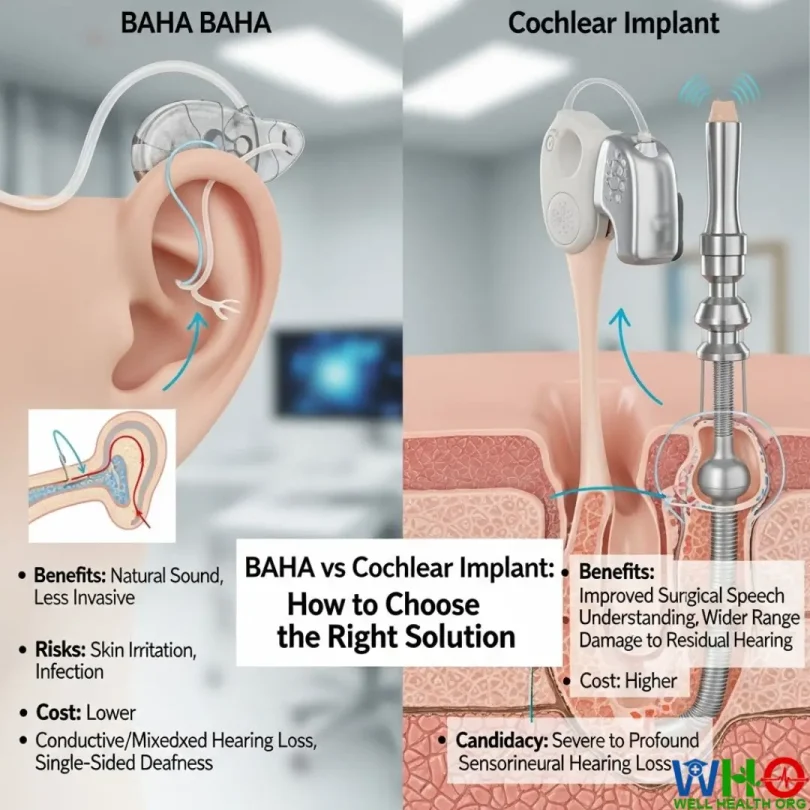
Introduction: BAHA vs Cochlear Implant
For millions of people worldwide, hearing loss is more than a medical diagnosis—it’s a daily challenge that affects communication, relationships, career opportunities, and overall quality of life. While traditional hearing aids have transformed hearing for many, they are not effective for everyone. Some types of hearing loss require more advanced solutions. This is where bone-anchored hearing aids (BAHA) and cochlear implants (CI) step in as life-changing technologies.
- Introduction: BAHA vs Cochlear Implant
- What is a BAHA? Understanding Bone-Anchored Hearing Aids
- How a BAHA Works
- The BAHA Surgical Experience
- Who Benefits from BAHA?
- Daily Life with a BAHA
- What is a Cochlear Implant? Restoring Sound Through Technology
- How a Cochlear Implant Works
- The Cochlear Implant Surgery
- Who Benefits from Cochlear Implants?
- Daily Life with a Cochlear Implant
- Key Differences Between BAHA and Cochlear Implants
- 1. Type of Hearing Loss Addressed
- 2. Surgical Complexity
- 3. Hearing Experience
- 4. Maintenance and Lifestyle
- Candidacy: Who Benefits from Each Device?
- BAHA Candidates
- Cochlear Implant Candidates
- Children vs. Adults
- Benefits & Limitations of BAHA
- Benefits of BAHA
- Limitations of BAHA
- Benefits & Limitations of Cochlear Implants
- Key Benefits of Cochlear Implants
- Limitations of Cochlear Implants
- Cost & Insurance Coverage: The Financial Side of Better Hearing
- BAHA Costs
- Cochlear Implant Costs
- Other Financial Considerations
- Rehabilitation & Adjustment Period
- BAHA Rehabilitation
- Cochlear Implant Rehabilitation
- Emotional Adjustment
- Daily Life with BAHA vs Cochlear Implant
- Living with a BAHA
- Living with a Cochlear Implant
- Emotional & Social Impact
- Emotional Impact
- Social Impact
- The Evaluation Process: Step by Step
- Step 1: Hearing Assessment
- Step 2: Medical Examination
- Step 3: Counseling and Education
- Step 4: Candidacy Confirmation
- Making the Decision: Questions to Ask Your Doctor
- Conclusion: Finding Your Path to Better Hearing
- FAQs About BAHA and Cochlear Implants
Both devices have been proven to restore meaningful hearing in people who cannot benefit from standard hearing aids, but they are not interchangeable. Each serves a unique purpose, is designed for different types of hearing loss, and involves a different level of surgical commitment and rehabilitation.
Choosing between a BAHA and a cochlear implant can feel overwhelming. The medical terminology is often confusing, and the decision is deeply personal because it impacts how you will interact with the world every day. The good news is that both solutions offer remarkable improvements in sound awareness, speech recognition, and overall quality of life.
In this guide, we’ll break down the differences between the two devices, explain how they work, outline candidacy requirements, and provide real-world insights into what living with each device is actually like. By the end, you’ll have the knowledge you need to make a confident, informed decision about your hearing future.
What is a BAHA? Understanding Bone-Anchored Hearing Aids
A bone-anchored hearing aid (BAHA) isn’t really a “hearing aid” in the traditional sense. Instead of amplifying sound through the ear canal, a BAHA uses the natural properties of bone conduction to transmit sound directly to the inner ear. For people whose outer or middle ears cannot transmit sound effectively, this device provides an alternate pathway that bypasses the damaged structures.
How a BAHA Works
The BAHA system has three primary components:
- The Sound Processor – A small external device worn behind the ear that captures sound waves from the environment and converts them into vibrations. It can be removed for swimming, sleeping, or other activities.
- The Abutment (Connector) – A titanium piece that connects the external processor to the implant beneath the skin. Some modern systems use magnets instead of an abutment for a more discreet look.
- The Titanium Implant – Surgically anchored into the skull bone behind the ear, this implant transmits sound vibrations directly into the inner ear (cochlea) via bone conduction.
The real “magic” of a BAHA lies in osseointegration, a natural biological process where bone cells grow around and fuse with the titanium implant. This creates a stable, long-lasting connection that ensures efficient sound transmission.
The BAHA Surgical Experience
Implanting a BAHA is generally a simple outpatient surgery that takes about 30–60 minutes. It’s often done under local anesthesia, and most patients go home the same day. Recovery usually involves keeping the surgical site clean and dry while the bone fuses with the implant, which typically takes 3–6 months. Once healing is complete, the sound processor can be attached and programmed by an audiologist.
Who Benefits from BAHA?
BAHA devices are especially effective for people with:
- Conductive hearing loss (problems with the outer or middle ear)
- Mixed hearing loss (a combination of conductive and sensorineural loss)
- Single-sided deafness (SSD) where one ear has profound hearing loss but the other has normal hearing
- Chronic ear infections or structural abnormalities that prevent regular hearing aid use
Many patients with congenital conditions such as microtia or atresia (underdeveloped or missing ear canals) also benefit from BAHA.
Daily Life with a BAHA
Patients often describe the BAHA as providing clear, natural sound quality, especially in quiet or one-on-one situations. Because the sound bypasses the middle ear, there is less distortion compared to conventional aids. However, background noise can still present challenges. Maintenance mainly involves cleaning the abutment site daily and ensuring the sound processor is functioning properly.
What is a Cochlear Implant? Restoring Sound Through Technology
While BAHA works by transmitting vibrations through bone, a cochlear implant (CI) takes an entirely different approach. It bypasses damaged sensory hair cells inside the cochlea and directly stimulates the auditory nerve with electrical signals. This allows people with severe to profound hearing loss—who cannot be helped by hearing aids—to regain access to sound.
How a Cochlear Implant Works
The CI system consists of both external and internal components:
External Components
- Microphone – Picks up sound from the environment.
- Speech Processor – Converts sound into a coded digital signal.
- Transmitter Coil – Sends the processed signal across the skin to the implanted receiver.
Internal Components
- Receiver/Stimulator – Surgically implanted under the skin behind the ear, this device receives the signal from the transmitter.
- Electrode Array – A thin wire with multiple electrodes that is inserted into the cochlea. These electrodes directly stimulate different regions of the auditory nerve, corresponding to various sound frequencies.
The brain then interprets these electrical signals as sound. While the experience is not identical to natural hearing, modern cochlear implants provide highly effective access to speech, environmental sounds, and even music for many users.
The Cochlear Implant Surgery
Cochlear implantation is a more complex procedure than BAHA surgery. It typically takes 2–4 hours under general anesthesia. The surgeon makes an incision behind the ear, creates a small opening in the skull bone, and carefully threads the electrode array into the cochlea.
Most patients stay in the hospital overnight for monitoring and return home the next day. Unlike BAHA, the device is not activated immediately after surgery. Healing must occur first, so activation usually happens 2–4 weeks post-surgery, followed by several programming sessions (called “mappings”) to fine-tune sound perception.
Who Benefits from Cochlear Implants?
Cochlear implants are ideal for people with:
- Severe to profound sensorineural hearing loss in one or both ears
- Limited or no benefit from hearing aids
- Functional auditory nerves capable of responding to electrical stimulation
- Strong motivation to commit to rehabilitation and follow-up care
Both children and adults can benefit from cochlear implants, and early implantation often leads to better long-term speech and language development in children.
Daily Life with a Cochlear Implant
Life with a CI is a journey. While some patients notice immediate improvements after activation, most require months of auditory training to maximize their ability to understand speech and environmental sounds. Users need to maintain the external processor, replace or recharge batteries regularly, and attend ongoing appointments for adjustments. Despite these commitments, many CI users report being able to hear conversations clearly, enjoy music, and engage fully in social activities—things they once thought were lost forever.
Key Differences Between BAHA and Cochlear Implants
At first glance, BAHA and cochlear implants may appear similar since both are surgically implanted hearing solutions for people who cannot benefit from conventional hearing aids. But their mechanisms, target conditions, and user experiences are vastly different. Understanding these differences is essential when considering which option aligns best with your hearing profile and lifestyle.
1. Type of Hearing Loss Addressed
- BAHA is best suited for individuals with conductive or mixed hearing loss where the outer or middle ear is unable to conduct sound properly. It’s also highly effective for single-sided deafness (SSD), allowing sound from the deaf side to be routed to the better-hearing ear through bone conduction.
- Cochlear implants, on the other hand, are designed for severe to profound sensorineural hearing loss, where the sensory hair cells in the cochlea are permanently damaged. Instead of relying on bone conduction, they directly stimulate the auditory nerve.
2. Surgical Complexity
- BAHA surgery is relatively minor, often completed in less than an hour under local anesthesia. Most patients return home the same day.
- Cochlear implant surgery is more complex, requiring general anesthesia and a hospital stay. It involves precise insertion of an electrode array into the cochlea, which carries higher surgical risks compared to BAHA.
3. Hearing Experience
- BAHA users often describe the sound as natural and clear, especially when the inner ear is healthy. Since the device uses bone conduction, it takes advantage of existing inner ear function.
- Cochlear implant users experience a more artificial sound quality initially. The brain must learn to interpret electrical signals as meaningful sound, which can take weeks to months of rehabilitation. However, over time, most users achieve excellent speech recognition.
4. Maintenance and Lifestyle
- BAHA involves daily cleaning of the abutment site (or skin care if using a magnetic system). Processors are easy to remove when showering, swimming, or sleeping.
- Cochlear implants require consistent external processor use, battery management, and follow-up programming sessions.
In short: BAHA is simpler, but limited to specific types of hearing loss. Cochlear implants are more complex, but open the door to hearing for those with profound loss.
Candidacy: Who Benefits from Each Device?
Not every hearing loss patient is a candidate for either device. Careful evaluation by audiologists and ENT specialists determines eligibility. Here’s how candidacy typically breaks down:
BAHA Candidates
You may be a good fit for BAHA if you have:
- Conductive hearing loss that isn’t correctable by surgery or hearing aids.
- Single-sided deafness (SSD) due to acoustic neuroma, sudden hearing loss, or trauma.
- Chronic ear infections where traditional aids worsen the condition.
- Congenital conditions like microtia or atresia, where the ear canal is underdeveloped or absent.
- Mild-to-moderate mixed hearing loss with preserved bone conduction thresholds.
👉 Example: Imagine a person born with one closed ear canal (atresia). Traditional hearing aids can’t deliver sound properly because of the structural issue, but a BAHA bypasses the blockage by sending sound through the bone, restoring clarity.
Cochlear Implant Candidates
You may qualify for a cochlear implant if you have:
- Severe-to-profound sensorineural hearing loss in one or both ears.
- Limited benefit from hearing aids (measured by poor speech recognition scores).
- Intact auditory nerve capable of transmitting electrical signals.
- Commitment to rehabilitation, since the brain must adapt to electrical hearing.
- No medical contraindications that increase surgical risk.
👉 Example: Consider an adult who has worn powerful hearing aids for years but still struggles to understand conversations, even in quiet settings. For them, a cochlear implant may offer a life-changing improvement in speech recognition.
Children vs. Adults
- Children: Early implantation often leads to better language development. A child born with profound hearing loss may achieve near-normal speech if implanted young.
- Adults: Outcomes vary depending on how long they have lived with hearing loss, but many regain conversational abilities and even enjoy music again.
Ultimately, the decision comes down to matching the device to the type and severity of hearing loss—and to the patient’s willingness to undergo surgery and rehabilitation.
Benefits & Limitations of BAHA
Like any medical device, BAHA comes with both strengths and weaknesses. For many patients, the advantages outweigh the limitations, but it’s important to know both sides.
Benefits of BAHA
- Natural Sound Quality – Because BAHA relies on bone conduction, it often delivers clearer, less distorted sound compared to traditional aids in cases of conductive loss.
- Improved Comfort – Unlike in-ear hearing aids, BAHAs don’t block the ear canal. This reduces the “plugged-up” feeling and avoids irritation for people with chronic ear problems.
- Effective for Single-Sided Deafness – For SSD patients, BAHA routes sound from the deaf side to the functioning ear, improving spatial awareness and conversation in noise.
- Convenient Use – The external processor is removable, making it easy to adapt to daily activities like sleeping, swimming, or sports.
- Less Invasive Surgery – Compared to cochlear implants, BAHA surgery is shorter, simpler, and usually done under local anesthesia.
👉 Real-life perspective: Many BAHA users report being able to hear their loved ones more clearly in quiet settings and participate in conversations they previously missed.
Limitations of BAHA
- Not Suitable for All Hearing Loss – BAHA is ineffective for severe-to-profound sensorineural loss because it requires a functioning inner ear.
- Maintenance Needs – The abutment site must be cleaned daily to prevent skin irritation or infection. With magnetic versions, skin pressure issues can sometimes arise.
- Background Noise Challenges – While BAHA improves hearing, noisy environments can still be difficult.
- Limited Power Output – Compared to cochlear implants, BAHAs have less amplification potential, making them less effective for profound loss.
- Cosmetic Considerations – Some people may feel self-conscious about the external processor or visible abutment.
In short: BAHA is a fantastic option for conductive and SSD patients who want a relatively low-maintenance, effective hearing solution—but it isn’t a one-size-fits-all answer.
Benefits & Limitations of Cochlear Implants
Cochlear implants are often described as a “miracle” for those with profound hearing loss, but like any medical device, they come with both remarkable advantages and important limitations. Knowing both sides helps set realistic expectations and ensures patients are fully prepared for the journey ahead.
Key Benefits of Cochlear Implants
- Restored Access to Speech – For people who cannot understand speech even with powerful hearing aids, cochlear implants open the door to meaningful communication. Research shows that most CI users achieve significant improvements in speech understanding, especially in quiet environments.
- Improved Quality of Life – Being able to participate in conversations, talk on the phone, or hear music again dramatically enhances social interactions and emotional well-being.
- Better Performance in Noisy Settings – While background noise can still pose challenges, CIs generally outperform hearing aids when it comes to speech clarity in restaurants, meetings, or group gatherings.
- Support for Children’s Language Development – Early implantation in children gives them access to sound during critical language-learning years, helping them develop speech and communication skills comparable to hearing peers.
- Technological Advancements – Modern CIs come with Bluetooth connectivity, rechargeable batteries, and advanced noise-reduction features, making them more user-friendly than ever.
👉 Real-life example: An adult who lost hearing gradually may find themselves suddenly able to enjoy conversations with their grandchildren or even rediscover the joy of music after years of silence.
Limitations of Cochlear Implants
- Surgical Risks – CI surgery is safe but more complex than BAHA. Risks include infection, dizziness, device failure, or in rare cases, facial nerve damage.
- Rehabilitation Required – Unlike BAHA, which provides instant hearing once activated, CI users must commit to months of auditory training to teach the brain how to interpret electrical signals as sound.
- Not Natural Hearing – While speech understanding is excellent, music and subtle environmental sounds may not sound the same as natural hearing.
- Higher Costs – CIs are a more significant financial investment, and while often covered by insurance, they require ongoing follow-up, mapping sessions, and processor upgrades over time.
- Medical Restrictions – Certain types of MRI scans may be limited, and external processors must be removed for swimming or contact sports.
In short: Cochlear implants can transform lives, but they require patience, rehabilitation, and realistic expectations.
Cost & Insurance Coverage: The Financial Side of Better Hearing
When considering BAHA vs. cochlear implant, cost plays an important role. These devices are not inexpensive, but insurance coverage and financial assistance programs often make them more accessible than patients expect.
BAHA Costs
The average cost of a BAHA system includes:
- Implant surgery: $10,000–$17,000
- Sound processor: $5,000–$8,000
- Total estimate: $15,000–$25,000
The good news is that BAHA is considered a prosthetic device rather than a hearing aid, meaning Medicare and many insurance providers cover much of the cost. Patients should confirm with their provider, as coverage varies depending on the specific plan.
Cochlear Implant Costs
Cochlear implants represent a higher financial investment:
- Surgery and device: $29,000–$33,000 (sometimes more depending on hospital fees)
- Insurance coverage: Medicare typically covers $23,500–$31,000, and many private insurers follow similar policies.
- Ongoing costs: Replacement batteries, upgraded processors (every 5–7 years), and follow-up mapping sessions.
Other Financial Considerations
- Rehabilitation costs: Cochlear implant users may require months of auditory training sessions, which may or may not be covered by insurance.
- Travel expenses: If patients need to visit specialized centers for surgery or programming, travel costs can add up.
- Long-term savings: For many, the ability to communicate effectively reduces social isolation, supports career opportunities, and improves mental health—benefits that far outweigh financial concerns.
👉 Practical tip: Always ask your provider’s billing office to pre-authorize insurance coverage before surgery. Some hospitals also have patient assistance programs to help manage out-of-pocket costs.
Rehabilitation & Adjustment Period
Perhaps the most important difference between BAHA and cochlear implants lies in the rehabilitation journey. While BAHA users typically adjust quickly, CI users must undergo a longer adaptation process.
BAHA Rehabilitation
For BAHA users, the adjustment is relatively straightforward. Once the implant has fused with the bone and the processor is activated, most patients experience immediate sound benefits. A short period of fine-tuning with the audiologist ensures the best settings. Daily life adjustments include:
- Learning to maintain and clean the abutment site
- Getting used to removing the processor during sleep and water activities
- Managing expectations in noisy environments
Most users adapt within weeks, and ongoing rehabilitation is rarely necessary.
Cochlear Implant Rehabilitation
Cochlear implant rehabilitation is more intensive because the brain must learn a new way of hearing. This process can take months to years, depending on the individual. Rehabilitation typically involves:
- Auditory training sessions with a speech-language pathologist or audiologist
- “Mapping” sessions where the processor is programmed to optimize sound clarity
- Daily listening practice—patients are encouraged to engage in conversations, listen to audiobooks, or practice speech recognition exercises
👉 Real-life insight: Many CI patients describe the first days after activation as overwhelming, with sounds that seem robotic or electronic. Over time, however, the brain adapts, and speech understanding improves dramatically.
Emotional Adjustment
Both BAHA and CI patients may experience an emotional adjustment period. For BAHA users, the excitement of restored hearing may come with frustration in noisy settings. For CI users, the long rehabilitation can test patience, but success stories highlight how persistence pays off.
In summary: BAHA offers quicker adjustment, while cochlear implants demand commitment but often deliver life-changing outcomes.
Daily Life with BAHA vs Cochlear Implant
One of the most practical ways to understand the difference between BAHA and cochlear implants is by looking at day-to-day life with each device. While both bring significant benefits, the lifestyle experience can be very different.
Living with a BAHA
- Simplicity and Convenience – The BAHA processor can be easily removed for sleeping, showering, or sports. This makes it low-maintenance and adaptable for active lifestyles.
- Cleaning Routine – If using an abutment system, the skin around the implant requires daily cleaning to prevent irritation. Magnet-based BAHAs require less skin care but may sometimes cause mild skin pressure.
- Hearing Experience – Most users find sound quality natural, though background noise can still pose challenges. BAHA is particularly effective for quiet conversations and one-on-one interactions.
- Durability – The titanium implant is permanent, but the processor may need replacement or upgrading every few years.
👉 Example: A teacher with single-sided deafness might find BAHA invaluable for hearing students on both sides of the classroom, improving work performance and confidence.
Living with a Cochlear Implant
- Processor Management – CI users must wear their external processor daily. It requires regular battery changes or charging.
- Water Activities – Most CIs require waterproof accessories for swimming or bathing. Processors must be removed in wet environments unless special cases are purchased.
- Sound Perception – CI users may initially struggle with robotic or artificial sound. Over months, speech becomes clearer, and many patients report being able to enjoy music again.
- Ongoing Support – Regular appointments for mapping, rehabilitation, and upgrades are part of CI life.
👉 Example: A retiree with profound hearing loss who once avoided social gatherings may find themselves comfortably participating in family dinners and enjoying phone calls again thanks to a CI.
In short: BAHA offers quicker adaptation and simpler daily routines, while cochlear implants require more commitment but deliver broader benefits for profound hearing loss.
Emotional & Social Impact
Hearing loss doesn’t just affect your ears—it impacts your self-confidence, relationships, career, and mental health. Both BAHA and cochlear implants provide not only physical improvements but also emotional and social benefits.
Emotional Impact
- BAHA often restores confidence in people who struggled with chronic ear infections or structural abnormalities. The ability to hear without discomfort is liberating.
- Cochlear implants can be life-changing, but the adjustment process may feel overwhelming at first. Many patients experience a rollercoaster of emotions—from excitement at hearing sounds again to frustration during rehabilitation.
Social Impact
- Improved Communication – Both devices make it easier to participate in conversations, reducing feelings of isolation.
- Greater Independence – Whether answering the phone or enjoying music, restored hearing gives patients more freedom in daily life.
- Relationship Benefits – Hearing again often strengthens bonds with family and friends.
👉 Research insight: Studies show that restoring hearing through BAHA or CI reduces the risk of social withdrawal and may even lower the risk of cognitive decline by keeping the brain engaged with sound.
The Evaluation Process: Step by Step
Before deciding between BAHA and cochlear implants, patients undergo a comprehensive evaluation to ensure the chosen solution matches their hearing profile.
Step 1: Hearing Assessment
- Audiologists perform pure-tone audiometry, speech recognition tests, and bone conduction testing.
- BAHA candidates are assessed for bone conduction strength.
- CI candidates undergo aided testing with hearing aids to measure benefit.
Step 2: Medical Examination
- ENT specialists review ear anatomy, infection history, and overall health.
- Imaging tests like CT or MRI scans may be ordered to assess inner ear and auditory nerve structures.
Step 3: Counseling and Education
- Patients learn about the surgical process, device maintenance, rehabilitation, and realistic expectations.
- Financial counseling is often provided to explain insurance coverage and out-of-pocket costs.
Step 4: Candidacy Confirmation
- After reviewing results, the care team confirms whether BAHA or CI—or sometimes neither—is the right option.
👉 Tip: Always ask your team about long-term follow-up care, as ongoing support is crucial for both BAHA and CI users.
Making the Decision: Questions to Ask Your Doctor
Choosing between BAHA and cochlear implant isn’t a one-size-fits-all decision. Here are key questions to guide your discussion with your healthcare provider:
- Which type of hearing loss do I have, and which device fits best?
- What kind of hearing improvement can I realistically expect?
- What risks are associated with each surgery?
- How much rehabilitation will I need?
- What are the costs, and how much will insurance cover?
- How experienced is the surgical team with these procedures?
- What kind of long-term support will I receive after surgery?
👉 Pro tip: It’s often wise to seek a second opinion, especially when facing a major surgical decision. Different specialists may offer different insights into which solution fits your lifestyle best.
Conclusion: Finding Your Path to Better Hearing
The choice between a bone-anchored hearing aid (BAHA) and a cochlear implant (CI) is one of the most important hearing-related decisions you may ever make. While both technologies share the same goal—restoring your ability to hear—they serve very different needs.
- BAHA is ideal for conductive loss, mixed loss, or single-sided deafness. It offers a relatively simple surgery, quick adaptation, and natural sound quality for those who still have a functioning inner ear.
- Cochlear implants are designed for severe to profound sensorineural loss. They require a more complex surgery and a longer rehabilitation process but can restore meaningful speech understanding and reconnect you to the world of sound.
Ultimately, the best solution depends on your unique hearing profile, lifestyle, and personal goals. With the guidance of skilled audiologists and ENT specialists, you can find the option that empowers you to live fully, communicate confidently, and reconnect with the sounds of life.
FAQs About BAHA and Cochlear Implants
1. Will BAHA or cochlear implants restore normal hearing?
No. Neither device restores natural hearing, but both significantly improve access to sound. BAHA delivers more natural quality in suitable cases, while cochlear implants provide life-changing clarity for profound loss.
2. How long does it take to adjust to each device?
BAHA users often adjust within weeks, while cochlear implant users may need several months of rehabilitation before achieving optimal results.
3. Can children receive BAHA or cochlear implants?
Yes. Children with congenital ear conditions often benefit from BAHA, while children with profound sensorineural hearing loss can receive cochlear implants, often with better outcomes if implanted early.
4. Do insurance plans cover these devices?
Yes. Both BAHA and cochlear implants are usually covered by Medicare and private insurers since they are classified as prosthetic devices, not hearing aids. Coverage varies, so always check with your provider.
5. Which device is easier to live with daily?
BAHA requires less rehabilitation and is easier to manage day-to-day. Cochlear implants demand more commitment but provide access to speech for people who otherwise wouldn’t hear at all.
Final Word
Both BAHA and cochlear implants have transformed millions of lives. The right choice depends on your type of hearing loss, medical history, and lifestyle goals. By working closely with your healthcare team, you can take the next step toward clearer communication, stronger relationships, and a richer life filled with sound.
Medically Reviewed by Prof. Dr. Akram
Orthopedic Surgeon | Professor | Senior Medical Specialist
Prof. Dr. Akram is a distinguished surgeon with over 15 years of clinical expertise. Having served as a lead Emergency Specialist at Complex International Government Hospital, he currently leads a specialized team of 13 medical professionals at his private hospital. As a Professor at top medical universities, he ensures that every article on WellHealthOrg.com meets rigorous clinical standards.
Medical Disclaimer:
The information provided is for educational purposes only and is not a substitute for professional medical advice, diagnosis, or treatment. Always consult your physician for any medical concerns.
Our content is rigorously fact-checked by our 13-member Editorial Team under the clinical supervision of Prof. Dr. Akram.