
In the vast and intricate world of natural medicine, few modalities spark as much curiosity and debate as homeopathy. For centuries, this therapeutic system has offered an alternative lens through which to view health and healing—one that looks beyond the surface symptoms to treat the underlying vitality of the individual. Within the expansive homeopathic materia medica (the encyclopedia of remedies), there are “polychrests”—major remedies with broad applications—and there are specific, targeted powerhouses. Phytolacca Decandra, specifically in the 200th centesimal potency (Phytolacca 200), belongs to the latter category, earning a reputation as a glandular specialist and a throat savior.
- 1. The Botanical Origins: From Poison to Panacea
- The Paradox of Pokeweed
- The Homeopathic Transformation
- 2. The “Phytolacca Picture”: Who Needs This Remedy?
- The Center of Gravity: Glandular Affinity
- 3. Throat Health: The Flagship Indication
- The “Dusky” Appearance
- The Nature of the Pain
- The Temperature Modality (The Clincher)
- 4. Women’s Health: Mastitis and Breast Care
- The Mastitis Profile
- Comparison with Other Remedies
- 5. Musculoskeletal Health: Rheumatic and Bone Pain
- The “Electric Shock” Pains
- The Weather Factor
- Specific Areas of Action
- 6. Less Common but Vital Uses
- Oral Health and Teething
- Skin Conditions
- Weight Management (Clarification Needed)
- 7. Dosage and Administration: The Art of Potency
- How to Take the Remedy
- Dosage Frequency
- The “Plussing” Method
- 8. Safety, Precautions, and The “Healing Crisis”
- The Homeopathic Aggravation
- When to Seek Conventional Medical Care
- Contraindications
- 9. Integrating Phytolacca into a Holistic Lifestyle
- Hydration is Key
- Rest and Digest
- Dietary Support
- 10. Frequently Asked Questions (FAQ)
- Conclusion: A Powerful Ally in the Homeopathic Kit
Whether you are a seasoned proponent of homeopathy who has a kit full of blue tubes or a newcomer searching for complementary therapies for stubborn health issues, understanding the nuance of Phytolacca 200 is crucial. It is not a “take one for everything” pill; it is a precision instrument.
This comprehensive guide will take you deep into the nature of this remedy. We will explore its botanical origins, its specific affinity for the glands and throat, its unique modality profile (what makes it better or worse), and the critical safety protocols required when using a high potency like 200C. By the end of this article, you will possess a level of expertise that goes far beyond the basic label instructions, empowering you to make informed decisions about your health regimen.
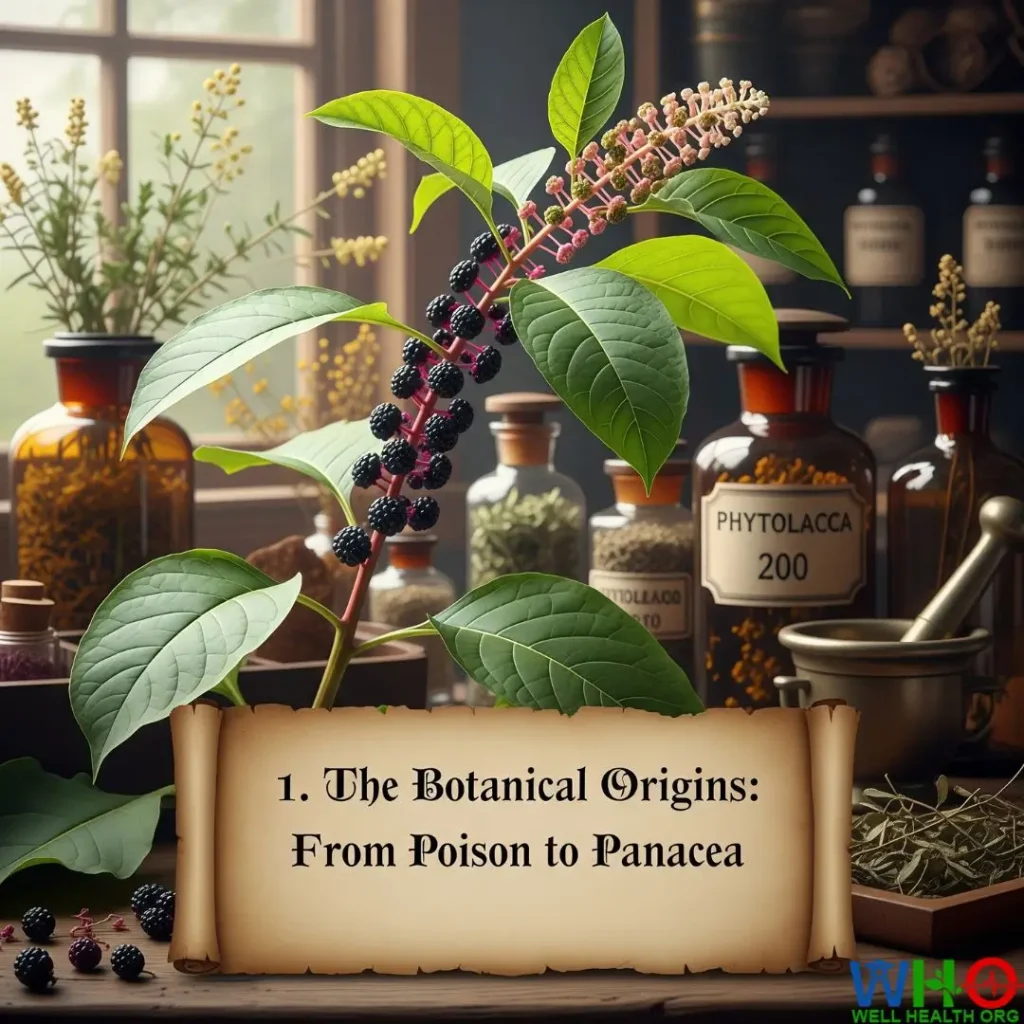
1. The Botanical Origins: From Poison to Panacea
To truly understand the power of Phytolacca 200, we must first return to the soil. The remedy is derived from the plant Phytolacca decandra, more commonly known in North America as Pokeweed, Poke Root, or Pigeon Berry.
The Paradox of Pokeweed
If you were to encounter Pokeweed in the wild, you would likely notice its striking appearance. It is a robust perennial with reddish-purple stems and long clusters of dark purple, almost black berries that droop heavily from the branches. It is indigenous to the eastern United States but can be found in various temperate zones.
Here lies the central paradox of homeopathy: The source material is often toxic.
In its raw, herbal form, the Poke plant is poisonous. The root, leaves, and berries contain chemical compounds such as saponins and the protein pokeweed mitogen. Ingestion of the raw plant can cause severe vomiting, spasms, and respiratory failure. In historical herbalism, skilled practitioners used it in minute doses as a drastic purgative or emetic, but the margin for error was slim.
The Homeopathic Transformation
Homeopathy acts on the principle of Similia Similibus Curentur—”Like Cures Like.” This means a substance that causes specific symptoms in a healthy person can cure those same symptoms in a sick person when used in a micro-dose.
The transformation from a toxic weed to a safe therapeutic agent happens through a process called Potentization.
- The Tincture: The fresh root is harvested (usually in autumn) and macerated in alcohol to create a “Mother Tincture.”
- Serial Dilution: To create a “C” potency, one drop of the tincture is mixed with 99 drops of a solvent (alcohol/water).
- Succussion: This mixture is vigorously shaken or struck against a firm surface. This step is believed to release the “energetic imprint” of the substance while shedding the material toxicity.
For Phytolacca 200, this process of 1-to-99 dilution and succussion is repeated 200 times. By the time the remedy reaches the 200C potency, not a single molecule of the original toxic alkaloid remains. What is left is the dynamic, healing energy of the plant, safe for use even in sensitive individuals when indicated.
2. The “Phytolacca Picture”: Who Needs This Remedy?
In homeopathy, we don’t just treat a disease name (like “tonsillitis”); we treat the specific manifestation of that disease in the individual. This is called the “Remedy Picture.”
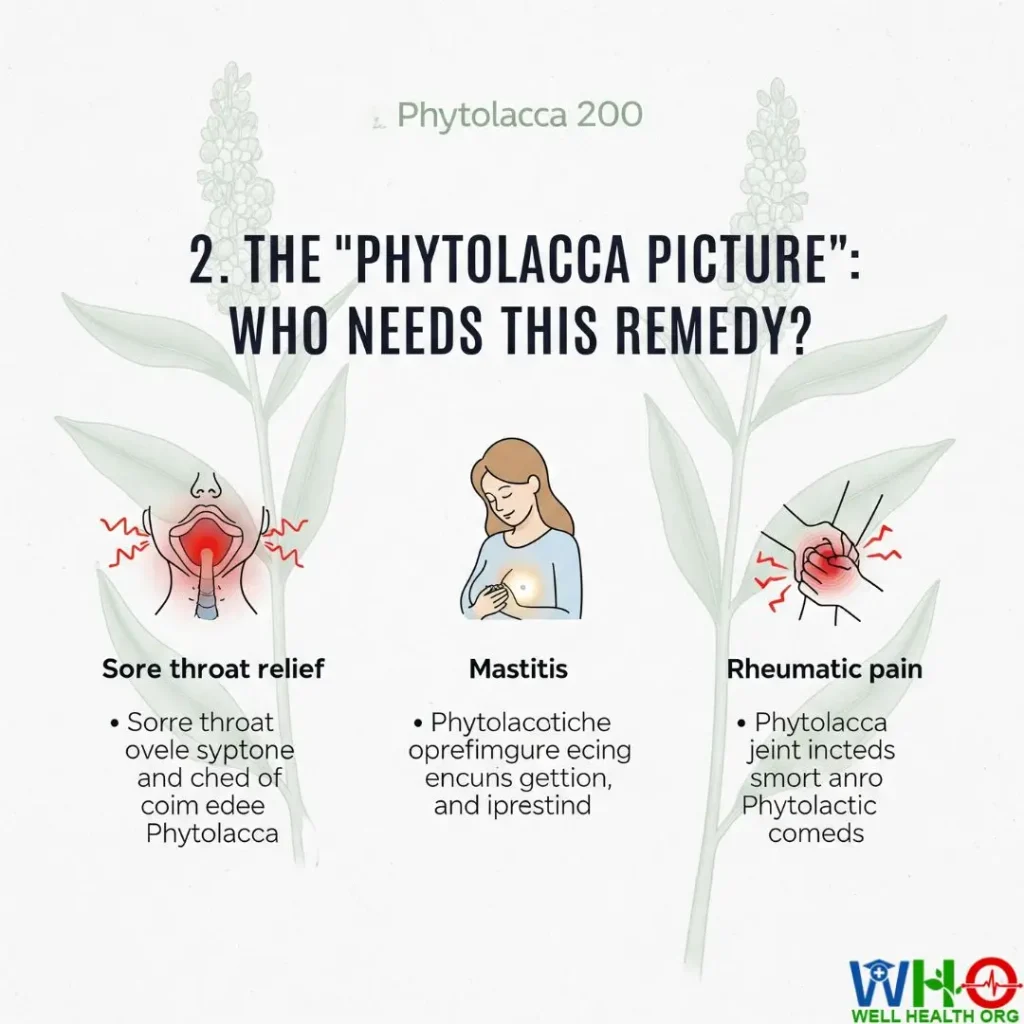
Phytolacca 200 has a very distinct personality. It is primarily a remedy for hardness, congestion, and inflammation, specifically centered around the glands, throat, and fibrous tissues.
The Center of Gravity: Glandular Affinity
If you were to summarize Phytolacca in one word, it would be “Glandular.”
This remedy has a magnetic pull toward the lymphatic system. It is indicated when glands are not just swollen, but stony hard and painful. This can apply to:
- The cervical glands (neck).
- The axillary glands (armpits).
- The mammary glands (breasts).
- The inguinal glands (groin).
When a patient presents with an infection where the lymph nodes are visibly swollen, tender to the touch, and feel like hard knots under the skin, Phytolacca is the first remedy a homeopath considers.
3. Throat Health: The Flagship Indication
While Phytolacca has many uses, it is most famous as a premier throat remedy. However, not every sore throat is a “Phytolacca throat.” Using it for the wrong type of sore throat will yield no results. You must look for specific “confirming symptoms.”

The “Dusky” Appearance
Unlike the bright, angry crimson redness seen in a Belladonna sore throat, the Phytolacca throat is dark. Upon inspection, the tonsils and the back of the throat (pharynx) appear bluish-red, purple, or dusky. This coloration indicates venous congestion—blood is stuck there and not circulating well.
The Nature of the Pain
The pain profile of Phytolacca is intense and specific:
- Root of the Tongue: The pain often feels centered at the very back of the tongue. Sticking the tongue out to show the doctor might be excruciating.
- The “Shooting” Sensation: This is a hallmark symptom. When the patient tries to swallow, sharp pains shoot from the throat directly up into the ears. If a child complains that their ears hurt every time they swallow food, think of Phytolacca immediately.
- Constriction: There is a feeling of a lump in the throat, or that the throat is too narrow to pass food.
The Temperature Modality (The Clincher)
In homeopathy, “modalities” (what makes a symptom better or worse) are key to selecting the right remedy.
- Phytolacca is Aggravated by HEAT.
Most people with sore throats want warm tea or soup. The Phytolacca patient is different. Hot drinks make the pain significantly worse. They may recoil from warm liquids. Conversely, cold drinks might offer slight relief, or at least do not aggravate the pain as much as heat does.
Summary of the Phytolacca Throat:
- Dark/bluish-red color.
- Swollen, hard tonsils.
- Pain shoots to the ears on swallowing.
- Worse with hot drinks.
4. Women’s Health: Mastitis and Breast Care
For breastfeeding mothers, Phytolacca 200 is often considered a “desert island” remedy. It is one of the most effective tools for managing Mastitis (inflammation of the breast tissue), a condition that can be debilitating and lead to early cessation of breastfeeding if not managed.

The Mastitis Profile
Mastitis usually comes on suddenly with fever, chills, and intense pain. Phytolacca is indicated when the symptoms align with the following:
- Stony Hardness: The breast feels incredibly heavy and hard, almost like a stone or a brick is inside the tissue. It is not just a soft swelling; it is rigid congestion.
- Radiating Pain: This is the key differentiator. When the baby latches on to nurse, the pain starts at the nipple and radiates outward over the whole body. The mother might feel the pain travel to her back, her armpit, or even down her arm.
- Cracks and Fissures: The nipples may be cracked, sensitive, and very sore.
- Lymphatic Involvement: As mentioned earlier, if the lymph nodes in the armpit (axilla) are swollen and tender alongside the breast pain, Phytolacca is strongly indicated.
Comparison with Other Remedies
To illustrate the specificity required:
- Bryonia: Also used for hard, painful breasts, but the Bryonia patient cannot move. Even a slight movement creates agony. They hold the breast firmly when walking.
- Phytolacca: The pain is intense, but the radiation of pain during nursing is the deciding factor.
Expert Tip: Many lactation consultants familiar with homeopathy recommend having Phytolacca 200 on hand before the baby is born, as mastitis can strike quickly in the first few weeks of nursing.
5. Musculoskeletal Health: Rheumatic and Bone Pain
Moving away from glands, Phytolacca 200 has a profound effect on the fibrous tissues and the periosteum (the thin tissue covering the bones). This makes it a valuable remedy for rheumatism, arthritis, and sciatica.

The “Electric Shock” Pains
The pain associated with this remedy is often neuralgic. Patients describe it as sudden electric shocks that come and go quickly. The pains are shifting; they may move from one joint to another or shoot down the length of a limb.
The Weather Factor
Phytolacca is a “weather remedy.” The patient is essentially a human barometer.
- Worse in Damp Cold: Cold, rainy weather is the enemy of the Phytolacca patient. A drop in temperature combined with humidity will cause their joints to ache and stiffen.
- Worse at Night: The bone pains and rheumatic stiffness are almost always exacerbated at night, leading to restlessness and an inability to find a comfortable position.
Specific Areas of Action
- Heels: Persistent pain in the heels, relieved only by elevating the feet.
- Back: Stiffness in the neck and back, particularly in the morning upon waking.
- Sciatica: Pain running down the outer side of the leg.
6. Less Common but Vital Uses
While throat, breast, and joint issues form the “triad” of Phytolacca usage, a deep study of the remedy reveals other important applications.
Oral Health and Teething
Because of its affinity for the jaw and throat, Phytolacca can be useful in difficult teething, especially when the child has an irresistible desire to bite down hard on things (similar to the remedy Podophyllum). It is also used for mouth ulcers or swollen gums where the tissue is dark red or purple.
Skin Conditions
The remedy helps the body eliminate metabolic waste. It can be useful for:
- Boils and Carbuncles: Especially those that are slow to heal and look purple or dark.
- Warts and Moles: Some homeopaths use it for warty growths, although Thuja is more commonly known for this.
- Fungal Infections: Ringworm or tinea infections that are stubborn.
Weight Management (Clarification Needed)
There is often confusion regarding Phytolacca and weight loss.
- Phytolacca Berry (The Herbal/Low Potency form): This is made from the berries specifically and is often sold as a tincture or tablet to regulate metabolism and curb appetite.
- Phytolacca 200 (The Potentized Remedy): This is generally not used for weight loss. It is used for the acute inflammatory conditions described above. Do not confuse the two. If you are seeking metabolic support, the “Berry” tincture is the traditional route, not the 200C potency.
7. Dosage and Administration: The Art of Potency
Using Phytolacca 200 requires respect. In homeopathy, “200C” is considered a medium-to-high potency. It acts deeply and swiftly. It is not a daily supplement like a vitamin.

How to Take the Remedy
Homeopathic remedies usually come in the form of small sucrose pellets or liquid drops.
- Clean Mouth: Ensure the mouth is free of strong flavors (mint toothpaste, coffee, garlic) for at least 15 minutes before and after taking the dose.
- No Touching: Try not to touch the pellets with your hands. Tip them into the cap and then directly under the tongue.
- Dissolution: Let the pellets dissolve naturally. Do not chew or swallow them whole with water.
Dosage Frequency
- For Acute Conditions (e.g., Sudden Sore Throat/Mastitis):
- Take one dose (usually 3-5 pellets).
- Wait and observe. If there is no change in 12 hours, the remedy may be incorrect.
- If there is improvement, do not repeat the dose. Let the remedy work.
- If symptoms improve but then stall or return, you may repeat the dose.
- In very intense, acute pain, a practitioner might advise taking a dose every 3-4 hours for a short period (usually no more than 3 doses total).
- For Chronic Conditions (e.g., Rheumatism):
- Phytolacca 200 is less commonly used daily for chronic issues. A lower potency (like 30C or 6C) might be used daily, or the 200C might be taken once a week. This should strictly be done under the guidance of a professional homeopath.
The “Plussing” Method
For a gentler action, especially with a 200C potency:
- Dissolve 3 pellets in half a glass of water.
- Stir vigorously.
- Take one teaspoon as a dose.
- If another dose is needed later, stir the water again before taking. This slightly alters the potency and can prevent aggravation.
8. Safety, Precautions, and The “Healing Crisis”
While homeopathic Phytolacca 200 is chemically non-toxic, it is energetically potent. Misuse can lead to unnecessary discomfort.
The Homeopathic Aggravation
Sometimes, after taking a high potency like 200C, symptoms may temporarily intensify. This is called an “aggravation” and is actually a good sign—it means the remedy has touched the root of the problem and the body is reacting.
- What to do: If symptoms worsen briefly, stop taking the remedy. The aggravation will subside, followed by improvement.
- Warning: If you keep taking the remedy during an aggravation, you may “prove” the remedy—meaning you will start developing new symptoms characteristic of Phytolacca that you didn’t have before.
When to Seek Conventional Medical Care
Homeopathy is complementary. It should not replace emergency medical care.
- Severe Mastitis: If you have a high fever, red streaks spreading on the breast, or signs of an abscess, see a doctor immediately. You may need antibiotics, and Phytolacca can be used alongside them to speed up recovery.
- Throat Infections: If throat swelling compromises breathing or if there is a peritonsillar abscess (quinsy), seek immediate emergency care.
- Pregnancy: While Phytolacca is used for post-partum issues, its use during pregnancy should be strictly monitored by a professional, as it acts on the uterus and mammary glands.
Contraindications
- Coffee and Camphor: Some homeopaths believe strong substances like coffee, camphor (found in muscle rubs), and mint can “antidote” or cancel out the effects of the remedy. It is best to avoid these during active treatment.
9. Integrating Phytolacca into a Holistic Lifestyle
To get the most out of Phytolacca 200, it helps to support the body’s healing pathways. This remedy works on the lymphatic system, so lifestyle choices that support lymph drainage are beneficial.
Hydration is Key
The lymphatic system relies on fluid to flush out toxins. When taking Phytolacca for swollen glands, increase your water intake. Warm water with lemon is excellent (unless you have the sore throat that hates heat, in which case, room temperature water is best).
Rest and Digest
Phytolacca patients are often exhausted and “bone weary.” The remedy signals the body to repair. You must honor this by resting. Pushing through the pain or fatigue will counteract the remedy’s action.
Dietary Support
During an acute phase (like tonsillitis or mastitis), avoid heavy, greasy, or sugary foods. These tax the digestive system and thicken the lymph fluid. Opt for light, nutrient-dense broths and vegetables.
10. Frequently Asked Questions (FAQ)
To further clarify the use of Phytolacca 200, here are answers to the most common questions asked by users.
Q: Can I use Phytolacca 200 for weight loss?
A: No. As clarified earlier, the Phytolacca Berry mother tincture is the form used for weight support. Phytolacca 200 is for acute inflammation, infection, and pain. Using a high potency 200C for weight loss is not effective and may cause unwanted proving symptoms.
Q: How quickly does it work for a sore throat?
A: If the remedy is the correct match (dark red throat, shooting pain to ears), you should see a shift in symptoms within 6 to 12 hours. If 24 hours pass with zero change, it is likely the wrong remedy.
Q: Can I give Phytolacca 200 to children?
A: Yes, it is safe for children when indicated. It is particularly useful for “school-age” tonsillitis or mumps. However, the dosage frequency should be conservative. Always consult a pediatrician for severe throat issues to rule out Strep throat.
Q: Is it safe to take with antibiotics?
A: Yes. Homeopathy works on the body’s vital force, while antibiotics work on the bacteria. They have different mechanisms of action and do not chemically interact. Many people find that using homeopathy alongside antibiotics helps them recover energy faster and prevents recurrence.
Q: Why does the bottle say “Poison” or have warnings if it’s safe?
A: Homeopathic labeling laws vary by country. Because the source plant (Pokeweed) is toxic, some regulations require strict labeling even though the 200C dilution contains no toxic molecules. Always buy from reputable homeopathic pharmacies that adhere to pharmacopeia standards.
Conclusion: A Powerful Ally in the Homeopathic Kit
Phytolacca 200 stands as a testament to the sophistication of homeopathic medicine. It transforms a plant that would be dangerous in the wild into a refined, elegant tool for healing. Its ability to resolve the specific agony of a “hot liquids aggravate” sore throat, the distress of mastitis, and the deep ache of damp-weather rheumatism makes it indispensable.
However, the power of Phytolacca lies in precision. It serves as a reminder that in holistic health, we must pay attention to the details—the exact sensation of pain, the color of the tissue, the time of day, and the weather outside. By observing these nuances, we move from simply suppressing symptoms to truly supporting the body’s innate wisdom.
As you incorporate this knowledge into your health routine, remember the golden rule of homeopathy: Less is often more. Respect the potency, observe your symptoms with care, and when in doubt, lean on the expertise of a qualified professional. With the right application, Phytolacca 200 can be a profound agent of relief and recovery.
Medically Reviewed by Prof. Dr. Akram
Orthopedic Surgeon | Professor | Senior Medical Specialist
Prof. Dr. Akram is a distinguished surgeon with over 15 years of clinical expertise. Having served as a lead Emergency Specialist at Complex International Government Hospital, he currently leads a specialized team of 13 medical professionals at his private hospital. As a Professor at top medical universities, he ensures that every article on WellHealthOrg.com meets rigorous clinical standards.
Medical Disclaimer:
The information provided is for educational purposes only and is not a substitute for professional medical advice, diagnosis, or treatment. Always consult your physician for any medical concerns.
Our content is rigorously fact-checked by our 13-member Editorial Team under the clinical supervision of Prof. Dr. Akram.