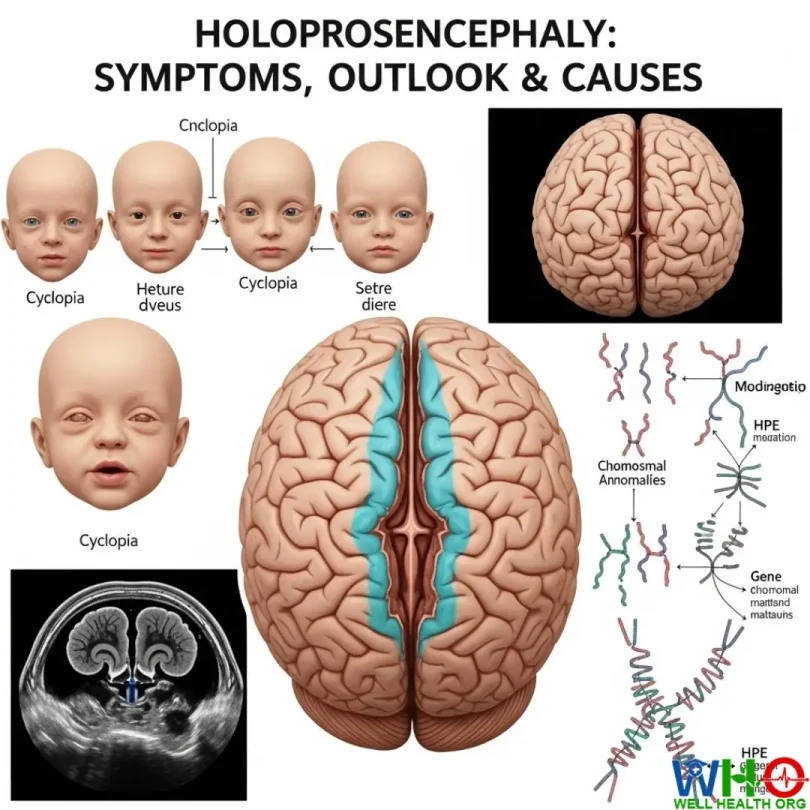
Holoprosencephaly (HPE) is a rare yet profoundly impactful congenital brain condition that occurs during the earliest stages of pregnancy. It happens when the developing brain does not properly split into two hemispheres — a critical process that normally forms the basis for normal brain function and structure. This incomplete division can cause a cascade of complications, affecting everything from neurological development to physical appearance.
- Types of Holoprosencephaly (HPE)
- 1. Alobar Holoprosencephaly – The Most Severe Form
- 2. Semilobar Holoprosencephaly – Partial Brain Division
- 3. Lobar Holoprosencephaly – The Mildest Classical Form
- 4. Middle Interhemispheric Variant (MIH) – A Rare Subtype
- Recognizing the Symptoms of Holoprosencephaly
- Understanding the Causes of Holoprosencephaly
- 1. Genetic Causes
- 2. Environmental and Maternal Factors
- How Holoprosencephaly Is Diagnosed
- 1. Prenatal Diagnosis
- 2. Postnatal Diagnosis
While the diagnosis can feel devastating for families, understanding what HPE is — including its causes, symptoms, diagnosis, and management options — can empower parents, caregivers, and medical professionals to navigate the condition with greater knowledge and hope. In this expanded and deeply researched guide, we’ll explore everything about holoprosencephaly in a clear, compassionate, and practical way.
Types of Holoprosencephaly (HPE)
Holoprosencephaly is not a one-size-fits-all condition. Instead, it is classified into four main subtypes, depending on how much the brain has separated during fetal development. The type of HPE directly influences the child’s symptoms, developmental progress, and overall prognosis.
1. Alobar Holoprosencephaly – The Most Severe Form
Alobar holoprosencephaly represents the most critical form of this disorder. In this type, the brain fails to divide at all, resulting in a single, undivided brain mass. This lack of separation disrupts the normal development of major brain structures such as the cerebral hemispheres and ventricles.
Infants born with alobar HPE often experience severe neurological impairments, facial abnormalities, and organ dysfunction. Common facial features may include a cleft lip or palate, closely spaced eyes (hypotelorism), or in extreme cases, a single central eye (cyclopia).
Tragically, this condition is usually incompatible with long-term survival. Many affected babies die in utero or shortly after birth. However, in rare cases where survival extends beyond the neonatal period, children require intensive medical care, frequent monitoring, and continuous support.
Families facing this diagnosis often experience profound emotional challenges. Early genetic counseling, palliative care, and family-centered support play an essential role in helping parents make informed decisions and cope with the realities of the condition.
2. Semilobar Holoprosencephaly – Partial Brain Division
Semilobar HPE is a less severe but still serious form of the disorder. In this subtype, the brain begins to divide but stops partway through development, resulting in a partial separation between the left and right hemispheres.
The severity of semilobar HPE varies widely. Some children may exhibit profound neurological disabilities, while others have a milder course. Common symptoms include seizures, significant developmental delays, feeding difficulties, and motor impairments.
Facial anomalies may be present but tend to be less pronounced than in alobar cases. A child might have a flattened nasal bridge, a single central upper incisor, or mild spacing differences between the eyes.
Despite the challenges, children with semilobar HPE can sometimes live beyond infancy, especially with the right medical care and therapy. Families often work closely with neurologists, physical therapists, and developmental specialists to maximize the child’s quality of life and independence.
3. Lobar Holoprosencephaly – The Mildest Classical Form
Lobar holoprosencephaly is considered the mildest traditional form. Here, the brain is mostly divided, with only a small area — usually at the front — remaining fused. Because of this, many individuals with lobar HPE have more typical facial appearances and may not be diagnosed until later in childhood.
However, even in mild cases, there are often signs of neurological dysfunction. These may include:
- Developmental delays or learning disabilities
- Coordination or balance issues
- Mild to moderate seizures
- Behavioral or social difficulties
Many children with lobar HPE can walk, talk, and attend school, though they often require specialized educational and medical support. With early interventions, including physical therapy and tailored learning plans, children can achieve meaningful developmental milestones.
The long-term outlook for lobar HPE depends largely on the extent of brain involvement and the presence of other health conditions. Regular neurological follow-up and a supportive environment greatly enhance the child’s quality of life.
4. Middle Interhemispheric Variant (MIH) – A Rare Subtype
The middle interhemispheric variant (MIH), also known as syntelencephaly, is a rare subtype of holoprosencephaly. Unlike the other forms that primarily affect the front of the brain, MIH involves improper separation of the middle parts of the cerebral hemispheres.
Children with MIH often have milder symptoms than those with alobar or semilobar HPE. They may show normal or near-normal facial structures, which sometimes leads to delayed diagnosis. However, subtle neurological issues such as mild motor dysfunction, speech delays, or learning difficulties can become more apparent as the child grows.
One notable feature in MIH is that while gross motor abilities may be relatively preserved, fine motor skills and cognitive processing can be affected. Early diagnosis through MRI and ongoing developmental evaluations can help parents and healthcare providers tailor therapy plans effectively.
Recognizing the Symptoms of Holoprosencephaly
The symptoms of holoprosencephaly can range from life-threatening to relatively subtle, depending on the form and severity. Because HPE affects how the brain develops and functions, it can impact virtually every system of the body.
Below are the most common signs and complications associated with HPE in infants and children:
- Intellectual and developmental disabilities: Nearly all children with HPE experience some degree of cognitive impairment. This can range from mild learning challenges to profound intellectual disability.
- Seizures and epilepsy: Recurrent seizures are frequent, often requiring long-term medication management.
- Motor control difficulties: Issues like spasticity (stiff muscles), dystonia (involuntary spasms), or hypotonia (weak muscle tone) are common.
- Hydrocephalus: The accumulation of cerebrospinal fluid in the brain can increase pressure and cause additional neurological damage if untreated.
- Microcephaly: A smaller-than-normal head size due to reduced brain growth.
- Feeding and swallowing difficulties: Many infants have trouble coordinating sucking and swallowing, sometimes requiring feeding tubes.
- Facial abnormalities: These may include a single front tooth, cleft lip or palate, or in very rare instances, cyclopia.
- Hormonal imbalances: The hypothalamus and pituitary gland may be affected, leading to problems such as low blood sugar (hypoglycemia), low sodium (hyponatremia), or growth hormone deficiencies.
- Vision and hearing problems: Some children experience partial blindness or hearing loss.
- Gastrointestinal and genital abnormalities: Conditions like GERD (acid reflux) and atypical genital formation are also seen in certain cases.
Because the symptoms vary so widely, no two cases of HPE are exactly the same. For this reason, individualized medical evaluation is essential. Early recognition allows families to access the right specialists and support services sooner, which can significantly improve outcomes.
Understanding the Causes of Holoprosencephaly
Holoprosencephaly is a complex condition that arises from a combination of genetic, chromosomal, and environmental factors. While scientists continue to uncover new information, the consensus is that disruptions in early brain patterning — often during the first month of pregnancy — play a key role.
1. Genetic Causes
Roughly one-third of all HPE cases are linked to genetic abnormalities, meaning the condition is rooted in changes to the chromosomes or specific genes.
One of the most common genetic causes is Trisomy 13 (Patau syndrome), where a child inherits an extra copy of chromosome 13. This chromosomal anomaly leads to widespread developmental defects, including brain malformations. Other chromosomal conditions like Trisomy 18 or structural rearrangements in chromosomes can also trigger HPE.
In addition to chromosomal abnormalities, mutations in certain genes — such as SHH (Sonic Hedgehog), ZIC2, SIX3, and TGIF1 — have been directly associated with holoprosencephaly. These genes play crucial roles in early brain and facial development, and even small disruptions can lead to major structural abnormalities.
Families with a history of HPE or unexplained miscarriages may benefit from genetic counseling and testing, which can identify mutations and provide insights into recurrence risks in future pregnancies.
2. Environmental and Maternal Factors
While genetics play a dominant role, environmental influences during pregnancy can also contribute to HPE. Factors that increase the risk include:
- Maternal diabetes: Poorly controlled blood sugar in early pregnancy significantly raises the risk of neural tube and brain malformations.
- Substance exposure: Alcohol, retinoic acid (used in some acne medications), certain anticonvulsants, and smoking have all been linked to abnormal fetal brain development.
- Infections: Certain viral infections during early pregnancy may interfere with normal brain formation.
- Nutritional deficiencies: Inadequate intake of folic acid or other essential nutrients may increase vulnerability to neural defects.
It’s important to note that many mothers who give birth to a child with HPE have no identifiable risk factors — meaning the condition often occurs sporadically, without warning or preventable cause.
How Holoprosencephaly Is Diagnosed
Diagnosing holoprosencephaly can happen before or after birth, depending on the severity of symptoms and the available medical technology.
1. Prenatal Diagnosis
Modern imaging technology allows doctors to detect HPE as early as the first or second trimester. Prenatal ultrasound can reveal key indicators such as abnormal brain structures or facial irregularities.
For a more detailed assessment, fetal MRI (magnetic resonance imaging) provides clearer visualization of the developing brain, helping to classify the type of HPE and predict potential outcomes.
If abnormalities are detected, doctors may recommend amniocentesis or chorionic villus sampling (CVS) to analyze fetal chromosomes and genes. This helps identify whether a chromosomal or genetic mutation is responsible.
2. Postnatal Diagnosis
After birth, physicians evaluate the baby’s physical features and neurological signs. Imaging studies such as MRI or CT scans confirm the diagnosis by revealing how the brain is structured.
In addition to imaging, genetic testing helps pinpoint the exact mutation or chromosomal issue involved. This not only assists in prognosis but also provides valuable information for family planning in the future.
Medically Reviewed by Prof. Dr. Akram
Orthopedic Surgeon | Professor | Senior Medical Specialist
Prof. Dr. Akram is a distinguished surgeon with over 15 years of clinical expertise. Having served as a lead Emergency Specialist at Complex International Government Hospital, he currently leads a specialized team of 13 medical professionals at his private hospital. As a Professor at top medical universities, he ensures that every article on WellHealthOrg.com meets rigorous clinical standards.
Medical Disclaimer:
The information provided is for educational purposes only and is not a substitute for professional medical advice, diagnosis, or treatment. Always consult your physician for any medical concerns.
Our content is rigorously fact-checked by our 13-member Editorial Team under the clinical supervision of Prof. Dr. Akram.