Neovascular macular degeneration, more commonly known as wet age-related macular degeneration (wet AMD or nAMD), is one of the leading causes of severe vision loss in adults over 50. Unlike its slower-progressing counterpart, dry AMD, this form is much more aggressive, resulting in sudden and significant loss of central vision. For many, the diagnosis feels overwhelming — but understanding the condition, its causes, symptoms, and treatment options is the first step toward protecting your eyesight and quality of life.
- What is Neovascular Macular Degeneration?
- Wet AMD vs. Dry AMD: Key Differences
- Dry AMD (Atrophic AMD)
- Wet AMD (Neovascular AMD)
- What Causes Wet Macular Degeneration?
- The Role of VEGF and PEDF
- Major Risk Factors for Wet AMD
- Other Contributing Factors
- Common Symptoms of Wet AMD
- Typical Symptoms Include:
- Real-Life Impact
- How is Neovascular AMD Diagnosed?
- Key Diagnostic Tools
- Treatment Options for Wet AMD
- 1. Anti-VEGF Injections: The Gold Standard
- 2. Laser Therapies
- 3. Other Medical Advances
- Living with Neovascular AMD: Practical Management Tips
- 1. Stick to Your Treatment Plan
- 2. Make Lifestyle Adjustments
- 3. Use Vision Aids
- 4. Modify Your Home for Safety and Comfort
- 5. Protect Your Eyes Outdoors
- 6. Emotional and Social Support
- Preventing Wet AMD: Can You Reduce Your Risk?
- Prevention Strategies
- Take Control of Your Eye Health
- FAQs About Neovascular Macular Degeneration
This in-depth guide explores everything you need to know about wet macular degeneration, including how it differs from dry AMD, what triggers it, how it is diagnosed, and the latest treatments that can help slow progression and preserve vision.
What is Neovascular Macular Degeneration?
Neovascular macular degeneration, or wet AMD, is a late-stage, progressive eye condition that damages the macula — the small but crucial area of the retina responsible for sharp, central vision. This is the vision you rely on for everyday tasks such as reading, driving, recognizing faces, or even threading a needle.
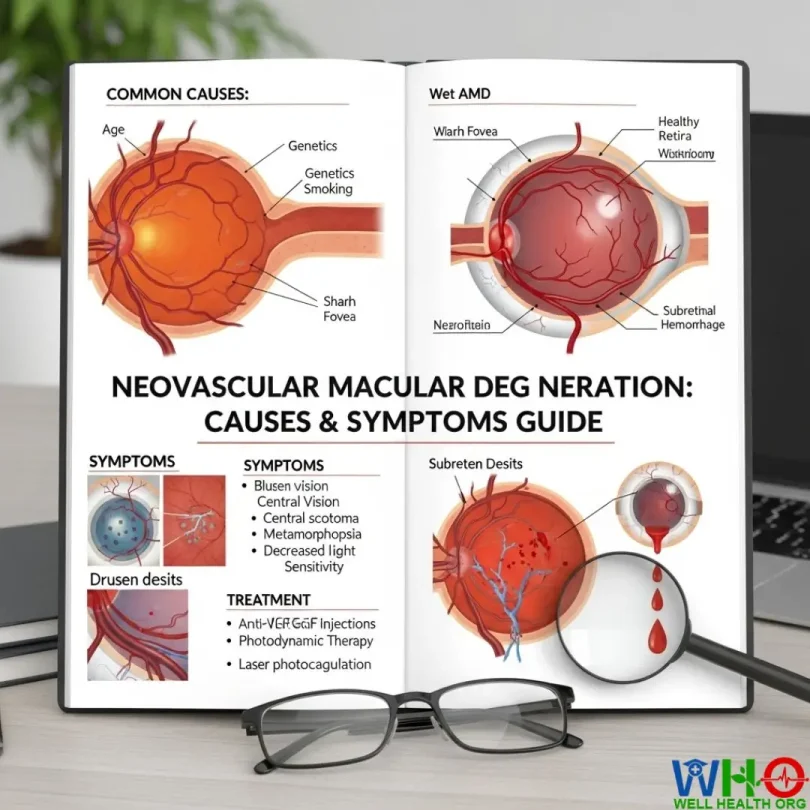
In wet AMD, abnormal blood vessels grow beneath the retina in an attempt to supply more oxygen and nutrients. This process, called neovascularization, is misguided. The new blood vessels are fragile and prone to leaking fluid and blood into the macula. The result is swelling, scarring, and a rapid deterioration of central vision.
Although wet AMD accounts for only about 10–15% of all AMD cases, it is responsible for up to 90% of cases of severe vision loss linked to macular degeneration. Without timely intervention, the damage can be permanent.
Think of the macula as the “camera sensor” of your eye. Just as scratches or smudges on a camera lens distort images, leakage and scarring in the macula blur and distort your central vision, making everyday tasks increasingly difficult.
Wet AMD vs. Dry AMD: Key Differences
Age-related macular degeneration has two distinct forms: dry AMD and wet AMD. Understanding the difference is vital for recognizing the urgency of treatment.
Dry AMD (Atrophic AMD)
- Most common form, affecting around 85–90% of people with AMD.
- Progresses slowly, often over many years.
- Caused by the thinning of the macula and the accumulation of drusen (tiny yellow deposits made up of proteins and waste products).
- Has three stages: early, intermediate, and late.
- Early stages may be symptom-free, while late stages can cause blurred central vision or small blind spots.
Wet AMD (Neovascular AMD)
- Less common but far more dangerous.
- Can develop suddenly at any stage of dry AMD.
- Defined by the abnormal growth of fragile blood vessels under the retina.
- Leads to faster, more severe central vision loss.
- Without treatment, vision loss may become permanent in weeks or months.
You can think of dry AMD as a slow erosion of vision, while wet AMD is like a sudden landslide — it can rapidly damage your sight if not treated promptly.
What Causes Wet Macular Degeneration?
The precise cause of wet AMD remains complex, but researchers agree that it is a multifactorial condition influenced by age, genetics, lifestyle, and health. At the heart of the disease lies a biological process called angiogenesis — the growth of new blood vessels.
The Role of VEGF and PEDF
- In a healthy eye, there’s a delicate balance between proteins that stimulate blood vessel growth and those that inhibit it.
- In wet AMD, the balance tips in favor of vessel growth.
- A key player is vascular endothelial growth factor (VEGF), a protein that signals the growth of new blood vessels.
- At the same time, protective proteins like pigment epithelium-derived factor (PEDF) — which normally keep vessel growth under control — may decrease.
- This imbalance leads to the formation of fragile, leaky vessels beneath the retina.
Major Risk Factors for Wet AMD
The American Academy of Ophthalmology highlights several risk factors:
- Age: The single biggest risk factor — AMD primarily affects people over 50, and risk increases significantly with age.
- Family history & genetics: If a close relative has AMD, your risk doubles. Certain genetic variations (like CFH and ARMS2 genes) further increase susceptibility.
- Race: Caucasians are more likely to develop AMD than other ethnic groups.
- Smoking: Smoking is one of the strongest modifiable risk factors — it can double your risk of AMD.
- Diet: Diets high in saturated fats and low in antioxidants can fuel the disease.
- Obesity: Excess weight is linked to progression from early to late AMD.
- Hypertension: Poorly controlled blood pressure damages retinal blood vessels.
Other Contributing Factors
- UV exposure: Prolonged sun exposure without eye protection may increase risk.
- Gender: Women appear to be at slightly higher risk, possibly due to longevity.
- Cardiovascular health: Poor circulation and cholesterol issues may contribute to disease progression.
In short: wet AMD isn’t caused by a single factor but rather a combination of age, environment, and genetics.
Common Symptoms of Wet AMD
Wet AMD often strikes suddenly and worsens quickly. Because it damages the macula, symptoms primarily affect central vision, not peripheral vision. This means you may still see from the corners of your eyes but struggle to focus straight ahead.
Typical Symptoms Include:
- Distorted Vision (Metamorphopsia): Straight lines appear bent, wavy, or crooked — for example, doorframes may look warped.
- Blurry Central Vision: A fuzzy or cloudy area may appear in the center of your sight.
- Blank Spots (Scotomas): Dark or empty patches obscure the central field of vision.
- Dull or Faded Colors: Colors may look less bright and vibrant.
- Difficulty Seeing in Low Light: Tasks like reading at dusk or driving at night become harder.
- Rapid Vision Changes: Unlike dry AMD, which progresses slowly, wet AMD can worsen in weeks.
Real-Life Impact
- Reading a book may feel like words are missing in the middle.
- Recognizing a loved one’s face becomes difficult.
- Driving becomes unsafe because traffic lights and road signs blur or disappear.
If any of these symptoms appear, it’s crucial to seek immediate medical attention. Early diagnosis and treatment can mean the difference between retaining usable vision and permanent central blindness.
How is Neovascular AMD Diagnosed?
An accurate and early diagnosis is critical for managing wet AMD effectively. Eye doctors use a variety of specialized tests to detect the condition and evaluate its severity.
Key Diagnostic Tools
- Comprehensive Eye Exam
- Your ophthalmologist will begin with a dilated eye exam to check for drusen, pigment changes, and retinal abnormalities.
- Amsler Grid Test
- A simple but effective test where you focus on a grid of straight lines. If any appear wavy, distorted, or missing, it may signal wet AMD.
- Fundus Photography
- High-resolution images of the retina reveal structural changes, drusen, and possible bleeding.
- Optical Coherence Tomography (OCT)
- Uses light waves to capture detailed, cross-sectional images of the retina. This allows doctors to spot fluid buildup, swelling, and thinning in the macula.
- Fluorescein Angiography
- A fluorescent dye is injected into the bloodstream, and as it circulates, photographs are taken of the retina to highlight any leaky vessels.
- Indocyanine Green Angiography (ICG)(sometimes used)
- Similar to fluorescein angiography but better for viewing deeper choroidal vessels.
These tests not only confirm the diagnosis but also guide treatment planning and help monitor the disease over time.
Treatment Options for Wet AMD
Although there is no permanent cure for wet macular degeneration, modern medicine offers effective treatments that can slow the disease, stabilize vision, and in some cases, even improve eyesight. Early and consistent treatment is key to preventing irreversible damage.
1. Anti-VEGF Injections: The Gold Standard
- Anti-VEGF medications directly target the vascular endothelial growth factor (VEGF) protein, which drives abnormal blood vessel growth.
- By blocking VEGF, these injections:
- Reduce leakage and swelling.
- Prevent new abnormal vessel growth.
- Help maintain or even restore vision.
- Commonly used drugs include:
- Ranibizumab (Lucentis)
- Aflibercept (Eylea)
- Bevacizumab (Avastin) (off-label use but widely adopted due to lower cost)
- Brolucizumab (Beovu)
- Injections are typically given every 4–8 weeks, although some patients transition to longer intervals once their condition stabilizes.
Patient insight: Many people are understandably anxious about injections into the eye. However, the procedure is quick, done under local anesthesia, and most patients describe it as uncomfortable but not painful.
2. Laser Therapies
Before the advent of anti-VEGF drugs, laser treatments were more common. Today, they are used in select cases.
- Photodynamic Therapy (PDT):
- A light-sensitive drug is injected into a vein in the arm.
- The drug collects in the abnormal eye vessels.
- A low-power laser activates the drug, closing off leaky vessels without harming surrounding tissue.
- Laser Photocoagulation:
- A high-energy laser burns and seals the abnormal blood vessels.
- Effective but risky — it can cause a permanent blind spot, so it’s reserved for specific cases where vessels are not directly beneath the central macula.
3. Other Medical Advances
- Dual-Action Medications:
- In 2022, the FDA approved Faricimab (Vabysmo), which targets both VEGF and Ang-2, another protein involved in vessel instability.
- Early results suggest longer-lasting effects, meaning fewer injections may be needed.
- Corticosteroids:
- Sometimes used in combination therapies to reduce inflammation in the retina.
- Gene Therapy (Experimental):
- Researchers are investigating methods to encourage the retina to produce its own anti-VEGF proteins, potentially reducing or eliminating the need for frequent injections.
- Sustained-Release Implants:
- Tiny implants that continuously release anti-VEGF drugs, reducing the frequency of office visits.
Living with Neovascular AMD: Practical Management Tips
Being diagnosed with wet AMD doesn’t mean losing all vision or independence. With the right treatment plan, lifestyle changes, and vision aids, many patients continue to live full, active lives.
1. Stick to Your Treatment Plan
- Consistency is everything — missing appointments can accelerate vision loss.
- Even if vision stabilizes, ongoing monitoring and injections may be necessary to keep the disease under control.
2. Make Lifestyle Adjustments
- Healthy diet: Incorporate leafy greens, fish rich in omega-3s, nuts, and foods high in antioxidants. The AREDS2 supplement formula (vitamins C, E, lutein, zeaxanthin, zinc, and copper) has been shown to reduce the risk of AMD progression.
- Exercise regularly: Supports cardiovascular health and blood flow to the eyes.
- Control blood pressure and cholesterol: Helps protect retinal blood vessels.
- Quit smoking immediately: Smoking is the most significant modifiable risk factor.
3. Use Vision Aids
- Magnifiers and digital readers: Helpful for reading books, menus, or medication labels.
- High-contrast settings: Many smartphones and computers offer accessibility features for low-vision users.
- Improved lighting: Brighter, glare-free lighting makes daily tasks easier.
4. Modify Your Home for Safety and Comfort
- Increase brightness in hallways and staircases.
- Reduce clutter to minimize fall risks.
- Use bold colors or contrasting tape on steps and doorframes to improve visibility.
5. Protect Your Eyes Outdoors
- Wear sunglasses with UV protection to reduce cumulative sun damage.
- Wide-brimmed hats provide extra shielding.
6. Emotional and Social Support
Vision changes can be emotionally challenging. Many patients experience frustration, anxiety, or depression.
- Joining a support group (in-person or online) helps connect with others facing similar challenges.
- Discussing mental health with your doctor ensures a holistic approach to care.
Preventing Wet AMD: Can You Reduce Your Risk?
While age and genetics cannot be controlled, several lifestyle habits can significantly lower your risk of developing wet AMD or slow its progression.
Prevention Strategies
- Stop smoking: The most impactful prevention step.
- Eat an eye-healthy diet: Rich in leafy greens, fruits, nuts, and omega-3 fatty acids.
- Take AREDS2 supplements if recommended by your doctor.
- Exercise regularly: Supports heart and eye health.
- Manage chronic conditions: Keep blood pressure, cholesterol, and diabetes under control.
- Wear UV-protective eyewear: Shields eyes from harmful rays.
- Schedule regular eye exams: Especially after age 50 or with a family history of AMD.
Early detection remains your best defense against vision loss. Many patients diagnosed early can continue living independently for years with proper management.
Take Control of Your Eye Health
Neovascular macular degeneration is a serious but manageable condition. While it cannot be cured, advances in treatment — especially anti-VEGF injections — mean that many patients retain useful vision for decades after diagnosis.
The key is awareness and action:
- Recognize symptoms early.
- Seek prompt medical care.
- Commit to regular treatment and healthy lifestyle habits.
Your vision is one of your most precious senses — protect it by making eye health a priority.
FAQs About Neovascular Macular Degeneration
1. Is wet AMD curable?
No, there is currently no cure. However, treatments like anti-VEGF injections can control the disease and prevent further vision loss.
2. Can wet AMD lead to complete blindness?
Wet AMD primarily affects central vision. Peripheral vision usually remains intact, meaning total blindness is rare.
3. How long do anti-VEGF injections work?
Most patients need injections every 4–8 weeks, but newer drugs and implants may extend treatment intervals.
4. Are there natural remedies for wet AMD?
There’s no natural cure, but a diet rich in leafy greens, fish, and antioxidants — along with AREDS2 supplements — supports retinal health.
5. Should I still get eye exams if I have no symptoms?
Yes. AMD can develop silently, especially in the early stages. Regular eye exams are vital for detection and prevention.
Medically Reviewed by Prof. Dr. Akram
Orthopedic Surgeon | Professor | Senior Medical Specialist
Prof. Dr. Akram is a distinguished surgeon with over 15 years of clinical expertise. Having served as a lead Emergency Specialist at Complex International Government Hospital, he currently leads a specialized team of 13 medical professionals at his private hospital. As a Professor at top medical universities, he ensures that every article on WellHealthOrg.com meets rigorous clinical standards.
Medical Disclaimer:
The information provided is for educational purposes only and is not a substitute for professional medical advice, diagnosis, or treatment. Always consult your physician for any medical concerns.
Our content is rigorously fact-checked by our 13-member Editorial Team under the clinical supervision of Prof. Dr. Akram.