
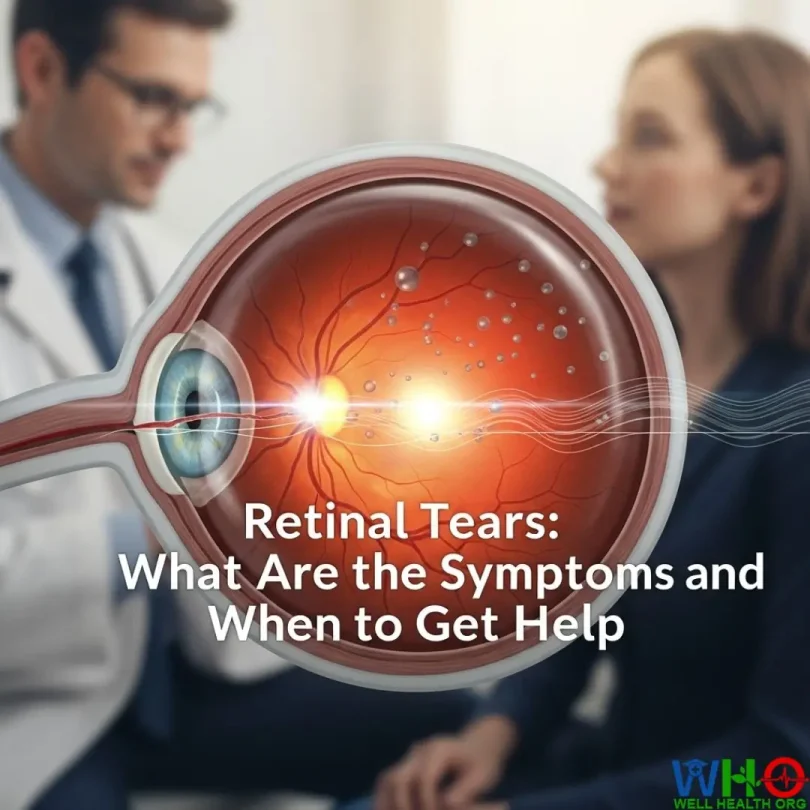
Retinal Tears
Imagine looking at a bright blue sky and suddenly seeing tiny black dots drifting across your vision—or perhaps flashes of light flickering at the edge of your sight like a strobe. It’s easy to dismiss these as harmless eye floaters or momentary flashes, but in some cases, these are red flags of a serious condition known as a retinal tear.
- What Is a Retinal Tear?
- Key Facts About Retinal Tears
- Understanding the Retina and the Vitreous: A Delicate Relationship
- Common Symptoms of a Retinal Tear
- 1. Sudden Appearance or Increase in Eye Floaters
- 2. Bright Flashes of Light (Photopsia)
- 3. Shadow or Curtain Across Vision
- 4. Blurred or Distorted Vision
- Who Is Most at Risk for Retinal Tears?
- 1. Age (40 and Older)
- 2. Nearsightedness (Myopia)
- 3. Previous Eye Surgery
- 4. Eye Trauma or Injury
- 5. Family History
- 6. Previous Retinal Tear or Detachment
- When to Seek Medical Help
- Emergency Response Tip
- How Retinal Tears Are Diagnosed
- 1. Dilated Eye Exam
- 2. Optical Coherence Tomography (OCT)
- 3. Fundus Photography
- 4. Ultrasound Imaging
- Treatment Options for Retinal Tears
- 1. Laser Photocoagulation
- 2. Cryopexy (Freezing Treatment)
- 3. Vitrectomy (For Complex Cases)
- Floaters and Flashes: What’s Normal vs. What’s Not
- Prevention and Long-Term Eye Care
- 1. Schedule Regular Eye Exams
- 2. Protect Your Eyes
- 3. Monitor Vision Changes
- 4. Follow Post-Surgery Guidelines
- 5. Manage Overall Health
- Protecting Your Vision for Life
- Frequently Asked Questions (FAQs)
A retinal tear isn’t just another eye irritation. It’s a small rip or hole in the retina, the delicate layer of tissue at the back of your eye responsible for turning light into visual images. Left untreated, it can quickly progress to retinal detachment, which can cause permanent vision loss. The good news? With early detection and prompt treatment, vision can often be preserved.
In this comprehensive guide, you’ll learn what retinal tears are, what causes them, how to recognize their symptoms, and—most importantly—when to seek medical help. We’ll also explore prevention strategies and long-term care tips to protect your vision for life.
What Is a Retinal Tear?
To understand a retinal tear, let’s start with the retina itself. The retina is a thin, light-sensitive membrane that lines the back wall of your eye. It acts like the film in a camera or the sensor in a digital camera, capturing light and sending visual signals to the brain through the optic nerve. Every image you see—every color, shape, and detail—relies on the retina functioning properly.
A retinal tear occurs when this delicate tissue develops a small break, hole, or rip. This opening allows vitreous fluid—the clear, gel-like substance filling the center of the eye—to seep behind the retina. Once fluid begins to accumulate, it can separate the retina from its underlying tissue, leading to retinal detachment, a sight-threatening emergency.
Retinal tears usually occur as a result of vitreous changes due to aging. The vitreous gel naturally shrinks and becomes more liquid over time, a process known as posterior vitreous detachment (PVD). In most cases, this separation is harmless. But sometimes, as the vitreous pulls away, it tugs too strongly on the retina, causing it to tear.
Key Facts About Retinal Tears
- They’re more common after age 50.
- A tear can occur suddenly, without pain.
- If untreated, it can lead to retinal detachment within days or even hours.
- Immediate treatment often prevents vision loss.
Understanding the Retina and the Vitreous: A Delicate Relationship
Think of your eye as a water balloon: the outer wall represents the eye’s structure, while the retina is like thin wallpaper lining the inside. The vitreous gel helps maintain the eye’s round shape and supports the retina by keeping it gently pressed against the back wall.
With age, the vitreous begins to liquefy and shrink, pulling away from the retina in spots. When this process happens unevenly, the retina can stretch and tear at points of strong attachment. In some cases, this traction can also cause small blood vessels to rupture, leaking blood into the vitreous and producing a sudden increase in floaters.
This process is a normal part of aging, but in certain individuals—especially those with nearsightedness, previous eye surgeries, or trauma—the retina may be more fragile and prone to tears.
Common Symptoms of a Retinal Tear
Retinal tears don’t cause pain, which makes them especially dangerous. Many people dismiss early symptoms as minor annoyances, but recognizing them promptly can save your sight. Below are the key warning signs.
1. Sudden Appearance or Increase in Eye Floaters
Floaters are tiny, shadowy specks that drift across your vision. They often look like small dots, cobwebs, or thread-like strands moving with your eye’s movement.
In most cases, floaters are harmless and result from age-related vitreous changes. However, if you suddenly notice a dramatic increase in the number or size of floaters, it may indicate that the retina has torn and that blood or pigment cells have leaked into the vitreous cavity.
You may notice:
- Dozens of new black or gray specks.
- Larger clumps or streaks floating across your vision.
- Floaters that appear after a mild flash or blur of light.
If this occurs suddenly—especially in one eye—it’s a sign to seek immediate evaluation.
2. Bright Flashes of Light (Photopsia)
Flashes of light in your peripheral vision, especially in dim lighting, are another classic symptom. These are caused by mechanical stimulation of the retina—essentially, the vitreous tugging on retinal tissue.
People describe these flashes as:
- Lightning streaks in the corner of the eye.
- Spark-like bursts.
- Quick flashes that appear when moving the eyes.
Flashes may come and go, but persistent or worsening photopsia is a red flag. It’s one of the earliest signs of retinal traction and possible tearing.
3. Shadow or Curtain Across Vision
Perhaps the most alarming symptom is when part of your vision suddenly becomes obscured by a dark curtain or shadow. This typically indicates that the retina has started to detach.
You might experience:
- A gray or black area in your peripheral vision.
- A dark “veil” that moves across your sight.
- Gradual narrowing of your visual field.
This symptom is an emergency. If you notice it, contact an eye doctor or go to the emergency room immediately—each hour matters in saving your vision.
4. Blurred or Distorted Vision
Some retinal tears cause mild blurriness or distortion before more severe symptoms appear. Straight lines may appear bent or wavy, or reading may feel more difficult in one eye. This occurs because light is no longer reaching the retina evenly.
Who Is Most at Risk for Retinal Tears?
Anyone can experience a retinal tear, but certain factors significantly increase your risk. Recognizing them can help you stay proactive about eye health.
1. Age (40 and Older)
After 40, the vitreous gel naturally begins to shrink and liquefy. The risk peaks between ages 50 and 70, coinciding with an increased likelihood of posterior vitreous detachment.
2. Nearsightedness (Myopia)
People with moderate to severe myopia have longer eyeballs, stretching and thinning the retina. This makes it more susceptible to tearing, even from mild traction or impact.
3. Previous Eye Surgery
Eye surgeries like cataract removal can increase the risk of retinal tears, particularly during the healing period. The change in the eye’s internal structure can cause stress on the retina.
4. Eye Trauma or Injury
Any blunt force to the head or eye—from sports, accidents, or falls—can cause vitreous traction, sometimes leading to tears immediately or weeks later.
5. Family History
Genetics can play a role. If a parent or sibling has experienced retinal detachment or tears, your own risk may be higher.
6. Previous Retinal Tear or Detachment
If one eye has suffered a retinal tear, the other eye may face a higher risk. Regular follow-ups with your ophthalmologist are crucial in such cases.
When to Seek Medical Help
A retinal tear is a medical emergency—and timing is everything. If you experience any of the following, don’t wait for symptoms to improve:
- A sudden shower of new floaters.
- Persistent flashes of light.
- A dark curtain or shadow across part of your vision.
- Rapidly worsening blurred or distorted vision.
Even if symptoms seem mild, they can progress quickly. Early treatment often prevents retinal detachment, which requires much more complex surgery and carries a higher risk of vision loss.
Emergency Response Tip
If your vision changes suddenly and you can’t reach your eye doctor, go to the nearest emergency room or an urgent ophthalmology clinic. Bring a list of medications and details about any previous eye surgeries or conditions—this helps speed up diagnosis.
How Retinal Tears Are Diagnosed
When you see an ophthalmologist for possible retinal issues, you’ll undergo a comprehensive examination. Early and accurate diagnosis ensures proper treatment before detachment occurs.
1. Dilated Eye Exam
Eye drops are used to widen your pupils so the doctor can see the retina more clearly. Using specialized lenses and bright light, they examine the entire back portion of the eye to check for tears, holes, or detachment.
2. Optical Coherence Tomography (OCT)
This advanced imaging technique captures cross-sectional images of your retina, revealing even tiny tears or fluid buildup beneath the tissue.
3. Fundus Photography
High-resolution retinal photographs document the exact location and size of any tear, serving as a reference for treatment and monitoring.
4. Ultrasound Imaging
If the view of the retina is obscured by bleeding or cloudiness, an ocular ultrasound can provide a detailed picture of the retinal structure.
These diagnostic tools help ophthalmologists determine whether immediate treatment is needed or if careful monitoring is sufficient.
Treatment Options for Retinal Tears
Prompt treatment can often seal a retinal tear before detachment occurs. Most procedures are quick, minimally invasive, and performed in the doctor’s office under local anesthesia.
1. Laser Photocoagulation
This is the most common treatment. A focused laser beam creates tiny burns around the tear’s edges, forming scar tissue that seals the retina in place.
- Procedure time: 15–30 minutes.
- Recovery: Minimal discomfort; normal activities resume within 24–48 hours.
- Success rate: Over 90% when done early.
2. Cryopexy (Freezing Treatment)
Instead of heat, cryopexy uses a freezing probe applied to the outer surface of the eye. This creates a controlled freeze that forms a scar, sealing the retinal tear.
- Best for: Tears located farther from the central retina.
- Effectiveness: Similar to laser treatment with slightly longer recovery.
3. Vitrectomy (For Complex Cases)
If the vitreous is pulling strongly on the retina, a vitrectomy may be required. This surgical procedure removes the vitreous gel and replaces it with a saline solution, relieving traction and reducing future risk.
Aftercare Tip:
After treatment, you may need to avoid strenuous activity for several days. Follow-up visits ensure the retina remains attached and healing is complete.
Floaters and Flashes: What’s Normal vs. What’s Not
Not every floater or flash means a retinal tear—but sudden changes should never be ignored.
Normal floaters:
- Develop gradually with age.
- Are few in number.
- Move slowly and consistently with eye movement.
Concerning floaters:
- Appear suddenly, in clusters or large numbers.
- Are accompanied by flashes or blurriness.
- Seem dense, dark, or cobweb-like.
If in doubt, get checked. Many people wait, assuming it’s temporary, only to find out later that the retina detached. Early detection saves sight.
Prevention and Long-Term Eye Care
While not all retinal tears are preventable, proactive eye care dramatically reduces your risk of serious complications.
1. Schedule Regular Eye Exams
Adults should have comprehensive eye exams every 1–2 years, or more frequently if they have risk factors like myopia, diabetes, or a family history of retinal issues.
2. Protect Your Eyes
Wear protective eyewear during sports, home repairs, or any activity that could result in blunt trauma to the head or eyes.
3. Monitor Vision Changes
Pay attention to new floaters, flashes, or visual shadows. The sooner you report changes, the faster treatment can be administered.
4. Follow Post-Surgery Guidelines
If you’ve had eye surgery, adhere to all recovery instructions. Avoid heavy lifting, strenuous exercise, or bending over excessively during the healing period.
5. Manage Overall Health
Conditions like diabetes and hypertension can damage blood vessels in the retina. Managing these through diet, exercise, and medication helps protect long-term vision.
Protecting Your Vision for Life
Retinal tears may sound frightening, but they’re highly treatable when caught early. Your vision is precious—acting quickly at the first sign of trouble can make the difference between a simple outpatient laser treatment and irreversible blindness.
If you’re over 40 or have known risk factors like nearsightedness or prior eye surgery, stay proactive. Schedule annual eye exams, monitor for changes, and seek emergency care for sudden floaters, flashes, or shadows.
Your eyes are irreplaceable—treat them with the urgency they deserve.
Frequently Asked Questions (FAQs)
1. Can a retinal tear heal on its own?
No. Retinal tears don’t heal without treatment. They must be sealed with a laser or freezing therapy to prevent detachment.
2. How fast can a retinal tear lead to detachment?
Sometimes within hours or days. Early treatment is crucial to preserving sight.
3. Do retinal tears cause permanent vision loss?
Not if treated promptly. However, untreated tears that progress to detachment can lead to permanent damage.
4. Can you get a retinal tear in both eyes?
Yes. People who have a tear or detachment in one eye are at higher risk in the other and should have regular check-ups.
5. Is laser treatment for retinal tears painful?
Most patients report mild discomfort or pressure during the procedure, but it’s quick and performed under local anesthesia.
Medically Reviewed by Prof. Dr. Akram
Orthopedic Surgeon | Professor | Senior Medical Specialist
Prof. Dr. Akram is a distinguished surgeon with over 15 years of clinical expertise. Having served as a lead Emergency Specialist at Complex International Government Hospital, he currently leads a specialized team of 13 medical professionals at his private hospital. As a Professor at top medical universities, he ensures that every article on WellHealthOrg.com meets rigorous clinical standards.
Medical Disclaimer:
The information provided is for educational purposes only and is not a substitute for professional medical advice, diagnosis, or treatment. Always consult your physician for any medical concerns.
Our content is rigorously fact-checked by our 13-member Editorial Team under the clinical supervision of Prof. Dr. Akram.







