In our modern, fast-paced world, the onset of a fever often triggers immediate anxiety. The moment the forehead feels hot or the thermometer creeps above 37°C (98.6°F), the instinct is usually to reach for the nearest bottle of paracetamol or ibuprofen to force the temperature down. We have been conditioned to view fever as an enemy—a malfunction of the body that needs to be “fixed” immediately so we can get back to work or school.
- The Ayurvedic Philosophy: Why We Get Fevers
- The Role of Agni and Ama
- Fever as a Friend
- Decoding Your Fever: The Three Doshas
- 1. Vata Fever (The Shivering Fever)
- 2. Pitta Fever (The High-Heat Fever)
- 3. Kapha Fever (The Congested Fever)
- The Golden Rule: “Langhana” (Therapeutic Fasting)
- The Protocol:
- Nature’s Pharmacy: Key Ayurvedic Herbs for Fever
- 1. Tulsi (Holy Basil): The Queen of Herbs
- 2. Guduchi (Giloy): The Amrita (Nectar)
- 3. Ginger (Adrak/Shunti): The Universal Medicine
- 4. Coriander (Dhania): The Coolant
- 5. Mahasudarshan Churna: The Fever Destroyer
- Practical Home Remedies & External Therapies
- 1. The “Cold” Compress (But Not Too Cold!)
- 2. Onion Poultice for High Fever
- 3. Spiced Steam Inhalation
- Detailed Dietary Guide: What to Eat and Avoid
- The “Yes” List (Pathya)
- The “No” List (Apathya)
- Real-Life Application: Case Studies
- Scenario A: The “Burnout” Fever (Vata)
- Scenario B: The “Summer” Fever (Pitta)
- Lifestyle Adjustments for Faster Recovery
- 1. Vishrama (Total Rest)
- 2. Protecting the Recovery Phase
- 3. Purification of the Environment
- Safety First: When to See a Doctor
- Conclusion: Empowering Your Inner Healer
- Frequently Asked Questions (FAQ)
However, the ancient wisdom of Ayurveda offers a radically different perspective. In this holistic system of medicine, which has flourished for over 5,000 years, a fever is not an error; it is a sophisticated, intelligent response. It is a sign that your body’s inner army is mobilizing.
In Ayurveda, fever is known as “Jwara.” It is considered the “king of diseases,” not because it is the most dangerous, but because it is the most fundamental expression of the body attempting to burn away impurities. When you suppress a fever too quickly without understanding its cause, you may be stopping the body’s cleaning process midway, leading to chronic issues later.
This comprehensive guide will take you deep into the world of Ayurvedic medicine for fever. We will move beyond simple home remedies and explore the root causes of Jwara, how to identify your specific fever type based on your body constitution (Dosha), and how to use food, herbs, and lifestyle changes to support your recovery. By the end of this article, you will have a complete toolkit to navigate fever with confidence, working with your body rather than against it.
The Ayurvedic Philosophy: Why We Get Fevers
To treat a fever naturally, we must first understand the mechanism behind it. In Western medicine, we look at bacteria and viruses. Ayurveda acknowledges these external invaders but focuses more on the internal environment that allowed the invasion to happen in the first place.

The Role of Agni and Ama
Central to Ayurvedic health is the concept of Agni (digestive fire). Imagine Agni as a campfire in your stomach. When it burns bright and hot, it cooks your food perfectly, absorbs nutrients, and keeps you energized.
However, when our lifestyle is poor—eating processed foods, eating at irregular times, stress, or lack of sleep—this fire dims. Food is not digested properly and turns into a sticky, toxic sludge called Ama.
Ama is the root of almost all disease in Ayurveda. It clogs the channels of the body (lymph, blood, digestion). When Ama accumulates to a tipping point, the body realizes it is toxic. It reacts by displacing the internal heat (Agni) from the digestive tract and spreading it to the skin and muscles to “cook off” the toxins. This is Jwara (Fever).
Therefore, the goal of Ayurvedic fever treatment is not to simply lower the temperature. The goal is to:
- Digest the Ama (burn up the toxins).
- Restore Agni (fix the digestion).
- Clear the Channels (sweat it out).
Fever as a Friend
When you view fever through this lens, you realize that the heat is the solution, not the problem. The rising temperature is the body’s way of creating an inhospitable environment for bacteria and viruses while simultaneously liquefying the sticky Ama so it can be expelled.
Decoding Your Fever: The Three Doshas
Ayurveda categorizes everyone and everything into three energies or “Doshas”: Vata (Air/Ether), Pitta (Fire/Water), and Kapha (Earth/Water).
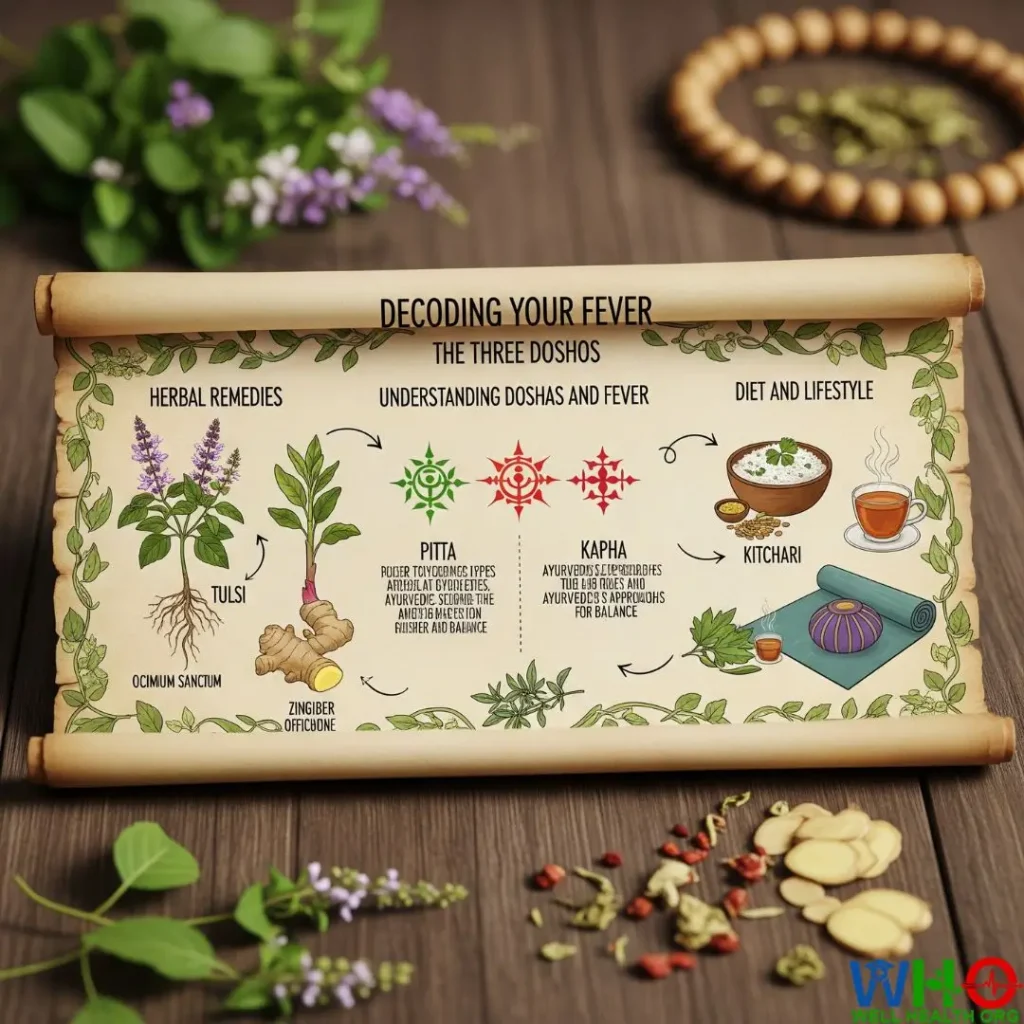
Fevers manifest differently depending on which Dosha is aggravated. Identifying the type of fever you have is crucial because a remedy that works for a fiery Pitta fever might make a cold Vata fever worse.
1. Vata Fever (The Shivering Fever)
This type of fever is usually brought on by exposure to cold wind, anxiety, exhaustion, or irregular eating.
- Symptoms: You don’t just feel hot; you feel wildly fluctuating symptoms. The fever might spike and drop unpredictably. You experience intense shivering, body aches, joint pain, and a stiff feeling. Your skin feels dry and rough. Emotionally, you may feel anxious or restless.
- The Sensation: A “cold” fever. You want to be buried under heavy blankets.
- What it needs: Warmth, grounding, and hydration.
2. Pitta Fever (The High-Heat Fever)
Pitta is composed of fire. When this energy flares up—often due to eating spicy foods, exposure to extreme heat, or anger—the fever is intense.
- Symptoms: High temperature (often above 102°F/39°C), burning sensation in the eyes, hands, and feet. You may have a flushed red face, intense thirst, and sweat that smells strong. Emotionally, you may feel irritable or even delirious.
- The Sensation: A “hot” fever. You can’t stand heavy blankets and crave cold air.
- What it needs: Cooling measures (without freezing the body) and bitter herbs.
3. Kapha Fever (The Congested Fever)
Kapha is heavy and wet. These fevers are common in spring or after eating too much heavy, sweet, or oily food.
- Symptoms: The temperature is usually low-grade (around 99°F-100°F) but lingers for a long time. It is accompanied by heaviness, excessive sleepiness, a coating of white mucus on the tongue, a runny nose, and a chesty cough. You might not feel hungry at all.
- The Sensation: A “heavy” fever. You feel like you are moving through mud.
- What it needs: Stimulation, drying herbs, and lightness.
The Golden Rule: “Langhana” (Therapeutic Fasting)
Before we touch a single herb, we must address the most important aspect of treating Jwara: Diet.

In many cultures, there is a saying, “Feed a cold, starve a fever.” Ayurveda agrees with the latter part. When you have a fever, your Agni (digestive fire) has migrated to the surface of your body to fight the infection. This means there is no fire left in the stomach to digest food.
If you eat a heavy meal (like a burger, cheese, or even bread) during a fever, it sits in your stomach, rots, creates more Ama (toxins), and fuels the fever further.
The Protocol:
- Stop Solid Foods: At the first sign of fever, stop eating solid, heavy foods.
- Sip Warm Water: Drink hot or warm water frequently. This helps dissolve the Ama.
- The “Kanji” Diet: If you are hungry, do not eat solids. Instead, consume “Kanji” (Rice Water).
- Why? It provides energy (carbohydrates) but requires almost zero digestion.
- Recipe: Boil 1 part rice in 14 parts water. Cook it until the rice is completely mushed and the water is thick. Strain and drink the liquid. You can add a pinch of rock salt and ginger.
Nature’s Pharmacy: Key Ayurvedic Herbs for Fever
Once you have stopped adding fuel to the fire (by fasting), you can use herbal allies to help the body fight the battle. Here is a deep dive into the most potent botanicals.

1. Tulsi (Holy Basil): The Queen of Herbs
Tulsi is worshipped in India not just for its spiritual significance but for its medical potency. It is a diaphoretic, meaning it induces sweating, which brings the temperature down naturally.
- Why it works: It is an adaptogen (helps the body handle stress) and has strong antiviral properties. It is specifically excellent for Kapha and Vata fevers where there is respiratory involvement.
- The Remedy:
- Take 10-12 fresh Tulsi leaves (or 1 tsp dried).
- Boil in 2 cups of water with 1 teaspoon of grated ginger.
- Boil until reduced to 1 cup.
- Add a teaspoon of honey (only once the tea is lukewarm, never hot).
- Dosage: Drink warm every 3-4 hours.
2. Guduchi (Giloy): The Amrita (Nectar)
If there is one herb you should know for fever, it is Guduchi (Tinospora cordifolia). In Ayurveda, it is legendary for its ability to treat chronic, lingering fevers (like those seen in dengue or mononucleosis).
- Why it works: Unlike aspirin, which just lowers heat, Guduchi is an immunomodulator. It increases the killing ability of your white blood cells. It is “Tridoshic,” meaning it is safe for Vata, Pitta, and Kapha fevers.
- The Remedy:
- Guduchi stems are best, but powder is widely available.
- Boil 1 tsp of Guduchi powder in water until reduced by half.
- Drink this bitter decoction twice a day.
- Pro Tip: If the fever is high (Pitta), take Guduchi with rock sugar. If it is a cold fever (Vata/Kapha), take it with honey.
3. Ginger (Adrak/Shunti): The Universal Medicine
Ginger is known as Vishwabhesaj (universal medicine). It rekindles the digestive fire (Agni) and burns up toxins (Ama).
- Why it works: It contains gingerols that reduce inflammation. It is vital for Vata (shivering) and Kapha (congestion) fevers.
- The Remedy (Agni Tea):
- Mix 1 tsp fresh ginger juice with 1 tsp lemon juice and 1 tsp honey.
- Lick this mixture off a spoon 3 times a day.
- Caution: Use cautiously in high-grade Pitta fevers (high burning heat) as ginger is hot in nature.
4. Coriander (Dhania): The Coolant
For a high Pitta fever where the person feels like they are burning up and is very thirsty, Ginger and Tulsi might be too heating. Enter Coriander.
- Why it works: Coriander seeds are cooling and diuretic. They help flush the urinary tract (where heat often accumulates) and reduce internal burning.
- The Remedy (Coriander Water):
- Crush 1 tablespoon of coriander seeds lightly.
- Soak them in a glass of water overnight (or boil for instant use).
- Strain and drink the water throughout the day.
- This is incredibly soothing for fevers accompanied by urinary burning or acidity.
5. Mahasudarshan Churna: The Fever Destroyer
This is not a single herb but a classical Ayurvedic formula containing over 50 bitter herbs (including Neem and Turmeric). It is the heavy artillery for fevers that won’t go away.
- Usage: It is extremely bitter. It is usually taken as a teaspoon of powder with warm water. It directly fights viral and bacterial pathogens and breaks the cycle of recurrent fevers.
Practical Home Remedies & External Therapies
Sometimes, we need to treat the body from the outside in. Here are practical therapies you can apply at home.

1. The “Cold” Compress (But Not Too Cold!)
For a high fever, we instinctively want to put ice on the head. Ayurveda advises against ice because extreme cold can shock the system and trap heat inside (vasoconstriction).
- The Ayurvedic Way: Use room temperature water or rose water.
- Method: Dip a clean cotton cloth in cool water mixed with a few drops of rose water or sandalwood oil. Place it on the forehead. The evaporation pulls heat out gently. This is specifically for Pitta fevers.
2. Onion Poultice for High Fever
This is an old folk remedy backed by Ayurvedic principles. Onions are known to draw out heat.
- Method: Slice raw onions and place them on the soles of the feet. Put on socks to hold them in place. Leave for 30 minutes. It sounds strange, but many parents swear by this for bringing down stubborn temperatures in children.
3. Spiced Steam Inhalation
For Kapha fevers with congestion and sinus pressure:
- Method: Boil a pot of water. Add eucalyptus oil or a pinch of turmeric and Ajwain (carom seeds). Cover your head with a towel and inhale the steam. This liquefies the mucus and opens the channels, allowing the heat to release.
Detailed Dietary Guide: What to Eat and Avoid
Recovery is 70% diet. As mentioned, digestion is weak, so we must be gentle.
The “Yes” List (Pathya)
- Liquids: Warm water, ginger water, coriander water.
- Fruits: Only if stewed/cooked. For example, a stewed apple with clove is easy to digest. Avoid raw fruits as they ferment.
- Grains: Old rice (aged rice is easier to digest), puffed rice, or barley water.
- Vegetables: Boiled pumpkin, zucchini, bottle gourd, and carrots.
- Spices: Cumin, black pepper, turmeric, cinnamon (these are medicines, not just flavor).
The “No” List (Apathya)
- Dairy: No milk (it causes mucus), no yogurt (it blocks channels), no cheese. The only exception is Golden Milk (turmeric milk) during the recovery phase, not the acute phase.
- Heavy Proteins: No meat, fish, or eggs. They are too hard to digest.
- Bakery Items: Bread, biscuits, and pastries clog the system with Ama.
- Cold Items: Ice cream, soda, or cold water are strictly forbidden. They instantly put out the digestive fire.
Real-Life Application: Case Studies
To help you visualize how to apply this, let’s look at two common scenarios.
Scenario A: The “Burnout” Fever (Vata)
- The Person: Sarah, a 35-year-old accountant. She has been sleeping 5 hours a night and drinking 4 coffees a day.
- The Symptoms: She wakes up shivering, body aching, temperature 100°F. She feels anxious.
- Ayurvedic Approach:
- Diet: Warm vegetable broth and rice kanji.
- Herbs: Ginger and Tulsi tea with honey to warm her up.
- Lifestyle: She needs to be buried in blankets to sweat. No screens/phone (rest the Vata mind).
- Outcome: The warmth balances the Vata coldness. She sweats out the fever in 24 hours.
Scenario B: The “Summer” Fever (Pitta)
- The Person: Mike, a 28-year-old athlete. He played soccer in the noon sun and ate a spicy meal afterward.
- The Symptoms: High fever (103°F), red face, angry, very thirsty.
- Ayurvedic Approach:
- Diet: Cool liquids. Coriander water and coconut water.
- Herbs: Guduchi and Sandalwood. NO Ginger (it’s too hot).
- Lifestyle: Cold compress on the forehead with rose water. Light cotton clothes.
- Outcome: The cooling therapies reduce the Pitta heat without suppressing the immune response.
Lifestyle Adjustments for Faster Recovery
Taking herbs while watching stressful news or working from your laptop will negate the benefits.
1. Vishrama (Total Rest)
In Ayurveda, rest is a therapy. It doesn’t mean lying in bed scrolling through social media. It means “Sense Withdrawal.” Dim the lights, turn off the Wi-Fi, and sleep. This directs all your Prana (life force) toward the immune system.
2. Protecting the Recovery Phase
A common mistake is returning to normal life the second the temperature drops. This leads to a “relapse fever” (Punaraavartaka Jwara).
- The Rule: Continue the light diet (soups/rice) for 2 days after the fever is gone. Your digestive fire is like a flickering candle; if you dump a steak on it too soon, it will go out.
3. Purification of the Environment
Burn dried Neem leaves or Sage in the room. This acts as a natural fumigation to kill airborne pathogens and cleanse the energy of the sick room.
Safety First: When to See a Doctor
While Ayurveda is powerful, it is also responsible. There are times when home remedies must be secondary to emergency medical intervention.
Seek immediate medical help if:
- High Fever: The temperature exceeds 103°F (39.4°C) in adults or 102°F in children.
- Duration: The fever persists for more than 3 days despite home remedies.
- Red Flag Symptoms:
- Severe stiff neck (could indicate meningitis).
- Difficulty breathing or severe chest pain.
- Confusion, hallucinations, or seizures.
- Severe dehydration (sunken eyes, no urine output).
- Vulnerable Groups: Infants under 3 months, pregnant women, and the elderly with chronic conditions should always consult a doctor first.
Note: Ayurvedic herbs can generally be taken alongside modern fever medication (like paracetamol), but always consult your healthcare provider to ensure there are no interactions.
Conclusion: Empowering Your Inner Healer
Ayurveda teaches us that the body is not a machine that breaks down and needs a mechanic. It is a garden that needs tending. A fever is simply the body’s way of weeding the garden—burning away the overgrowth of toxins and restoring balance.
By choosing Ayurvedic medicine for fever, you are making a conscious choice to support this natural process. Instead of suppressing the symptoms and forcing the toxins deeper into your tissues, you are helping the body expel them.
Whether you brew a cup of spicy Ginger tea for a shivering cold, apply a soothing Sandalwood compress for a raging heat, or simply respect your body enough to fast and rest, you are engaging in a profound act of self-healing.
Next time the temperature rises, don’t panic. Remember that you have thousands of years of wisdom in your kitchen cabinet. Breathe, hydrate, and let the fire of Jwara cleanse you.
Frequently Asked Questions (FAQ)
Q: Can I take a shower when I have a fever?
A: Ayurveda generally advises against cold showers during a fever as it can shock the body and drive the heat deeper internally. A sponge bath with lukewarm water is safer. If you must bathe, use warm water and dry yourself immediately and thoroughly.
Q: Is milk good for a fever?
A: No. Regular milk is heavy and mucus-forming, which creates more Ama (toxins). However, during the recovery phase (after the fever breaks), warm milk boiled with turmeric and black pepper can be restorative.
Q: Why do I feel cold when I have a fever?
A: This is usually a Vata-type symptom. Even though your internal temperature is high, the circulation to the skin is constricted to conserve heat, making you feel cold. This indicates you need to cover up and sip warm ginger tea.
Q: How long should I continue the diet after the fever is gone?
A: It is best to maintain a light diet (avoiding heavy oils, meats, and processed foods) for at least 48 hours after your temperature returns to normal. This gives your digestive fire (Agni) time to return to full strength.
Q: Can I use honey in hot tea?
A: In Ayurveda, honey should never be cooked or added to boiling hot liquids, as it is believed to become toxic and clog channels. Always wait for your tea to cool down to a lukewarm temperature before stirring in honey.
Medically Reviewed by Prof. Dr. Akram
Orthopedic Surgeon | Professor | Senior Medical Specialist
Prof. Dr. Akram is a distinguished surgeon with over 15 years of clinical expertise. Having served as a lead Emergency Specialist at Complex International Government Hospital, he currently leads a specialized team of 13 medical professionals at his private hospital. As a Professor at top medical universities, he ensures that every article on WellHealthOrg.com meets rigorous clinical standards.
Medical Disclaimer:
The information provided is for educational purposes only and is not a substitute for professional medical advice, diagnosis, or treatment. Always consult your physician for any medical concerns.
Our content is rigorously fact-checked by our 13-member Editorial Team under the clinical supervision of Prof. Dr. Akram.