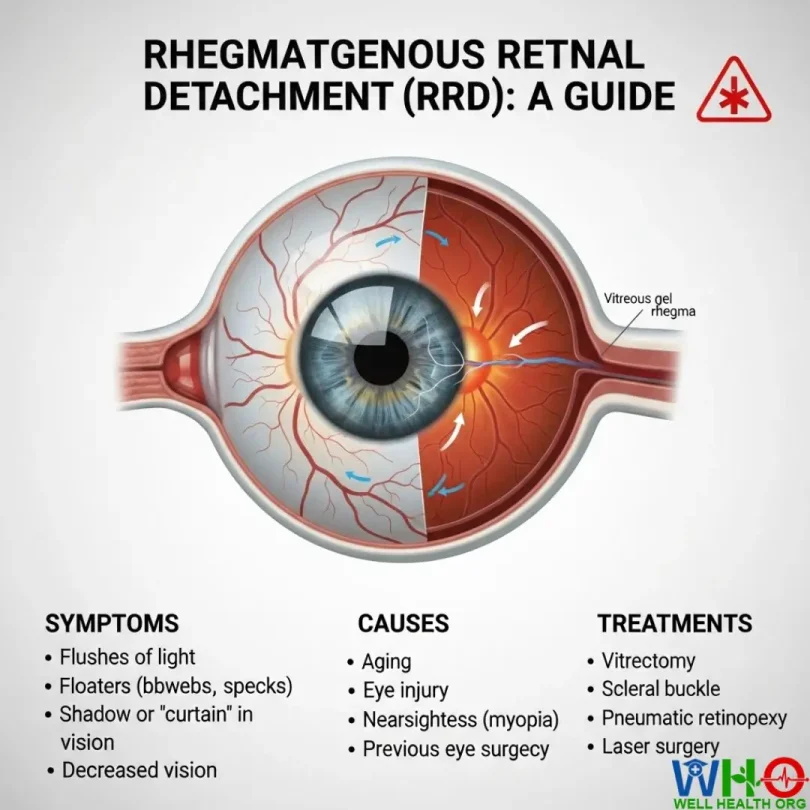
Understanding Rhegmatogenous Retinal Detachment (RRD)
Imagine waking up one morning and suddenly noticing flashes of light, strange floating spots, or a dark shadow creeping across your vision. These unsettling visual changes can sometimes signal a condition called rhegmatogenous retinal detachment (RRD) — one of the most urgent eye emergencies.
- Understanding Rhegmatogenous Retinal Detachment (RRD)
- The Retina’s Role in Vision — Why It’s So Vital
- Causes and Risk Factors of Rhegmatogenous Retinal Detachment
- 1. Age-Related Vitreous Changes
- 2. High Myopia (Severe Nearsightedness)
- 3. Eye Trauma
- 4. Previous Eye Surgeries
- 5. Family History and Genetic Factors
- 6. Previous Retinal Problems or Eye Diseases
- Recognizing the Early Warning Signs of RRD
- 1. New or Sudden Increase in Floaters
- 2. Flashes of Light (Photopsia)
- 3. A Dark Shadow or “Curtain” Over Vision
- 4. Blurred or Distorted Vision
- 5. Loss of Peripheral (Side) Vision
- A Real-Life Example
- Diagnosis: How Ophthalmologists Detect RRD
- 1. Dilated Eye Exam
- 2. Optical Coherence Tomography (OCT)
- 3. Ultrasound (B-Scan) Imaging
- 4. Visual Acuity and Peripheral Vision Tests
- 5. Identifying Retinal Tears or Weak Spots
- Treatment Options for Rhegmatogenous Retinal Detachment
- 1. Pneumatic Retinopexy
- 2. Scleral Buckling
- 3. Vitrectomy
- Success Rates and Outcomes
- What to Expect During and After RRD Surgery
- Before Surgery
- During Surgery
- After Surgery
- Long-Term Vision Recovery
- Potential Risks and Complications of RRD Surgery
- 1. Recurrent Retinal Detachment
- 2. Cataract Formation
- 3. Infection (Endophthalmitis)
- 4. Increased Eye Pressure (Glaucoma)
- 5. Scar Tissue or Macular Distortion
- 6. Vision Fluctuations or Blurriness
- Recovery and Rehabilitation After Retinal Detachment Surgery
- Immediate Postoperative Phase (First Few Weeks)
- Intermediate Phase (Weeks 3–8)
- Long-Term Recovery (Months 2–6 and Beyond)
- Practical Self-Care Tips for a Smooth Recovery
- 1. Follow Post-Op Instructions Religiously
- 2. Protect Your Eyes
- 3. Manage Pain and Discomfort
- 4. Maintain a Healthy Lifestyle
- 5. Avoid Eye Strain
- 6. Attend All Follow-Up Appointments
- Preventing Rhegmatogenous Retinal Detachment
- 1. Regular Comprehensive Eye Exams
- 2. Manage Eye Conditions Proactively
- 3. Protect Your Eyes from Trauma
- 4. Be Aware of Symptoms
- 5. Monitor the Other Eye
- Living with Retinal Detachment: Adjusting to Vision Changes
- 1. Vision Rehabilitation Therapy
- 2. Emotional Adjustment
- 3. Adapting Your Environment
- 4. Returning to Work and Activities
- Long-Term Outlook: What to Expect After RRD Surgery
- Expert Q&A: Insights from Leading Ophthalmologists
- Q1. How fast do I need to act if I suspect a retinal detachment?
- Q2. Can retinal detachment happen again after surgery?
- Q3. Will my vision return to normal after surgery?
- Q4. Are there any restrictions after retinal detachment surgery?
- Q5. How can I protect my eyes after surgery and in the future?
- Making an Informed Decision About Your Eye Health
- Conclusion: Protecting Your Vision Starts with Awareness
- Frequently Asked Questions (FAQs)
- 1. What’s the difference between rhegmatogenous, tractional, and exudative retinal detachment?
- 2. Can retinal detachment cause total blindness?
- 3. What is the recovery time after retinal detachment surgery?
- 4. Are floaters always a sign of retinal detachment?
- 5. Will I need surgery again in the future?
- Final Thoughts
RRD occurs when the retina, a thin layer of tissue that lines the back of your eye, separates from the underlying layer of blood vessels that supply it with oxygen and nutrients. This layer acts like the film in a camera — capturing light and sending signals to your brain to create the images you see. When it detaches, your vision can quickly become blurry, shadowed, or distorted.
The term “rhegmatogenous” comes from the Greek word “rhegma”, meaning “tear.” It refers to a retinal detachment that begins with a tear or hole in the retina. Once that tear forms, the vitreous humor — the clear, gel-like substance that fills your eyeball — can leak through the opening and accumulate behind the retina. As fluid builds up, it gently peels the retina away from the back of the eye, much like wallpaper bubbling away from a damp wall.
If left untreated, this separation can lead to irreversible vision loss or blindness. That’s why RRD is considered a medical emergency requiring immediate attention from an ophthalmologist. The sooner the retina is repaired, the better the chance of restoring your vision.
The Retina’s Role in Vision — Why It’s So Vital
To understand why RRD is so dangerous, it helps to know how essential the retina is for vision.
The retina contains millions of photoreceptor cells — rods and cones — that capture light and convert it into electrical impulses. These signals travel through the optic nerve to the brain, where they’re processed into the images you see.
The retina also has a crucial area called the macula, responsible for sharp central vision. This is what allows you to read, drive, or recognize faces. If the macula detaches, it can severely affect your ability to see fine details — even after successful surgery.
Think of the retina as the “sensor” of your eye’s camera. If it’s damaged or disconnected from its power source (the blood supply), the camera can no longer produce a clear image. That’s why time is of the essence when RRD symptoms appear. Every minute counts toward saving sight.
Causes and Risk Factors of Rhegmatogenous Retinal Detachment
While RRD can happen suddenly, it often develops from gradual changes inside the eye. Understanding the causes and risk factors can help you recognize early warning signs and seek timely care.
1. Age-Related Vitreous Changes
As we age, the vitreous gel inside our eye naturally begins to shrink and liquefy — a process known as posterior vitreous detachment (PVD). When this happens, the vitreous can pull away from the retina. In most people, this separation occurs harmlessly. But in some, the tugging creates a small retinal tear that can progress to detachment.
Most cases of RRD occur in people over 50 years old, though it can happen earlier, especially if other risk factors are present.
2. High Myopia (Severe Nearsightedness)
People with severe myopia are at a significantly higher risk. Nearsighted individuals have longer eyeballs, which stretch and thin the retina over time. This makes it more fragile and prone to tearing. Studies show that myopic patients are 6 to 10 times more likely to develop RRD compared to those with normal vision.
3. Eye Trauma
A strong blow to the eye or head — such as from sports injuries, car accidents, or falls — can cause a retinal tear or even a full detachment. In fact, trauma-related RRD can occur days or even weeks after an injury, which is why any eye trauma should be promptly examined by an ophthalmologist.
4. Previous Eye Surgeries
Surgeries like cataract removal, especially in patients with pre-existing retinal thinning, can slightly increase the risk of retinal detachment. Although modern cataract surgery is very safe, it changes the internal structure of the eye and may accelerate vitreous changes.
5. Family History and Genetic Factors
If retinal detachment runs in your family, your risk may be higher due to inherited conditions like lattice degeneration, a type of retinal thinning that can make tears more likely. Genetic predispositions such as Stickler syndrome or Marfan syndrome can also weaken the retina.
6. Previous Retinal Problems or Eye Diseases
Conditions like retinal lattice degeneration, diabetic retinopathy, or viral retinitis can create weak areas in the retina that are more likely to tear. Even if you’ve had a retinal tear repaired in one eye, your other eye remains at increased risk, so regular follow-up exams are essential.
Recognizing the Early Warning Signs of RRD
Rhegmatogenous retinal detachment often begins with subtle, painless symptoms. Because the retina doesn’t contain pain receptors, you won’t feel discomfort — but you’ll notice visual changes that appear suddenly and progress quickly.
Here are the key symptoms to watch for:
1. New or Sudden Increase in Floaters
Floaters are small specks, lines, or cobweb-like shadows drifting across your field of vision. They’re usually harmless, caused by natural age-related changes in the vitreous. However, a sudden surge in floaters — especially accompanied by light flashes — can signal a retinal tear. These floaters may look like black dots, smoke, or hair strands.
2. Flashes of Light (Photopsia)
Flashes of light, often described as “seeing stars” or brief lightning streaks, occur when the vitreous tugs on the retina. This traction stimulates the light-sensitive cells, creating the illusion of flashes. Persistent flashes, especially in one eye, are a red flag that needs immediate medical attention.
3. A Dark Shadow or “Curtain” Over Vision
One of the most serious symptoms is a dark shadow — often compared to a curtain or veil — that begins at the edge of your vision and slowly moves toward the center. This indicates that the retina is detaching. The direction of the shadow (top, bottom, or side) depends on the part of the retina affected.
4. Blurred or Distorted Vision
As the retina detaches, your vision may become blurry or distorted, especially in the affected area. Straight lines may appear bent or wavy. If the macula detaches, your central vision will rapidly worsen — a medical emergency that needs same-day treatment.
5. Loss of Peripheral (Side) Vision
RRD often starts at the outer edges of the retina, so the first vision loss occurs in your peripheral field. It might feel like part of your visual world has dimmed or disappeared. Left untreated, the detachment can spread inward and lead to total blindness.
A Real-Life Example
Consider a 57-year-old woman named Linda. One afternoon, she noticed a few new floaters and bright flashes in her right eye. She assumed it was fatigue. But by evening, she saw a dark gray shadow blocking part of her side vision. Alarmed, she visited an emergency eye clinic — where doctors diagnosed rhegmatogenous retinal detachment. Because she acted quickly, surgeons were able to repair her retina successfully. Today, her vision is almost completely restored.
Linda’s story highlights an essential truth: never ignore sudden vision changes. Early detection and swift treatment can make the difference between recovery and permanent vision loss.
Diagnosis: How Ophthalmologists Detect RRD
When you visit an eye doctor with symptoms of flashes or floaters, they will conduct a comprehensive eye examination to look for tears, holes, or detachment. Prompt diagnosis is crucial to prevent further vision loss.
Here’s what typically happens during an RRD evaluation:
1. Dilated Eye Exam
The doctor will place dilating eye drops to widen your pupils, allowing a clearer view of the retina. Using a specialized microscope called an ophthalmoscope, they’ll carefully inspect for retinal tears or detached areas.
2. Optical Coherence Tomography (OCT)
OCT is a noninvasive imaging technique that captures detailed cross-sectional images of your retina using light waves. It helps the doctor see whether fluid has accumulated under the retina and the extent of any separation.
3. Ultrasound (B-Scan) Imaging
If the view of your retina is obscured by bleeding or cloudiness, your ophthalmologist may perform a B-scan ultrasound. This painless test uses sound waves to create an image of the retina and confirm a detachment.
4. Visual Acuity and Peripheral Vision Tests
You’ll also undergo tests to measure how well you see in the center and at the edges of your vision. These help the doctor evaluate how much of your sight has been affected and guide treatment planning.
5. Identifying Retinal Tears or Weak Spots
Even if the retina hasn’t fully detached, doctors will check for retinal holes, lattice degeneration, or thinning areas that could lead to future tears. These can often be treated immediately with laser photocoagulation or cryotherapy to prevent a full detachment.
“The earlier we diagnose a retinal tear, the easier it is to treat,” explains Dr. Michael Chen, a vitreoretinal surgeon. “In many cases, sealing a small tear early can prevent the retina from detaching entirely — saving the patient from major surgery.”
Treatment Options for Rhegmatogenous Retinal Detachment
Once diagnosed, rhegmatogenous retinal detachment (RRD) requires urgent medical treatment. Unlike minor eye conditions that can be monitored or managed with medication, RRD is a surgical emergency. The goal is simple yet vital — reattach the retina to the back of the eye and seal any tears that caused the detachment.
Several surgical options are available, each tailored to the location, severity, and cause of the detachment. The right procedure depends on the shape and position of the tear, the presence of scar tissue, and the patient’s overall eye health.
Let’s explore the three most common surgical treatments for RRD and what to expect from each.
1. Pneumatic Retinopexy
Overview:
This minimally invasive procedure is often used for smaller, uncomplicated retinal detachments. The surgeon injects a small gas bubble into the vitreous cavity inside the eye. The bubble rises and gently presses the detached retina back against the eye wall, closing the retinal tear.
Once the retina is properly repositioned, the surgeon uses laser photocoagulation or cryopexy (a freezing probe) to seal the retinal tear. This creates scar tissue that prevents fluid from leaking underneath the retina again.
Recovery:
Patients must maintain a specific head position — often face-down — for several days to keep the gas bubble in the correct place. Over time, the gas is absorbed naturally, and the eye refills with its own fluid.
Pros:
- Minimally invasive
- Quick recovery (often performed in-office)
- High success rate for selected cases
Cons:
- Only suitable for certain types of retinal tears
- Requires strict compliance with head positioning
- Flying or high-altitude travel is prohibited until the gas bubble disappears
2. Scleral Buckling
Overview:
Scleral buckling is one of the oldest and most time-tested methods for treating RRD. The surgeon places a soft silicone band around the outer layer of the eye (the sclera). This band gently indents the wall of the eye inward, reducing traction on the retina and allowing it to reattach.
The buckle also brings the eye wall closer to the detached retina, enabling the tear to seal. It’s often combined with laser treatment or cryotherapy to strengthen the reattachment.
Recovery:
You may notice temporary double vision or mild discomfort after the surgery. The silicone band usually stays in place permanently, but you won’t feel it once healing is complete.
Pros:
- Proven long-term success
- Suitable for more complex or multiple retinal tears
- Often used for younger patients or traumatic detachments
Cons:
- More invasive than pneumatic retinopexy
- Slight change in eye shape may affect prescription
- Longer recovery time
3. Vitrectomy
Overview:
Vitrectomy is a modern microsurgical procedure used for complex or severe retinal detachments, especially those involving scar tissue or bleeding inside the eye. The surgeon removes the vitreous gel that’s pulling on the retina and replaces it with a clear saline solution, gas, or silicone oil.
Next, the retinal tear is sealed with a laser or freezing probe, and the new internal fluid (gas or oil) keeps the retina in place while it heals.
Recovery:
After surgery, you may need to maintain a specific head position (often face-down) for several days. If silicone oil is used, it may be removed in a later procedure once healing is complete.
Pros:
- Ideal for complex or recurrent detachments
- Can address internal bleeding and scar tissue
- High anatomical success rate
Cons:
- Requires operating room and anesthesia
- Longer recovery and vision stabilization time
- Possible need for additional procedures
Success Rates and Outcomes
The good news is that modern surgical techniques for RRD have high success rates. Studies indicate that approximately 85–90% of patients achieve successful retinal reattachment after the first surgery. If a second procedure is needed, success rates rise to over 95%.
However, visual recovery depends largely on whether the macula (the central part of the retina) was detached before surgery. If the macula remained intact, patients often regain excellent vision. If it was detached, some visual distortion or blurriness may persist — though prompt treatment greatly improves outcomes.
What to Expect During and After RRD Surgery
Undergoing eye surgery can sound intimidating, but understanding what happens before, during, and after the procedure can make the process less stressful. Let’s break down the typical patient journey.
Before Surgery
Before your operation, your ophthalmologist will:
- Review your medical history, medications, and allergies.
- Perform a comprehensive eye examination and discuss which surgical method suits your condition.
- Give you detailed instructions, such as avoiding food or drink for several hours before the procedure.
You’ll also be informed about post-operative positioning requirements, activity restrictions, and follow-up visits. Having a friend or family member accompany you is essential since you won’t be able to drive afterward.
During Surgery
RRD surgery is typically performed under local or general anesthesia. Depending on the type of surgery:
- Pneumatic retinopexy may take less than 30 minutes and can sometimes be done in the office.
- Vitrectomy or scleral buckle procedures are done in a surgical suite and can last from 1 to 2 hours.
The surgeon will carefully manipulate delicate structures within the eye using high-magnification microscopes and precision instruments. You’ll feel no pain during the procedure, though you may be aware of light or movement.
After Surgery
Immediately following surgery, your eye will be covered with a protective patch or shield. You might experience mild discomfort, tearing, or a gritty sensation — this is normal. Eye drops will be prescribed to reduce inflammation and prevent infection.
If a gas bubble was used:
- You must avoid flying or scuba diving until it’s fully absorbed.
- Maintain the head position your doctor recommends — often face-down for several days to weeks.
- Avoid sleeping flat on your back, as it can shift the bubble away from the retina.
Vision may appear blurry or wavy initially, but improvement typically begins within a few weeks. Your doctor will schedule follow-up visits to monitor healing and ensure the retina remains attached.
Long-Term Vision Recovery
Healing after RRD surgery is gradual. While the retina reattaches fairly quickly, full visual recovery may take several months. The degree of improvement depends on several factors, including:
- The location and size of the detachment
- Whether the macula was involved
- The speed of surgical intervention
- Your overall eye health
Some patients notice near-complete restoration of sight, while others may have mild distortions or a permanent blind spot. Still, timely surgery dramatically increases the odds of preserving functional vision.
Potential Risks and Complications of RRD Surgery
Like any surgery, retinal detachment repair carries potential risks. Fortunately, serious complications are rare, and most patients recover without significant problems. However, being informed helps you recognize warning signs early.
Here are the most common risks and how they’re managed:
1. Recurrent Retinal Detachment
In about 5–10% of cases, the retina may detach again — usually due to new tears or scar tissue formation (known as proliferative vitreoretinopathy or PVR). If this happens, another surgery may be required. Regular follow-up visits help catch these issues before they progress.
2. Cataract Formation
Particularly after vitrectomy, cataracts (clouding of the eye’s lens) can develop over time. Many patients eventually undergo cataract surgery, often resulting in clearer vision.
3. Infection (Endophthalmitis)
Though rare, infection inside the eye can occur. Symptoms include severe pain, redness, or sudden vision loss. Immediate medical attention is essential if these appear.
4. Increased Eye Pressure (Glaucoma)
Some patients experience temporary or persistent elevated intraocular pressure following surgery. This can usually be managed with medicated eye drops or laser treatment.
5. Scar Tissue or Macular Distortion
Scar tissue may cause minor visual distortions or wavy vision, especially if the macula was involved. Vision therapy and adaptation techniques can help the brain adjust over time.
6. Vision Fluctuations or Blurriness
It’s normal for vision to fluctuate during healing. You may notice changes in clarity or color perception as your eye stabilizes. These typically improve gradually over several months.
“While risks exist, modern retinal surgery is highly refined,” says Dr. Susan Lee, a retinal specialist. “The benefits of timely intervention — preserving or restoring sight — far outweigh the potential complications. Early action remains the key to success.”
Recovery and Rehabilitation After Retinal Detachment Surgery
Recovering from rhegmatogenous retinal detachment (RRD) surgery is a journey that requires patience, careful self-care, and consistent follow-up with your ophthalmologist. While the retina itself may reattach within days, full visual rehabilitation can take several months — sometimes up to a year — depending on your individual case.
Every patient’s recovery is unique, but the following stages and strategies can help guide you toward optimal healing and vision restoration.
Immediate Postoperative Phase (First Few Weeks)
In the days following your surgery, your eye will likely feel sore, itchy, or watery. You might also experience mild discomfort, sensitivity to light, or blurred vision. Your doctor will prescribe antibiotic and anti-inflammatory eye drops to prevent infection and reduce swelling.
It’s essential to follow your doctor’s directions carefully — especially if you’ve had a gas bubble or silicone oil placed inside your eye. This bubble serves as internal support for the retina, and correct head positioning is critical for success.
You may need to:
- Keep your face-down position for several days or weeks.
- Sleep on your side as instructed.
- Avoid lying flat on your back or looking up, which could displace the gas bubble.
During this phase, vision will likely remain blurry or distorted. This is normal. As your retina heals and fluid clears, your sight will gradually improve.
Intermediate Phase (Weeks 3–8)
Around the third or fourth week, the eye begins to stabilize. The gas bubble, if used, will start to shrink and eventually disappear as it’s absorbed by the body.
Your doctor will check:
- Retinal attachment stability
- Intraocular pressure
- Signs of inflammation or infection
You can typically return to light daily activities like reading or walking, but avoid:
- Heavy lifting
- Strenuous exercise
- Driving (until your ophthalmologist approves)
- Flying or traveling to high altitudes (if a gas bubble remains)
You might still notice waviness or color distortions in your vision. These effects often fade as your brain adjusts to the changes in visual input.
Long-Term Recovery (Months 2–6 and Beyond)
During this period, your retina continues to strengthen and reattach completely. If your macula was affected, visual clarity will recover more slowly, and you may require low-vision rehabilitation to help adapt.
Your ophthalmologist may also discuss cataract development, which commonly occurs after vitrectomy. If needed, cataract surgery can be performed several months later, once the retina is fully stable.
Maintaining routine eye exams is essential, as it allows your doctor to monitor for any new retinal tears or changes in the opposite eye.
“Vision recovery after retinal detachment is not just physical — it’s emotional,” says Dr. Helen Crawford, a clinical ophthalmologist. “Patients must stay patient and positive. Every week brings subtle improvements.”
Practical Self-Care Tips for a Smooth Recovery
Taking care of your eye properly after surgery plays a big role in how well and how quickly you heal. Here are some practical recovery guidelines you can follow:
1. Follow Post-Op Instructions Religiously
Your surgeon’s directions — especially regarding medication and head positioning — are vital for success. Skipping doses or ignoring posture recommendations can delay healing or cause re-detachment.
2. Protect Your Eyes
- Wear your eye shield while sleeping to prevent accidental rubbing.
- Use sunglasses outdoors to reduce light sensitivity.
- Avoid water exposure (swimming, hot tubs, direct shower spray).
3. Manage Pain and Discomfort
Mild pain can be managed with over-the-counter medications like acetaminophen (unless advised otherwise). Avoid aspirin, as it can increase the risk of bleeding.
4. Maintain a Healthy Lifestyle
Eat a nutrient-rich diet full of omega-3s, leafy greens, and vitamin A to support retinal health. Stay hydrated and get adequate rest — both aid tissue recovery.
5. Avoid Eye Strain
Limit screen time, reading, or any activity requiring prolonged focus during early recovery. Use good lighting and take frequent breaks to rest your eyes.
6. Attend All Follow-Up Appointments
These visits are not optional — they’re the backbone of your recovery plan. Your ophthalmologist will check that your retina remains attached and adjust your care as needed.
Preventing Rhegmatogenous Retinal Detachment
Although not every case of retinal detachment can be prevented, you can significantly reduce your risk by protecting your eyes and addressing underlying issues early.
1. Regular Comprehensive Eye Exams
Regular eye checkups allow doctors to detect early retinal thinning or small tears before they progress. For those at higher risk (like people with high myopia or family history), annual retinal exams are crucial.
2. Manage Eye Conditions Proactively
Conditions like diabetic retinopathy and lattice degeneration can weaken the retina. Keeping your blood sugar under control and monitoring retinal health can prevent complications.
3. Protect Your Eyes from Trauma
Always wear protective eyewear when playing sports, using tools, or doing activities that could cause impact or debris to enter your eye. Even a minor injury can trigger a retinal tear in susceptible individuals.
4. Be Aware of Symptoms
Knowing the warning signs — sudden flashes, new floaters, or a curtain-like shadow — can literally save your sight. Seek immediate medical care at the first sign of trouble.
5. Monitor the Other Eye
If you’ve had a retinal detachment in one eye, the other eye is at greater risk. Your doctor may recommend prophylactic laser treatment to strengthen weak areas before they tear.
Living with Retinal Detachment: Adjusting to Vision Changes
Even after successful treatment, it’s normal to experience visual differences — such as minor distortion, reduced peripheral vision, or sensitivity to light. Many patients, however, adapt remarkably well with time and practice.
1. Vision Rehabilitation Therapy
If some visual limitations remain, vision therapy programs can help you train your brain to optimize your remaining sight. Specialists use magnifying devices, contrast enhancement techniques, and exercises to improve clarity.
2. Emotional Adjustment
Vision loss — even partial — can be emotionally challenging. Feelings of frustration or anxiety are common. Support groups, counseling, and patient networks can help you process your experience and connect with others who’ve recovered from RRD.
3. Adapting Your Environment
Simple modifications make a big difference:
- Increase lighting in your home.
- Use bold-colored or high-contrast labels.
- Install voice-activated devices for accessibility.
These small adjustments make daily tasks easier and reduce visual strain.
4. Returning to Work and Activities
Most patients can return to light work within a few weeks, depending on their job demands. For those with visually intensive roles, gradual reintegration and adaptive tools may be recommended.
Physical activities like swimming, running, or heavy lifting should only resume after your surgeon confirms the retina is fully healed.
Long-Term Outlook: What to Expect After RRD Surgery
The long-term outlook for patients with rhegmatogenous retinal detachment has improved dramatically over the last two decades. Thanks to modern imaging, early diagnosis, and refined surgical techniques, over 90% of patients achieve successful reattachment.
However, final visual results depend on:
- Whether the macula detached
- How quickly treatment occurred
- Your eye’s overall health
Most people regain enough sight for reading, driving, and daily life. Even in cases where perfect vision isn’t restored, patients often maintain functional sight with proper correction and care.
“We’ve entered an era where retinal detachment no longer means certain blindness,” says Dr. Anjali Mehta, a vitreoretinal surgeon. “With timely treatment and follow-up, most patients can look forward to years of stable, useful vision.”
Expert Q&A: Insights from Leading Ophthalmologists
To deepen understanding, here are answers to some of the most common patient questions about rhegmatogenous retinal detachment, provided by experts in retinal surgery and ocular health.
Q1. How fast do I need to act if I suspect a retinal detachment?
Answer:
Time is critical. The sooner you seek treatment, the better your chances of saving vision. Ideally, you should see an eye specialist within 24 hours of noticing symptoms like flashes, floaters, or a shadow in your vision. The retina is highly sensitive tissue—once it separates from its nutrient source, the photoreceptor cells begin to die. Rapid intervention can mean the difference between full recovery and permanent vision loss.
Q2. Can retinal detachment happen again after surgery?
Answer:
Yes, but it’s relatively uncommon. Studies show that about 10% of cases experience a recurrence, often within the first six weeks after surgery. Recurrence may occur if a new retinal tear develops or if scar tissue forms on the retina (a condition called proliferative vitreoretinopathy). Regular follow-ups and prompt reporting of new symptoms greatly reduce this risk.
Q3. Will my vision return to normal after surgery?
Answer:
That depends on several factors. If the macula—the central part of your retina responsible for detailed vision—was still attached at the time of surgery, recovery outcomes are often excellent. If the macula detached, some degree of visual distortion or blurriness may remain. However, even in those cases, surgery often preserves functional vision and prevents complete blindness.
Q4. Are there any restrictions after retinal detachment surgery?
Answer:
Yes. During recovery, you should avoid heavy lifting, strenuous activity, and flying until your surgeon confirms it’s safe. If a gas bubble was used in your surgery, changes in air pressure can cause dangerous eye pressure spikes. Always get clearance before traveling by air or visiting high-altitude areas.
Q5. How can I protect my eyes after surgery and in the future?
Answer:
Your best defense is ongoing care and vigilance. Continue with annual eye exams, protect your eyes from trauma, control systemic conditions like diabetes or hypertension, and maintain a healthy diet rich in omega-3 fatty acids and antioxidants. If you notice any new floaters, flashes, or shadows, contact your ophthalmologist immediately. Prevention and early action are key to lifelong vision preservation.
Making an Informed Decision About Your Eye Health
Choosing to undergo surgery for rhegmatogenous retinal detachment is a major decision, but it is one that must be made swiftly and wisely. Patients often experience fear when faced with a possible vision-threatening diagnosis, yet understanding the procedure, recovery, and long-term outcomes can bring peace of mind.
Here are essential steps to making an informed decision:
- Consult a Retinal Specialist Immediately
A general eye doctor may refer you to a vitreoretinal surgeon—these are highly trained experts who specialize in the retina and its diseases. - Ask Questions and Understand the Risks
Inquire about the specific technique being recommended (vitrectomy, scleral buckle, or pneumatic retinopexy), expected recovery time, and potential complications. - Consider Your Overall Health
Conditions like diabetes or hypertension can affect healing. Discuss your full medical history with your surgeon to ensure safe anesthesia and optimal postoperative care. - Follow Up Diligently
Recovery doesn’t end when you leave the operating room. Follow-up visits allow your doctor to ensure the retina remains attached and detect any early signs of recurrence. - Stay Positive and Patient
Visual recovery can be gradual. With time, consistency, and adherence to medical guidance, most patients regain useful and stable vision.
“Retinal detachment isn’t the end of clear vision—it’s a call to action,” explains Dr. Miguel Santos, vitreoretinal surgeon at the Vision Restoration Center. “Early diagnosis and expert intervention can make what once caused blindness a reversible event.”
Conclusion: Protecting Your Vision Starts with Awareness
Rhegmatogenous retinal detachment is one of the most urgent eye conditions—but also one of the most treatable if detected early. It often begins silently, with flashes of light or a shower of new floaters. Recognizing these warning signs and acting immediately can be the key to preserving your sight.
Today’s advanced diagnostic tools and surgical techniques, like vitrectomy and scleral buckling, have transformed outcomes for patients. The vast majority recover useful vision and resume their daily activities with minimal limitations.
However, your role as a patient is equally important. Regular eye checkups, protecting your eyes from injury, and managing underlying health conditions all contribute to lifelong ocular health. Remember—vision once lost is rarely fully restored, but with awareness and timely care, you can greatly reduce your risk.
Protect your sight. Stay vigilant. And never ignore what your eyes are trying to tell you.
Frequently Asked Questions (FAQs)
1. What’s the difference between rhegmatogenous, tractional, and exudative retinal detachment?
- Rhegmatogenous: Caused by a tear or hole in the retina allowing fluid to seep underneath.
- Tractional: Caused by scar tissue pulling on the retina (common in diabetic retinopathy).
- Exudative: Caused by fluid accumulation due to inflammation or tumors without a retinal tear.
2. Can retinal detachment cause total blindness?
If left untreated, yes. Permanent blindness can occur when the retina remains detached for too long. However, with modern surgical intervention, most cases are successfully treated before irreversible damage occurs.
3. What is the recovery time after retinal detachment surgery?
Most patients recover initial stability within 4–6 weeks, but full visual recovery can take several months. Factors like the type of surgery, the extent of detachment, and overall eye health influence the timeline.
4. Are floaters always a sign of retinal detachment?
Not always. Floaters are common with aging and usually harmless. However, if you suddenly see a large number of floaters, especially accompanied by flashes of light or loss of peripheral vision, you should seek medical attention immediately.
5. Will I need surgery again in the future?
Most patients don’t. Once the retina heals properly, the success rate is high. However, since retinal detachment can occur in the other eye or recur in rare cases, regular monitoring is essential.
Final Thoughts
Your eyes are your window to the world — and protecting them is one of the most valuable investments you can make in your overall well-being. Rhegmatogenous retinal detachment might sound intimidating, but understanding it deeply and acting promptly empowers you to safeguard your vision.
Whether it’s recognizing symptoms early, following your post-surgery instructions carefully, or keeping up with yearly eye exams, every step you take today helps preserve your sight for tomorrow.
Medically Reviewed by Prof. Dr. Akram
Orthopedic Surgeon | Professor | Senior Medical Specialist
Prof. Dr. Akram is a distinguished surgeon with over 15 years of clinical expertise. Having served as a lead Emergency Specialist at Complex International Government Hospital, he currently leads a specialized team of 13 medical professionals at his private hospital. As a Professor at top medical universities, he ensures that every article on WellHealthOrg.com meets rigorous clinical standards.
Medical Disclaimer:
The information provided is for educational purposes only and is not a substitute for professional medical advice, diagnosis, or treatment. Always consult your physician for any medical concerns.
Our content is rigorously fact-checked by our 13-member Editorial Team under the clinical supervision of Prof. Dr. Akram.